
Babywear products have a lot of demand in the b2b clothing market. The global babywear market is projected to cross USD 82 billion by 2027, growing at a CAGR of around 5.9%.
In the b2b clothing space, kids wear brands that become famous as they are a necessity. It is not just about following trends. Parents buy clothes often as their kids outgrow the older size. Till a specific age, there is a compulsory seasonal shopping as the child would have outgrown the size of the last season. Thus for retailers baby clothing is a profitable market to invest in. However, retailers need to know what to order and when so that they can meet customer’s demands
At Karnika Industries, we have noticed that retailers who stock the right babywear SKUs move inventory 30–40% faster than those who sell slow selling passion. Retailers should know that fast stocking helps to sell instead of slow stocking.
This guide breaks down exactly which products to prioritize, how to plan your inventory, and what separates high-turnover babywear stores from the ones left with dead stock.
What “Fast-Moving” Actually Means in Babywear Retail
In retail, fast moving products are those that sell fast in a short window under 30–45 days for babywear. In the context of b2b clothing, this translates to items your retail buyers are reordering consistently, not just picking up once.
Fast-moving babywear products share a few common traits:
- High repeat purchase frequency — Kids grow fast. As a result, parents often buy the same thing in another size. Some sizes have repeat purchases.
- Broad customer appeal —There are some products like winter wear that have huge seasonal demand. A wide range of customers opt for it. Baby rompers have become very common for new born babies. They are now in high demand as even for gifting people buy baby rompers.
- Low return rates — Products that are soft, fits the size as per age range and have a good quality have low return rates.
- Price accessibility — Products in the ₹150–₹600 MRP range for Indian retail usually have more demand and move faster than premium-priced alternatives.
This framework helps to build a stock list that works and helps get profit.
Babywear Demand by Size (Retail Reality)
Here is a clear breakdown of how demand typically distributes across sizes in b2b clothing retail.
| Size Range | Demand Share (%) | Buying Behavior |
| 0–3M | 20% | High urgency, gifting-driven |
| 3–6M | 25% | Frequent repeat purchases |
| 6–12M | 35% | Peak consumption phase |
| 12–24M | 20% | Stable but selective buying |
Everyday Essentials That Never Stop Selling
In kids wear wholesale clothing business, few products are your bread-and-butter SKUs. There are some specific products that every parent must have.
Onesies and bodysuits rules this list. For newborns, this has become the best clothing item. This one item is both trendy and comfortable. As newborns have to be changed several times, parents have a good number of onesies and rompers.
Cotton jhablas are a staple in Indian babywear retail. These are lightweight, breathable, and universally demanded from newborn through 12 months.These are famous in India because in most places in India , the climate is hot. Somewhere it is humid and somewhere dry. In both the situations, these jhablas are must haves during summers. Our data at Karnika shows jhablas are among the top 3 SKUs requested by our retail network, particularly in summer and humidity-heavy regions.
Cotton inner vests and thermal inners (by season) are similarly reliable. Inner wears are must, be it cotton or thermal. There is a constant demand for these as children soon outgrow the old sizes.
Leggings, track pants, and elastic-waist bottoms in soft cotton are also in high demand. They are easy to wear, easy to wash, and compatible with almost any top. For babies and toddlers, elastic pants are in demand as they are easy to put on.
These items should be stocked in packs of 3–5 units per size rather than individual pieces. Bundle displays drive higher average basket values and move more units per transaction.
Newborn Must-Haves: Small Sizes, Massive Demand
The moment the day comes for the baby to be born, parents and relatives arrive at stores with a big list. New parents do not want to take risks. So, they stock up so that they do not face any problem later. Key newborn products to never run out of:
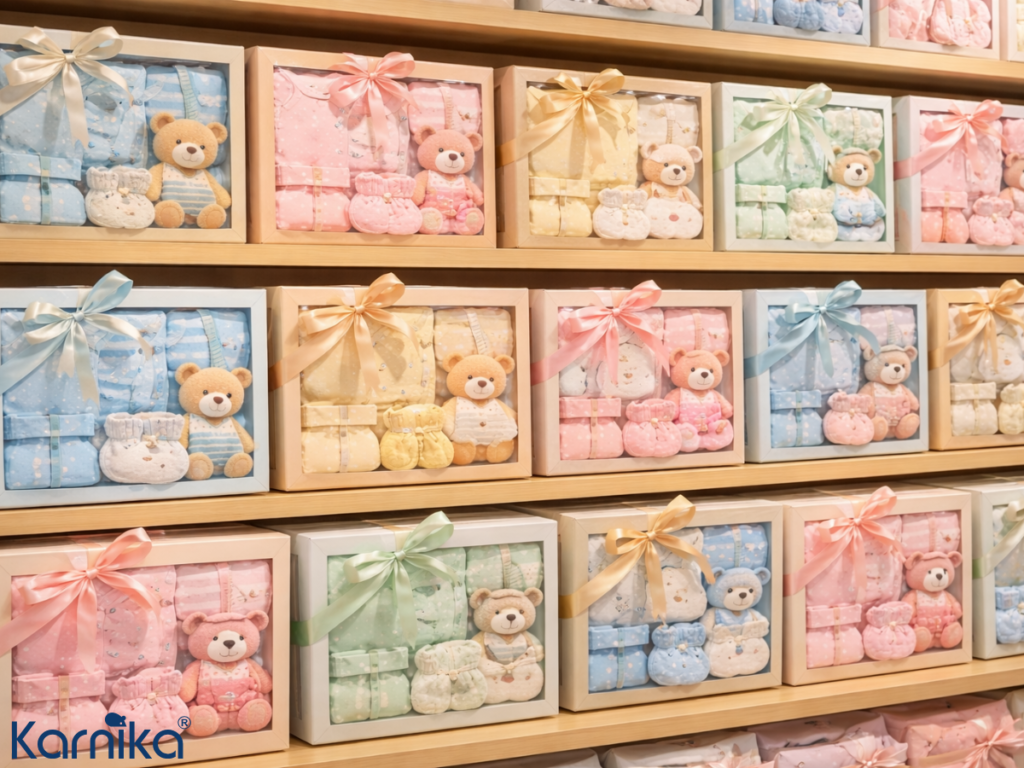
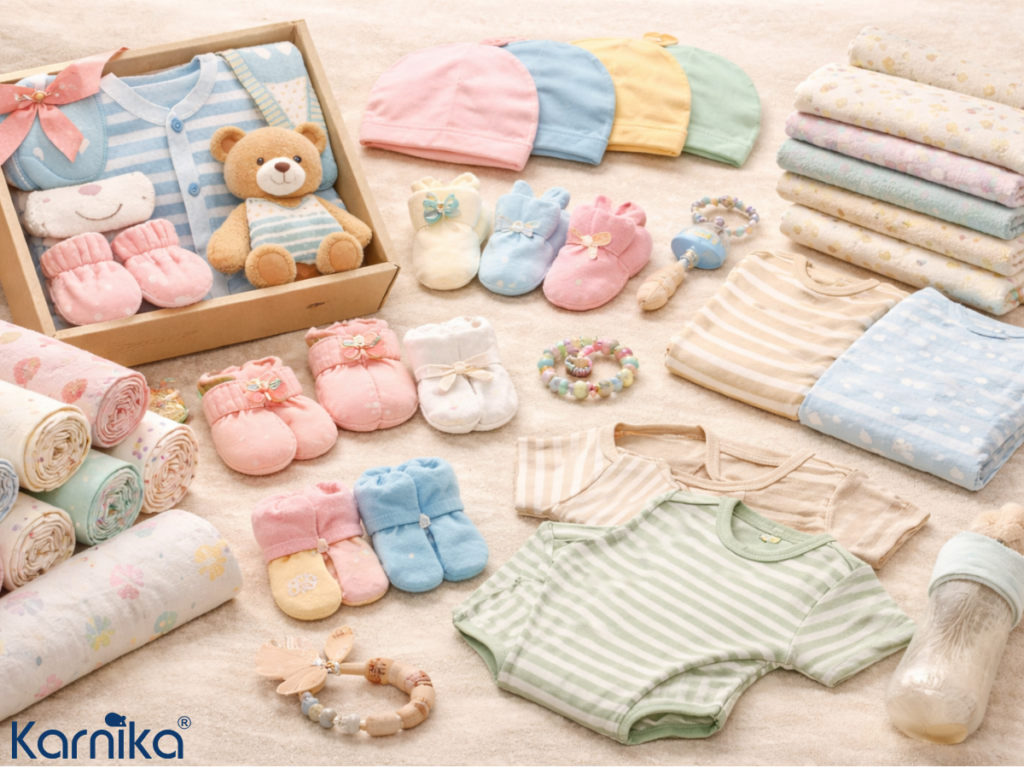
- Newborn gift sets (onesie + cap + mittens + booties combos)
- Swaddle wraps and muslin blankets — critical for infant comfort and sleep
- Soft caps and head bands — hospitals and visiting relatives buy these constantly
- Mittens and socks — small ticket, extremely fast movers
- Snap-button and front-open bodysuits — functional design that parents specifically seek
Many retailers do not prefer to stock newborn sizes (0–3M and 3–6M). They assume that the window is “too small.” In reality, these move in days, not weeks.
Seasonal Babywear: Timing Your Inventory Right
Any wholesale kids clothing supplier knows that there will be seasonal demands in babywear. If you plan right, you are never caught off guard.
Winter (October–February)
- Fleece and woollen rompers — These products are in every parents wishlist in India.
- Hooded jackets and padded full-suits- These are not only a necessity but are also a trendy wear especially for toddlers.
- Thermal inner sets (vests + lower)
- Socks, mittens, beanies — These are in high demand as they are either overused or get lost.
Summer (March–June)
- Half-sleeve cotton rompers and short sets
- Sleeveless jhablas
- Light muslin onesies and shirts
Festive Season (August–November)
- Ethnic sets (kurta-pyjama, lehenga-choli for infants)- Children look very cute when they dress up in ethnic clothes during festivities and weddings.
- Embroidered rompers
- Indo-western fusion sets for gifting
In any b2b clothing, retailers should place seasonal orders 6–8 weeks in advance. The best wholesale kids clothing suppliers in India run out of popular winter and festive SKUs well before peak demand hits. Thus the planning has to be right and there needs to be restocking.
Read Me: Kids Apparel Bulk Order Timing: Before the Season or Mid-Season?
Seasonal Inventory Planning Matrix
| Season | Key Products | Order Timeline | Risk Level |
| Winter (Oct–Feb) | Fleece rompers, thermals, jackets | Aug–Sep | High (stockouts common) |
| Summer (Mar–Jun) | Cotton rompers, sleeveless sets | Jan–Feb | Medium |
| Festive (Aug–Nov) | Ethnic wear, gift sets | Jun–Jul | Very High |
Comfort-Driven Fabrics Reshaping Buyer Preferences
Parents have become conscious about what they buy for their babies. They are more knowledgeable now and they make sure that they get the best for their children at an affordable price.
- 100% cotton Muslin for swaddles and light summer wear
- Fleece for winter
- OEKO-TEX certified fabrics for families with sensitivity concerns
Soft, certified and breathable fabrics are a clear winner in kidswear wholesale. Customers return to those retailers who give priority to quality.
At Karnika Industries, all our babywear fabrics are tested for softness, shrinkage, and steady color. In this way the retailers can trust the products and give the best deal to the customers.
Occasion and Gift-Ready Babywear
Baby showers, Namkaran ceremonies, birthdays, Diwali, Eid, Christmas, Durga Puja, Navratri, weddings and so on, gifting is very common in India. Gift-ready babywear often are in demand if they are priced affordably and packaged well.
What makes babywear “gift-ready”?
- Coordinated sets with matching accessories (cap, bib, booties)
- Attractive, giftable packaging.
- Ethnic and festive prints that feel special
- A universal size (typically 0–6M or 6–12M) that works across recipients
Dedicating even a small section for gifting displays often attracts customers.
Value Packs and Combo Sets: Why Bundles Move Faster
The value pack is one of the most underused tools in babywear retail and one of the most effective.
In b2b clothing, packs of 3, 5, and 7 units work better than single-unit listings in reorder rates.
There are some common fast-moving bundles like onesie 5-packs, jhabala 3-packs, socks 6-pairs, inner vest + lower combos, tshirt and pants combo 3 set.
If size and occasion are kept in mind before creating bundles, they give better results.
Bundle Strategy Performance
| Bundle Type | Avg Units Sold | Conversion Impact |
| 3-Pack | Medium | +20% |
| 5-Pack | High | +35% |
| 7-Pack | Very High | +50% |
Gender-Neutral Designs and What’s Trending Now
Parents are no more stuck to just pink and blue. Pastel yellows, mints, ivory, beige, and sage green now occupy significant shelf space where pink and blue once dominated.
Gender-neutral babywear is no longer a niche preference. It has become mainstream preference
- Gifting convenience: While gifting or purchasing before the baby is born, in India people do not know the baby’s gender. Thus it is safe to buy neutral colors.
- Resale and hand-me-down culture: Neutral pieces get more reuse cycles.
- Modern parenting philosophy: With modern parenting, parents prefer not to segregate kids into blue and pink. Thus neutral colors are safest.
Beyond neutrals, what’s trending in kidswear wholesale clothing right now:
- Minimalist prints
- Muted tones with one bold accent (mustard, rust, terracotta)
- Text-free designs t
- Oversized silhouettes
Stocking a 60:40 ratio of neutral-to-gendered designs helps to serve the modern parents.
Size Range Planning: How Parents Actually Shop
One of the most common stocking mistakes in b2b clothing is under-representing certain size brackets. Here’s the reality of how parents buy:
- 0–3M and 3–6M: Bought immediately and frequently often gifted as well. Highest velocity.
- 6–12M: Peak consumption phase. Babies are active, outgrowing faster, and parents are buying most heavily here.
- 12–18M and 18–24M: Still strong, but buyers start mixing babywear with toddlerwear options.
- 2–3 years: Transition zone — some retailers miss this bracket entirely.
A practical stocking guideline: for every 10 units at 0–3M, stock 12–15 units at 6–12M. This reflects actual demand curves, not gut feeling.
Also worth noting: many parents “size up” intentionally, buying 6–12M clothing for a 4-month-old. Stock your mid-range sizes deeper than you think you need to.
Pricing Strategy for High-Turnover Babywear
In the Indian retail market, babywear pricing psychology works differently than adult categories. A few principles that hold consistently:
Price points that clear fastest:
- Onesies and jablas: ₹150–₹350 MRP
- Sets and combos: ₹400–₹799 MRP
- Premium / festive outfits: ₹800–₹1,499 MRP
- Newborn gift sets: ₹599–₹1,200 MRP
What accelerates sales:
- Clear “per piece” pricing on multipacks
- Visible “soft cotton” or “tested fabric” messaging
- Bundle pricing that shows implied savings (e.g., “5 for ₹599 | MRP ₹149 each”)
Margin in kids wear wholesale is typically 35–55% on well-negotiated MOQs. Retailers who work directly with manufacturers like Karnika Industries consistently protect higher margins on fast-moving lines.
Inventory Planning to Avoid Stockouts
Dead stock kills margin. Stockouts kill customers. The goal is a tight, data-informed middle ground.
A practical approach:
- Classify your SKUs into A (top 20% of sales), B (middle 30%), and C (remaining 50%). Stock A-items 2x deeper.
- Set reorder triggers, not reorder schedules. When a size-colour combination dips below 20% of standard stock, reorder — don’t wait for the calendar.
- Maintain a 4–6 week safety stock for evergreen SKUs (jhablas, plain onesies, inner vests).
- Never over-index on fashion SKUs. Trendy prints have short windows — keep them at 30% or less of total babywear inventory.
For those working with a wholesale kids clothing supplier, negotiate standing orders or monthly replenishment agreements on evergreen lines. This protects against production delays during peak seasons.
Choosing the Right Wholesale Kids Clothing Supplier
Your supplier is your inventory’s foundation. Choosing wrong here compounds into every other decision.
| Criteria | Why It Matters |
| MOQ flexibility | Low MOQs allow you to test new SKUs without overcommitting |
| Fabric certification | OEKO-TEX or equivalent builds customer trust |
| Lead time consistency | Delays cascade into stockouts during peak season |
| Size accuracy | Poor sizing = returns and lost repeat customers |
| Sampling process | You need to touch and test before you buy at scale |
| Reorder speed | Fast replenishment is worth more than rock-bottom prices |
What to evaluate in a kids wear brand or manufacturer: At Karnika Industries, we operate with transparent MOQs, quality-tested fabrics, and a retail partner network that spans 500+ stores across India. If you’re evaluating a new wholesale kids clothing supplier, those are the benchmarks to hold any vendor to.
Common Mistakes Retailers Make (And How to Avoid Them)
We have seen these patterns across our retail network more times than we can count:
Overstocking slow-moving fashion pieces Bright neon prints and character-licensed designs feel exciting at the trade show. They sit on shelves for months. Evergreen and neutral SKUs are your real engine.
Poor size distribution Buying 40 units of 0–3M and 5 units of 6–12M is backwards. Mid-sizes move 2–3x faster.
Ignoring the gifting opportunity Retailers who don’t create a dedicated gift section leave significant revenue on the table, especially around festivals.
Reordering on schedule, not on data Monthly reorders without checking actual sell-through rates lead to either stockouts or dead stock. Both hurt.
Choosing price over reliability in suppliers The cheapest kids wear wholesale source is rarely the best. A supplier who delivers late, inconsistently, or with variable quality costs far more than any price difference saves.
Read Me: Baby T-Shirts Wholesale: The Ultimate Bulk Buying Checklist for Kidswear Retailers
Quick Stocking Checklist for Retailers
Use this before placing your next order with your wholesale kids clothing supplier:
Evergreen Must-Haves (always in stock)
- Cotton jhablas / jablas (NB to 12M)
- Inner vests (seasonal: cotton or thermal)
- Snap-button onesies (0–12M, neutral colors)
- Elastic-waist pants / track lowers
- Socks (0–3M and 3–12M)
- Mittens and booties
Size Distribution Check
- 0–3M: Moderate stock (high velocity but short window)
- 3–6M: Moderate-high stock
- 6–12M: Deep stock (highest demand)
- 12–24M: Medium stock
Seasonal Layer
- Summer: Light cotton rompers, short sets, sleeveless options
- Winter: Fleece rompers, padded jackets, thermal sets
- Festive: Ethnic sets, embroidered pieces, gift-ready combos
Supplier Health Check
- MOQ fits your current sales velocity
- Turnaround time is 3–4 weeks or less
- Fabric is certified / documented
- Samples received and quality verified
Key Takeaways
Babywear is one of the most reliable segments in b2b clothing. However stocking has to be done strategically. The retailers who consistently outperform are not buying more. They are buying smarter.
There are few things that work.
- Everyday essentials and newborn basics are your highest-velocity SKUs. Never let them run out.
- Seasonal inventory needs to be ordered 6–8 weeks ahead. The best kids wear wholesale lines that sell out early.
- Fabric quality and gender-neutral designs are now table stakes, not differentiators.
- Bundle packs increase basket value without needing a price change.
- Inventory is data, not intuition. Set reorder triggers. Classify your SKUs. Protect your margins.
If you’re building or refining your babywear buying strategy, Karnika Industries works directly with retailers and distributors across India. Our team can help you identify the right SKUs, plan MOQs, and build a stocking system that keeps shelves full and cash flowing.
Karnika Industries is a leading kidswear wholesale manufacturer based in India, supplying retailers and distributors with quality-tested, fabric-certified babywear and children’s clothing across the country. To get the best, contact us.
Frequently Asked Questions (FAQs)
Q1: What is the projected size of the global babywear market?
The global babywear market is projected to cross USD 82 billion by 2027, growing at a CAGR of approximately 5.9%.
Q2: What makes babywear a profitable segment for B2B clothing retailers?
Babywear has built-in repeat demand childrens outgrow sizes quickly, making seasonal and size-based repurchases compulsory. Unlike adult clothing, parents buy the same product types repeatedly in new sizes, driving consistent reorders for retailers.
Q3: How fast should babywear products sell to be considered “fast-moving”?
In babywear retail, fast-moving products are those that sell within a 30–45 day window. For B2B clothing buyers, this means items your retail customers are reordering consistently, not just purchasing once.
Q4: Which babywear products are the fastest-selling everyday essentials?
The top everyday essentials include cotton jhablas/jablas, snap-button onesies and bodysuits, inner vests (cotton or thermal by season), elastic-waist pants and leggings, and socks and mittens. Cotton jhablas consistently rank in the top 3 SKUs, particularly in summer and humidity-heavy regions of India.
Q5: Why are newborn sizes (0–3M and 3–6M) worth stocking despite the short window?
Many retailers avoid newborn sizes assuming the window is too small. In reality, these sizes move in days, not weeks. New parents stock up heavily before and immediately after birth, and gift purchases from relatives further drive demand for these sizes.