
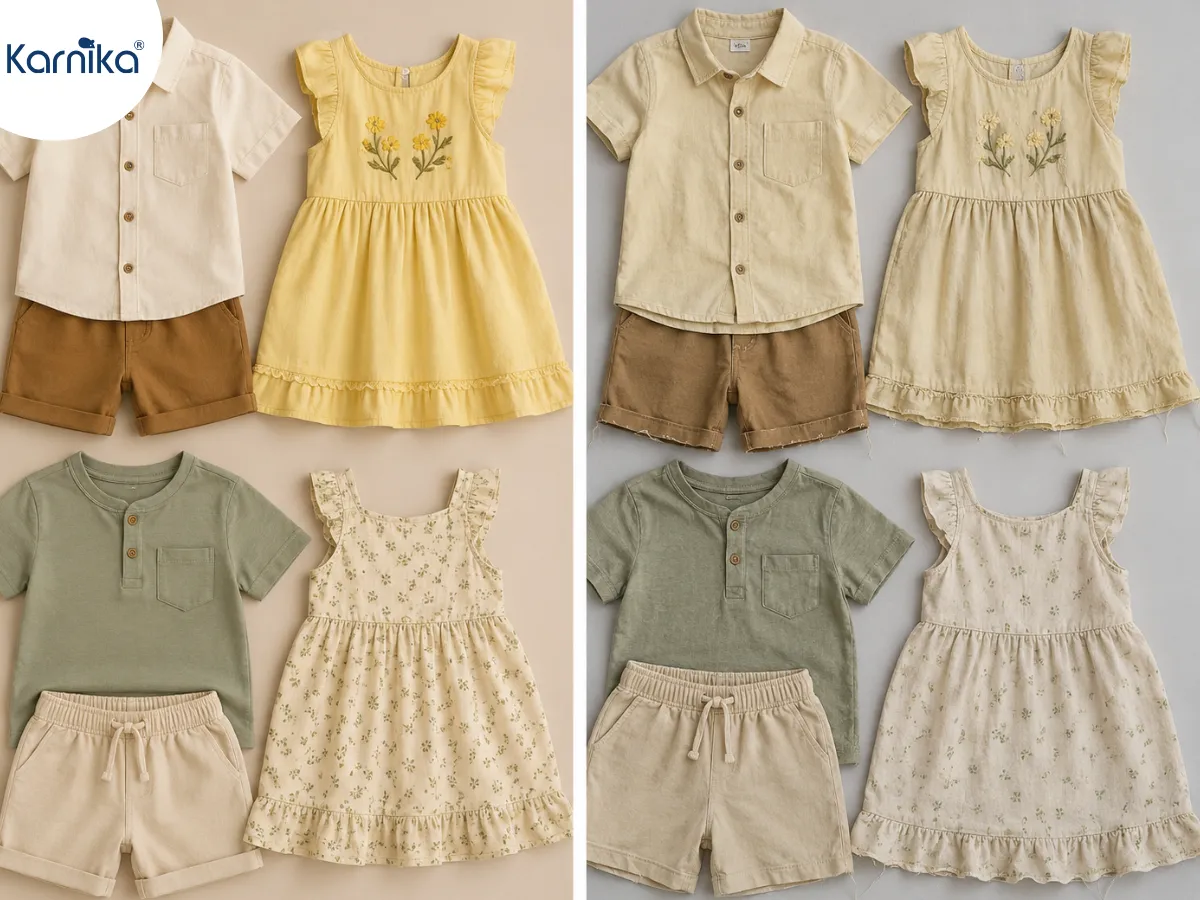
The golden sample is here. Every seam is perfect. You have approved the colour. The quality is perfect. The fit is good. The sample follows all the standards. You approve, sign and return. But your world turns upside down when the bulk order arrives. Each product in the bulk order is not as perfect as the golden sample. This results in loss for the retailers. Why? This is because the golden sample or the approved product was considered as a guarantee for a huge bulk order. In reality it is just a reference point. The journey from a single approved garment to thousands of identical units is far more complex than it appears, and that gap is where problems are born.
Karnika Industries is a Kolkata-based manufacturer of quality kidswear supplying retailers across India and internationally. Here we have seen how the golden sample trap catches even experienced buyers. This guide gives a detailed explanation of why it happens, what are the reasons and how retailers can escape losses.
Does Sample Approval Guarantee Perfect Bulk Production?
Some retailers think that approving the sample ends the work and they can blindly place the bulk order. However, an approved sample is a design brief that confirms that a manufacturer can produce the garments. An approved sample confirms the colour, design, fabric and fit. However, it does not confirm that every unit in a production run of 500, 2,000, or 10,000 pieces will be identical. That is a different challenge.
The Difference Between Sample Production and Bulk Production
Sample garments produced by a single experienced skilled person who keeps check of every factor. Bulk production involves multiple operators, multiple machines, multiple fabric rolls, and multiple shifts working at commercial speed. The variables multiply considerably.
Why Manufacturing Variables Increase During Large Orders
As the number of products increases, the possibility of uneven dying of fabric rolls increases. With more operators and more machines, there are variations in stitches and calibre.
Understanding the Transition From Sample to Bulk Production
Small Batch Production vs Mass Production
A sample is limited to five to six garments. So, the production is very little and each product can be supervised separately. However, in a bulk order, the quantity is huge. So there are chances that if monitoring is not done actively, batches might fail.
Multiple Production Stages Involved in Bulk Manufacturing
There are different stages for bulk garment manufacturing .
- Inspection of fabric and testing.
- Checking the spread and cutting
- The process of bundling and ticketing.
- The process of stitching and assembling.
- Giving a finishing and trimming
- Carrying on quality inspection
- Packing and labelling
So, if a problem arises at any of the above stages, the entire production can become problematic.
Why Consistency Becomes More Challenging at Scale
In large production there is a standardized process. So, when there is a large production, there has to be proper scrutiny in every step to see there is consistency. Regular calibration of machine, operator training and systematic inline quality checks are important. If there is any problem in the checks, the batch can become problematic.
The Importance of Production Controls
Production controls should be done during the production, not after the productions. If the problems are not caught and corrected during the different steps in the production, there will be post approval problems. So, it is important that the retailers clarify from the suppliers what the production controls are before they place an order.
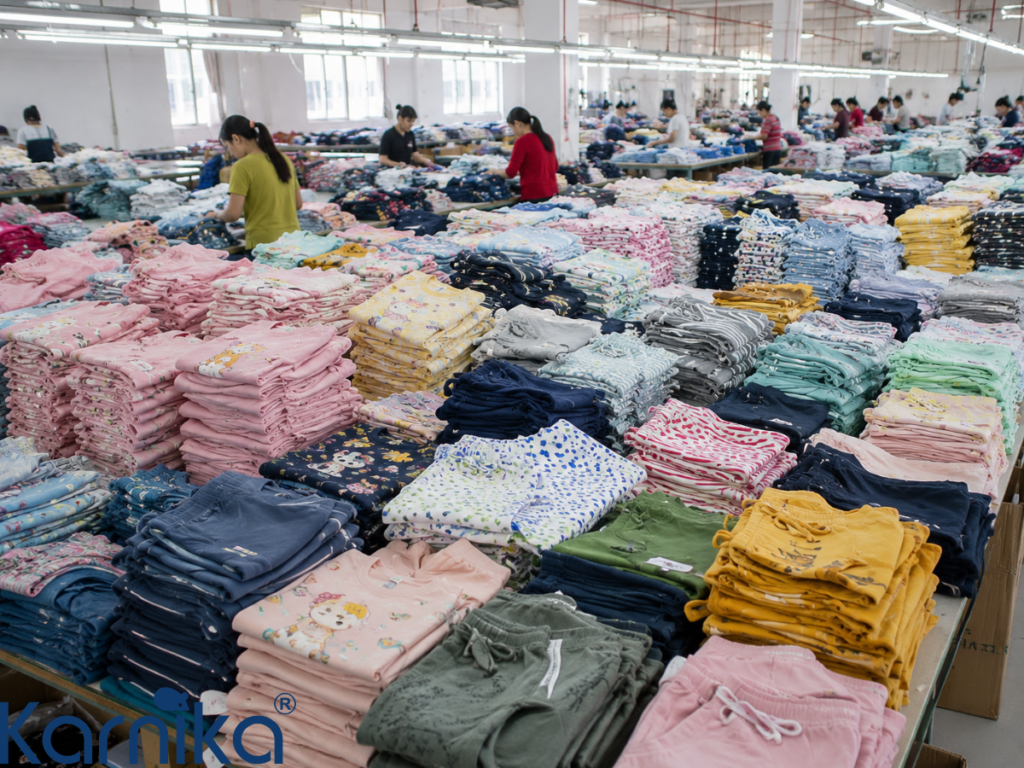
The Most Common Causes of the Golden Sample Trap
Golden sample trap takes place because of a few reasons.
Fabric Variations Between Batches
One major question is why bulk order quality differs from sample? Why are there variations in fabric? This problem occurs as a bulk order uses fabric rolls. So when there are different batches, there is a high chance of variation in GSM or grammes per square metre. There can also be variation in texture, dye absorption, and post-wash shrinkage. There can be differences in fabric dye where one batch can have fader shade than the other. Sometimes these differences often do not give the same output. There can be variation in the feel of the garment. For a wholesale kids clothing supplier, it becomes crucial to check that the ultimate quality and feel is the same and is premium as in the current era, parents do not compromise.
Human Error Across Production Stages
As bulk garment manufacturing goes through different stages, there can be errors in different stages.
- Spreading and cutting : There can be problems in fabric relaxation and marker placement which can affect the finished measurements.
- Stitching and assembly:As there are different operators, there is a possibility that there will be differences in stitch tension and seam allowance.
- Finishing and trimming: If there is a rush in finishing, it affects appearance and presentation. The finished product is what customers will buy. If there are threads coming out, or colour differences, customers will not buy them.
- Labelling and packing: Any types of mislabeling of sizes can turn out to be a disaster. Especially for kidswear parents and guardians buy as per sizes. The brands that can make perfect sizes get repeat customers.
If there is any error in any stage, it can cause a defective batch and ruin everything.
Size Deviations in Wholesale Kids Clothing
Often it is asked that in apparel manufacturing why is production quality not matching samples? Specifications are given, but the result is not the same. Usually as per industry standards, there is supposed to be a tolerance level of plus or minus 1 cm. But this becomes a problem when this issue is not addressed earlier in writing.
For wholesale kids clothing, size accuracy is crucial as parents are particular about sizes. They check labels and then buy clothes. It is obvious that a parent would not try a new cloth on a newborn and buy it. So their judgment depends on the size tag. If the labeling is wrong, it will definitely affect the reputation of the business.
Communication Gaps Between Retailers and Manufacturers
Incomplete specifications are among the most preventable causes of bulk production problems. When measurement tolerances, colour deviation limits, stitch density requirements, and finishing standards are not documented in writing, manufacturers make their own judgements. Now this might not match retailer expectations.
So, last-minute verbal changes, informal email approvals, and missing technical packs all create ambiguity that becomes a defect risk on the production floor. There should always be clarity . Proper formal emails that are proof of the conversation. The mails should mention to what extent there is a possibility of variations in the batches. These clarities would help the retailer to plan their purchase properly.
Common Causes and How to Control Them
| Cause | What It Affects | Prevention |
|---|---|---|
| Fabric batch variation | Colour, weight, shrinkage, hand feel | Pre-production fabric testing; single dye lot per colourway |
| Cutting errors | Finished measurements across the run | Fabric relaxation time; in-line size checks after cutting |
| Operator inconsistency | Stitch quality, seam strength, finishing | Standardised work instructions; in-line supervision |
| Missing specifications | All quality parameters | Written technical pack approved before production begins |
| No in-line checks | Defects multiply before detection | Quality checks at cutting, stitching, and finishing stages |
How Retailers Can Reduce Post-Approval Problems
Request a Pre-Production Sample
A pre-production sample (PPS) is produced from the actual bulk fabric and trims before the full run begins. Unlike the development sample, which may use substitute materials, the PPS gives a reliable indication of what the bulk order will look like. Approving the PPS is one of the most effective safeguards a retailer has.
Define Quality Standards in Writing
Specify your AQL (Acceptable Quality Level) requirements before production begins. AQL 2.5 is a widely used standard for retail apparel. It provides a statistically valid framework for how many units to inspect and what defect rates are acceptable. Without agreed AQL criteria, final inspections have no objective benchmark.
Request Fabric Test Reports
Ask for pre-production fabric testing covering colourfastness, shrinkage, GSM, and tensile strength. For kidswear destined for export, compliance with the safety standards of your target market is essential. In India, the Bureau of Indian Standards (BIS) sets textile quality requirements; the EU, UK, and US each have their own regulatory frameworks for children’s garments.
Schedule In-Line Production Updates
Do not wait until shipment to review quality. Agree a schedule of in-line inspection updates at key milestones like after cutting, after stitching, and at the start of finishing. Problems caught early cost far less to correct than those identified at final inspection or after delivery.
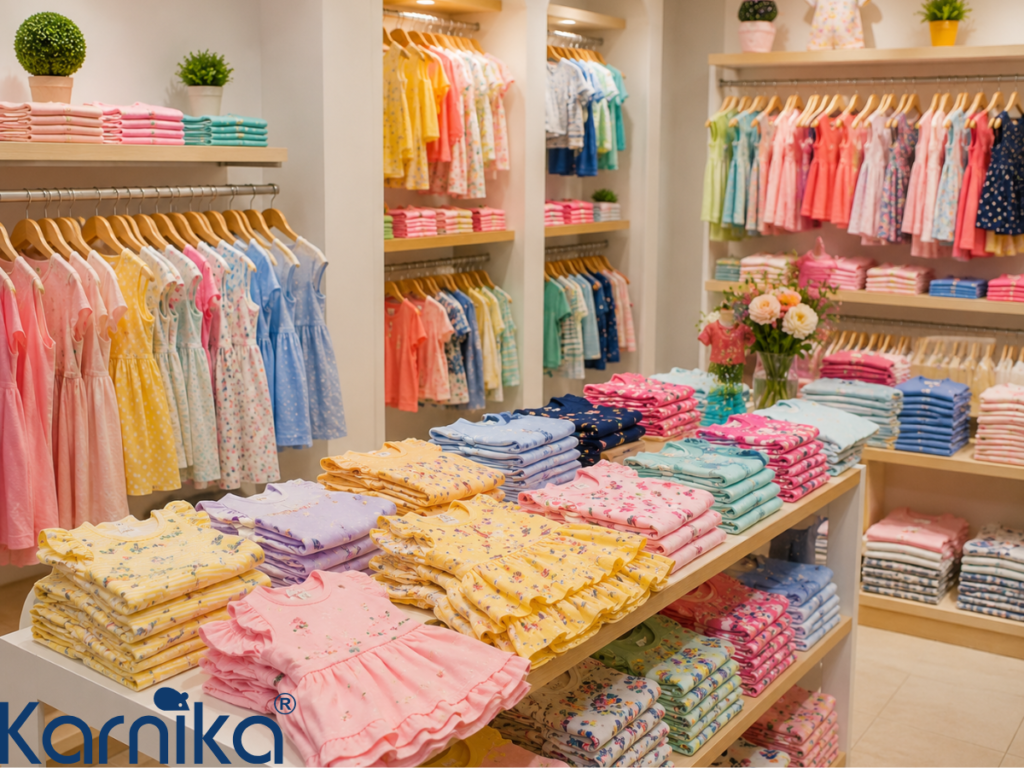
How Experienced Private Label Apparel Manufacturers Avoid the Golden Sample Trap
The golden sample trap is not an intentional trap, it is a failure of systems. At Karnika Industries, our approach to bulk production quality is built on the understanding that sample approval is the beginning of a quality process, not the end of one.
Our quality control framework covers every production stage: incoming fabric inspection on all rolls before cutting, in-line checks at stitching and finishing, and a formal AQL-based final inspection before packing. For kidswear specifically, we apply heightened standards to seam strength, button and embellishment attachment, and chemical safety. These are the areas where a production shortfall is not merely a commercial problem but a safety one.
As a private label clothing supplier, we provide retailers with documented production records at each stage, so there are no surprises at delivery. Our pre-production meetings, written technical packs, and single dye lot sourcing policy are all designed to close the gap between the approved sample and the bulk shipment.
Sample Approval vs Production Monitoring: What Retailers Should Check
| Sample Approval Checklist | Production Monitoring Checklist |
|---|---|
| Design and construction | Fabric consistency across all rolls in use |
| Fabric (/weight, texture, composition | Cutting accuracy against approved measurements |
| Fit, measurements against size chart | Stitching quality, density, tension, seam strength |
| Colour — match to approved stand | Size tolerances, in-line checks at key stages |
| Comfort and safety (kidswear) | Labelling, packaging, and barcode accuracy |
Read Me: Best fabric for dress for kids’ T-shirts for wholesale buying
Conclusion
Sample approval is an important milestone . But it dodes not guarantee the consistency of all the products. Fabric variations, human errors, size deviations, and communication gaps can all cause bulk production to fall short of the approved sample, even when both parties are acting in good faith.
Retailers who combine sample approval with pre-production samples, written specifications, fabric testing, and in-line quality updates significantly reduce their exposure to post-delivery problems. Selecting a manufacturer with documented quality systems , rather than one relying solely on individual skill , is the single most effective long-term protection against the golden sample trap.
Karnika Industries makes sure that there is clarity between the manufacturer and the retailer so that no one has to face losses. For best quality products contact us.
Frequently Asked Questions (FAQs)
1. Why does bulk production quality differ from the approved sample?
Bulk production introduces variables absent during sampling like multiple fabric rolls, different operators, and commercial production speeds. Without in-line quality controls, these variables cause the finished run to deviate from the approved reference.
2. What is the golden sample trap?
The golden sample trap describes the mistaken belief that an approved sample guarantees identical bulk production quality. Retailers who disengage after sample sign-off and rely on it as a final quality check are most at risk.
3. What causes colour variations between sample and bulk production?
Colour variation most commonly results from dye lot differences . Fabric dyed in separate batches can show subtle shade differences. Using a single dye lot per colourway and testing colour against an approved standard before production begins are the most reliable preventive measures.
4. How can retailers choose a reliable wholesale kids clothing supplier?
Look for manufacturers who provide fabric test reports, maintain documented quality control procedures, use pre-production samples from actual bulk materials, and offer in-line inspection updates during production. Avoid suppliers who are vague about timelines, inconsistent in sample quality, or unable to supply quality documentation.
5. What is a pre-production sample and why does it matter?
A pre-production sample is produced from the actual bulk fabric and trims before the main production run begins. Unlike the development sample, it reflects the real materials that will be used. Approving the PPS before committing to full production is one of the most effective ways to prevent end-product deviation.
6. What quality checks should happen during bulk manufacturing?
Quality checks should cover incoming fabric inspection, in-line checks at cutting and stitching stages, random sampling from the middle and end of the production run, and a formal AQL-based final inspection before packing.