
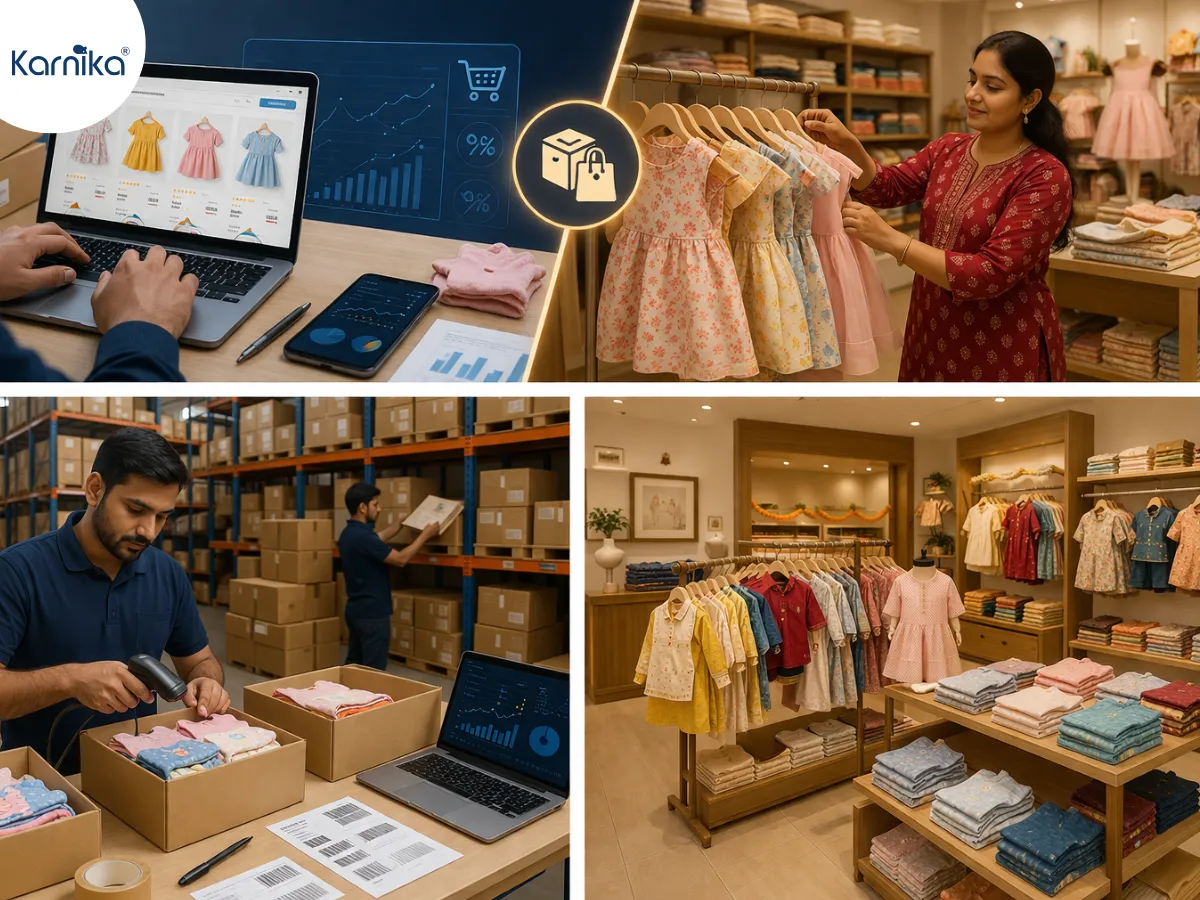
Bulk buying is a necessity for retailers, but using one logic across all channels does not give appropriate results. Bulk buying is not one-size-fits-all. So, the wholesale inventory management depends on whether you are an online store or a physical store.
Karnika Industries has 15+ years of experience in supplying kids dress wholesale across India to more than 2500 clients. So with this experience we can say that the retailers who apply the same logic of online and offline buying usually face 18-25% more dead stocks than those who target each channel separately. This guide helps retailers build a bulk buying strategy that works in reality to gain profits in the business.
Core Differences Between Online & Offline Bulk Buying
First, we have to understand the fundamental difference between online and offline models. The table below helps to understand what to buy and what to prioritize.
| Inventory Visibility | Virtual catalogue — image-led | Physical display — touch & feel | Online needs more image variety per SKU |
| Customer Behaviour | Size guessing; buy to try | Try before buying | Online needs larger return buffer |
| Return Rate | 20–35% | 5–10% | Buy 20% extra units for online |
| Data Tracking | SKU-level analytics dashboards | Manual / basic POS | Online can reorder faster & smarter |
| Storage Need | Centralised warehouse | Showroom + backroom | Different space cost structures |
| Impulse Buying | Lower | Higher | Offline benefits from visual variety |
| Cash Settlement | 7–14 day gateway delay | Immediate (cash/UPI) | Online needs larger working capital |
| Seasonal Demand | Ad-driven, volatile spikes | Local festivals, predictable | Different buy-timing needed |
| Competition Pressure | Platform-wide price comparison | Local competition only | Online margin pressure is higher |
| Size Range Required | Full range, deep on peak sizes | Full display range, moderate depth | Different depth-per-size ratios |
Inventory Planning Differences
Wholesale inventory management is important. However, a retailer can manage their inventory depending on their customers and the channel they choose. Customers are different. Some of them prefer online shopping, and some still prefer going to the shop physically, take a look at the product, and then buying. So, when the retailers know their customers, they can plan accordingly.
Online Stores
- Need wider size range: A wider size range in online stores always gives customers more opportunities to explore. Customers usually prefer sites that have more variety and availability.
- Higher stock depth in popular sizes: Sizes like 3-5 and 6-8 years are sizes that have more restocks and thus are in demand. Therefore, because of re- purchasing demands, 3-8 year window sizes are in demand online.
- Plan for higher returns (20%–30%): There is always a high chance of return rates in online stores, as customers buy depending on what they see. They cannot try or touch. Thus, the retailers selling online should add a corresponding buffer stock.
- Fast-moving SKUs(stock keeping units): The top 20 % styles usually result in 80 % of revenue. So, one should focus on fast-moving SKUs. Customers prefer a few types of products, and thus those products are always in demand. If retailers focus on fast-moving stocks, they can have better profits.
- Reorder cycle: The reorder cycle should be 3-4 weeks. This is supposed to be data-driven through analytics.
- Stockouts waste ad spend: Ione should maintain an accurate catalogue so that stockouts do not affect the business.
Offline Stores
Balanced display stock: In offline stores, customers see the products and buy them . If there is no visual variety, no one would come to the retail store. For instance, while online shopping, one would type in the search area “Summer collection for 4-year-old boy” and choose from the results. However, in offline stores, customers will see the boys’ section. If they find a variety of interesting options, they will purchase from the store.
Physical shelf space limitation is important as it creates a natural ceiling on quantity.
- Fewer size returns: In offline stores, return rates are usually low as customers try before buying. They are able to check the size, the quality, and the feel of the product.
- More emphasis on visual variety: Retailers should focus on a variety of prints and colours to promote impulse buying.
- There should be backroom stocks for only replenishing proven best sellers.
- Reorder cycle: The cycle of reordering should be 4-6 weeks based on observation.
Size Ratio Strategy Differences
Wrong size ratios can prove to be the biggest blunder and can result in dead stocks in kids dress wholesale and baby dress wholesale. The sizes in kidswear varies from brand to brand, as per age and region too. The optimal ratio is also weirdly different across both channels. So, the retailers need to have an understanding of what to do.
Online Bulk Buying
- Stocking common sizes: High velocity sizes means that there are more re-buying amongst the sizes of 3-8 years. So if the retailers stock more in these sizes, there will not be dead stocks, nor will the customers have to wait for long. So, during bulk buying, these sizes should get preference.
- Avoid overstocking extreme sizes: Extreme sizes like 0-3 years and 12-14 years should not be overstocked. These sizes do not have more re-buying, so it is better not to invest more.
- Analytics use: Platform analytics can help to choose the top 3 sizes per SKU. This can help to plan the reorder.
- Practically, the online ratio among six sizes should be: 10%, 15%, 25% , 30%, 15% ,5% (smallest to largest).
- H3: Offline Bulk Buying
- Display : In offline stores, customers are attracted by the display. So the more varieties are available in the store, the more people will visit the store.
- Keep moderate depth per size: 3- 5 units per size is enough, as volume is less important than variety.
- Use local demand patterns: Local demands affect buying. If a store is near a hospital, the products for newborn kids will sell more. Whereas a store near a school will have more customers aged 4-8 years old.
Since Karnika Industries has more than 15 years of experience in the industry, we can give suggestions to new retailers or those who need guidance. We have noticed that the same size ratio for both online and offline channels is not wise. In such cases, there are high chances of around 22% dead stock. Offline and online have different customers, so the treatment should be different as well.
Read Me: How to Buy Children’s Clothing in Bulk: A Beginner’s Guide
Cash Flow & Risk Management Comparison
Bulk buying blocks a lot of cash. So, before understanding the requirements of the channel, one should not buy.
| Storage Model | Centralized warehouse for all orders | Dual storage: showroom + backroom |
| Inventory Handling | Each unit handled individually | Bulk handling + in-store replenishment |
| Packing Requirement | Mandatory (packing, labeling, barcode tagging) | Not required for regular in-store sales |
| Packaging Cost | ₹15–₹40 per unit | Minimal / none (except for delivery) |
| Shipping Cost | ₹40–₹120 per shipment (depends on weight & zone) | ₹30–₹80 only if home delivery is offered |
| Operational Complexity | High (SKU-level barcode accuracy required) | Moderate (focus on physical organization) |
| Error Impact | Barcode errors → order cancellations | Misplacement affects sales but not transactions directly |
| Inventory Movement Strategy | Algorithm-driven (based on demand data) | Manual rotation (fast sellers eye-level, slow sellers front) |
| Display Influence | No physical display impact | Visual merchandising directly drives sales |
| Storage Costs | FBA/FBF fees for slow/dead stock | Rent + space utilization costs |
| Labor Requirement | Picking, packing, labeling staff needed | Staff needed for stocking, tagging, merchandising |
| Receiving Inventory | System-based intake and scanning | Physical unboxing, tagging, arranging |
| Customer Experience | Delivery-based | Immediate purchase experience |
Marketing-Driven Bulk Buying
Retailers should understand that it is essential to track the market before ny bulk buying. Bulk buying means a lot of investment. So, when retailers invest after market research, there are chances that there will be less loss.
Online Strategy
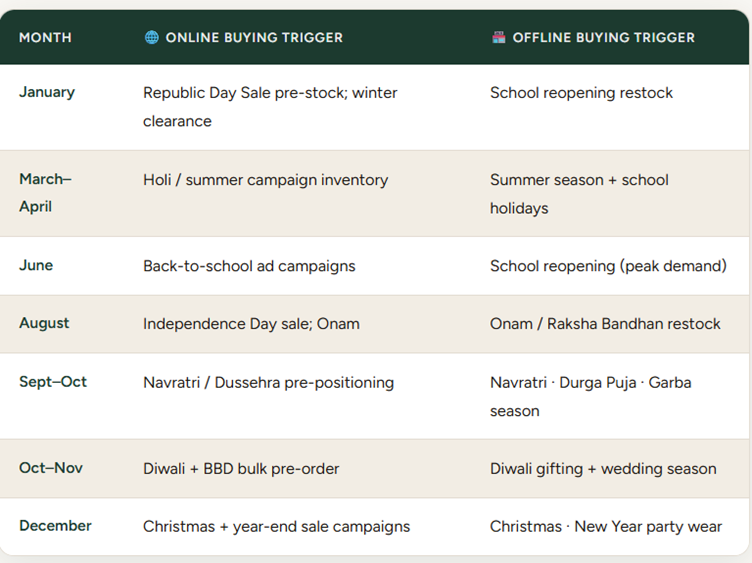
Planned Promotions: Retailers should buy inventory 4-5 weeks before major online sales. For example, online platforms like Amazon, Flipkart, First Cry, Myntra, etc. have a few fixed huge sales for which the customers wait throughout the year. Retailers should target these sales and plan inventory.
Flash sales: Flash sales can give a huge profit of up to 2-3 times the normal stock. Thus, the retailers should plan 10-14 days before the sale and keep stocks accordingly.
Influencer or ad-based spikes- In the current age, there have been many instances where influencer or ad-based campaigns have resulted in sudden demand. Thus, there should be 10-15% safety stocks in buffer for such viral moments.
Offline Strategy
Plan around local festivals- Retailers should stock up products at least 8 weeks before major festivals, as people start shopping early in big festivals like Durga Puja, Navratri, Christmas, Eid, and Diwali.
Seasonal footfall spikes: Seasonal footfall spikes other than festivals occur during school openings, changes in season like monsoon or winter, where there can be a 30 – 50 % hike in kids’ wear wholesale. There are also sudden demands for ethnic wear during wedding seasons.
Local event: Local events, gatherings, and fairs can increase footfalls. Thus, retailers should keep these events in mind too.
Read Me: How to Buy Children’s Clothing in Bulk: A Beginner’s Guide
Storage & Logistics Differences
Storage and inventory affect the operating costs. Thus, this affects how much bulk buying one should engage in.
Online:
- A centralized warehouse helps to dispatch all orders from one location.
- Shipping cost planning: Shipping cost planning needs to be done accurately. There can be a ₹40–₹120 shipping cost depending on the weight and the zone.
- Packaging materials can cost ₹15–₹40 per unit
- The SKU level barcode should be accurate, as if there are errors, orders can get canceled.
Offline:
- Dual storage zone. In offline stores, there are two places where stocks are kept. One is a showroom display, and the other is backroom stock.
- In-store inventory rotation: In stores, it is very important to rotate. The fast-selling products should be kept at the front.
- Visual merchandising impact: Visual cleanliness and arrangements like hangers, racks, and lighting are assets in inventory.
Return & Exchange Management
Return is something that needs to be considered in bulk buying.
Online:
- Higher size mismatch returns: In online shopping, there is a high chance of returns, as buyers cannot test.
- Need return buffer stock, buffer stocks should be kept in seasons where demand is high.
Offline:
- On-spot exchange: There are no logistics costs as the customers directly change sizes if there are size issues.
- Damaged returns : There is a very small chance of damaged returns as customers check the products physically.
In case of kids dress wholesale or baby dress wholesale orders for an online channel, there should be 20% extra designated as return-ready buffer stock.
This should be added to the cost as it is not a surprise loss.
Which Model Is Riskier for Bulk Buying?
It is not possible to tag either online or offline channels as safe for bulk buying. According to the experience of Karnika Industries, the new retail partner should consider a few things.
Explain:
Online = demand volatility + high returns
Online stores can have demand–side risk like algorithm changes, ad cost spikes, platform policy shifts, and return expenses.
Offline = fixed cost pressure + location risk
Offline stores have supply-side risk like rent, staffing costs, and location dependency.
So, both channels have their positive and negative points.
Read Me: Start Your Baby Clothing Business with Kolkata’s Wholesale Markets
Hybrid Model: The Smart Approach
The most profitable retailers in India including long-term wholesale partners of Karnika industries, run a hybrid model. Offline model helps to bring trust and online model helps to scale up and reach people. Each channel has a separate inventory identity and they should be treated separately. Even the top brands for kids’ wear in India will prefer the retailers who have both physical and online presence as it helps in more sales.
Customers who visit stores become repeat buyers, too.
- The online channel helps to test new styles.
- Inventory should always be planned separately for the channel.
- There should be 10-15 % of bulk stalk left uncommitted.
- Start with a 60:40 split. 60 % for the primary channel and 40% for the secondary channel.
- Track SKU sales per channel every 2 weeks.
- 2- 3 cycles will give data to make a permanent decision.
Common Mistakes to Avoid
There are some very common wholesale inventory management mistakes that one should avoid.
- The same size ratio should not be used for both channels.
- Return rate is crucial in an online model. Never ignore them.
- Overstocking slow-moving items can cause losses. 30 % of the planned quantity should be first tested.
- Not tracking channel-wise sales can give misleading reorder signs.
Key Takeaways
The retailers who gain success in the kids wear wholesale market focus their bulk buying as per the channel. They do not follow the same planning for both online and offline channels. Top brands for kidswear in India also believe that retailers who are able to understand and plan the channel according to market needs.
At Karnika Industries, our wholesale team understands the demands of the customers as per seasons, age and place.
This guide will be helpful for those trying to invest in their first bulk buying in kids wear wholesale or trying to optimise their inventory in different channels.
Karnika Industries offers flexible MOQs, channel-specific buying guidance, and fast pan-India dispatch for kids dress wholesale, baby dress wholesale, and all kids wear wholesale categories. Our team can help you build a buying plan aligned to your channel model, your seasonality, and your working capital. Reach out to our team today.
Frequently Asked Questions (FAQs)
Q1. Should online stores keep more inventory than offline stores?
It is not necessary to keep more inventory than offline stores. However, there should be greater size depth per SKU and a return buffer of 15-25% above planned sales.
Q2. Why do online stores experience higher returns?
Online customers cannot try the products. They cannot touch the products as well. Not only this, but the size varies from brand to brand. Thus, there are high possibilities that there is either a size issue or the customer might not like the product when they get it. Thus, there are high returns.
Q3. How do I split inventory between online and offline channels?
Start with a 60:40 split. 60 % for the primary channel and 40% for the secondary channel. 10- 15 % should be maintained as a centralised buffer pool of the total buy. Tracking SKUs for both channels helps to plan better.
Q4. Which model requires more working capital?
Online stores require more working capital. Other than inventory purchase, there has to be upfront marketing spend (₹1–1.5L per ₹5L of inventory), a 7–14 day payment settlement gap, return processing costs, and per-unit packaging. They usually need 30-40% more working capital.
Q5. Is bulk buying safer for offline retail?
Offline bulk buying looks predictable, but offline stores have fixed costs that do not depend on sales performance. On the other hand, online buying allows product testing and low fixed costs. So, the safe option depends on geographical location, cost structure, and risk tolerance.