
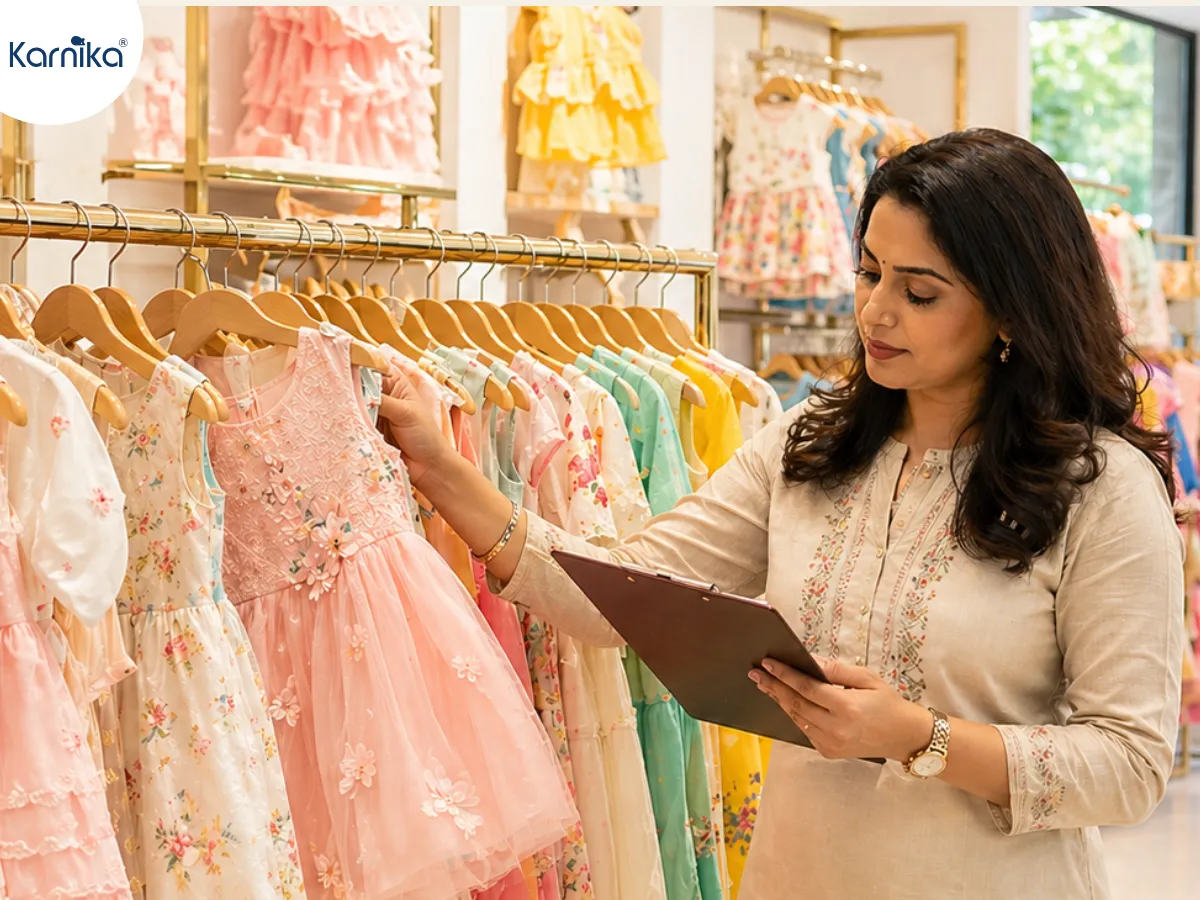
Children’s clothing wholesalers often face several questions before placing a wholesale order worth lakhs of rupees. If they order a wrong design mix, the stocks can just stay on the racks for months. But if the design combination is right, the products can sell off in a blink. The most variety of designs are found in girls clothes. Thus, knowing how to select the right design for a girl’s dress can solve a lot of issues while ordering.
Understanding Your Target Customer
The first question that a wholesaler needs to think about is: Who is the customer? In the girls’ dresses segment, you are rarely selling to the child. You are selling to mothers, grandmothers, and gift buyers who each have distinct triggers. Usually mothers of a girl child try to experiment and want to explore. Thus, the wholesalers have to keep the demand in mind before a bulk order.
Buyer personas that drive girls’ dress sales
Karnika Industries has an experience across 500+ retail accounts. According to the survey three buyer types dominate:
| Buyer Type | Price Sensitivity | Design Priority | Purchase Frequency |
| Urban working mothers (25–38) | Medium | Comfort + trendy prints | Every 2–3 months |
| Tier-2/3 city parents | High | Value + occasion wear | Seasonal / festive |
| Gift buyers (relatives) | Low | Attractive packaging + design | Gifting seasons |
Retailers who stock across all three buyer types see 28% higher sell-through rates than those optimizing for a single profile.
Why Design Selection Drives Wholesale Success
Among children’s clothing wholesalers, design is a crucial lever. A poorly designed dress at ₹180 MRP will stay on the shelf. A well-chosen design at ₹320 will get sold.
Repeat customers, brand perception, and your store’s reputation depends on the fact that the designs you stock are liked by buyers or not. Wholesale baby clothes and wholesale girls’ dresses are emotional purchases. Thus design quality is a trust signal.
Age-Wise Design Preferences
In wholesale girls’ dresses, designs that attract a mother of a 2 years old will not work similarly for a 10 years old. Designs should usually work according to the age. Or babies, parents usually choose prints, however, the 10 years old prefer going with the trend. If the wholesalers do not track these market demands, they will end up ordering the wrong amount.
| Age Group | Design Preference | Key Attributes | Avoid |
| 0–2 yrs (Infants) | Pastels, animal prints, soft florals | Snap closures, zero embellishment | Small buttons, scratchy lace |
| 2–4 yrs (Toddlers) | Cartoon prints, bright solids | Elastic waists, easy-on-off | Complex zippers, tight fits |
| 5–8 yrs (Young girls) | Frocks with frills, printed sets | Mix of fun + some structure | Overly adult silhouettes |
| 9–12 yrs (Pre-teens) | Boho, denim looks, tie-dye, minimal prints | Flattering cuts, modest styles | Overly childish motifs |
The 5–8 age group accounts for 41% of wholesale girls’ dress volume. It is the sweet spot. Do not under-invest in this segment.
Read Me: Fast-Moving Babywear Every B2B Clothing Retailer Needs
Seasonal & Occasion-Based Designs
The demand for girls’ dress spikes are predictable. Retailers need to align their wholesale orders to these windows. These sell faster and carry less residual inventory.
Seasonal demand calendar
Relative demand index for wholesale girls dresses: monthly (indexed to 100)
| Occasion/Season | Design Style | Top Fabrics | Lead Time to Order |
| Diwali / Navratri | Lehenga choli, ethnic frocks, embroidered | Silk blend, cotton silk | 8–10 weeks before |
| Christmas / New Year | Red/green prints, western party dresses | Velvet, satin | 6–8 weeks before |
| Summer (Apr–Jun) | Floral prints, light cotton frocks | Pure cotton, linen blend | 6 weeks before |
| Wedding season | Lehenga, sherara, sharara sets | Net, georgette, silk | 10–12 weeks before |
| School / Casual | Printed cotton frocks, pinafore sets | Cotton, cotton-poly | 4–6 weeks before |
Fabric & Comfort Considerations
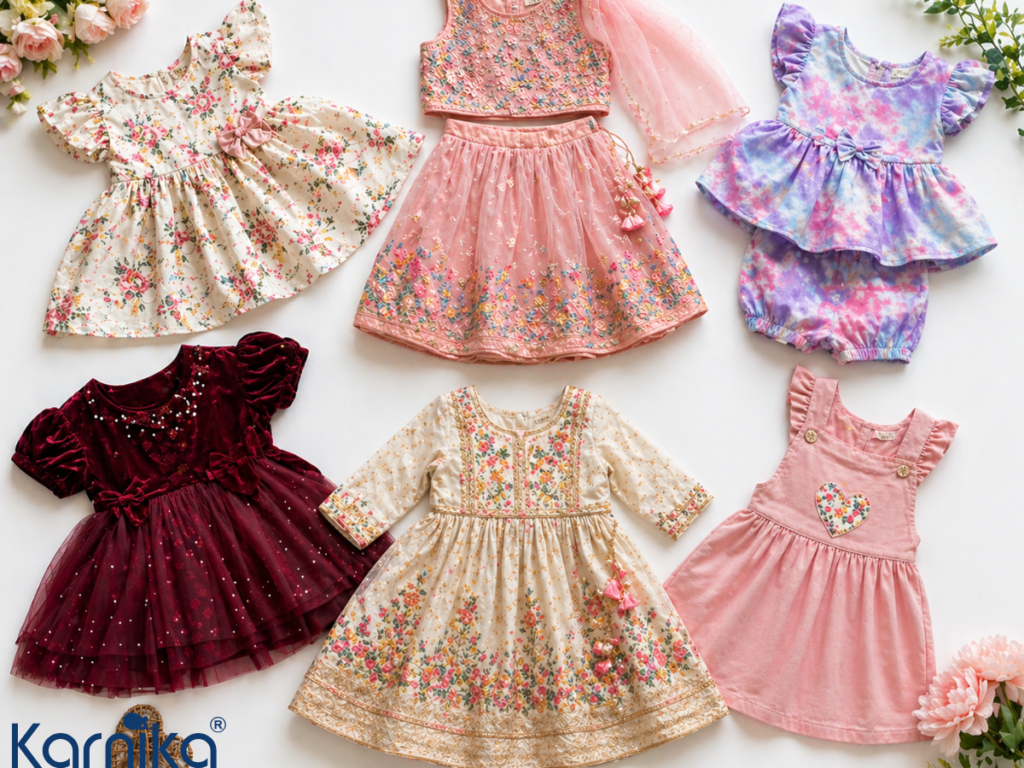
Design and fabric are inseparable. A gorgeous embroidered neckline on a rough synthetic base will generate returns and complaints. As children’s clothing wholesalers, Karnika Industries mandates a fabric-design compatibility check for every new SKU.
| Fabric | Best Design Styles | Age Suitability | Wash Durability |
| 100% cotton | Printed frocks, casual day dresses | All ages, esp. 0–6 yrs | ★★★★★ |
| Cotton-poly blend | School uniforms, printed sets | 3–12 yrs | ★★★★☆ |
| Silk/silk blend | Ethnic, festive, wedding wear | 4+ yrs (supervised) | ★★★☆☆ |
| Velvet | Winter party dresses | 2–10 yrs | ★★★☆☆ |
| Net/georgette | Layered frocks, lehengas | 5+ yrs | ★★☆☆☆ |
| Linen blend | Summer boho, relaxed casual | 6–12 yrs | ★★★★☆ |
Color Trends & Pattern Selection
Color is the first thing a shopper notices even before price. Getting it wrong means the design never gets a second look. Colour choices for girls are also crucial. While ordering in bulk wholesalers have to give importance to certain colours like pink or shades of pink that are usually little girls’ favourites. But that does not mean that they will stick to it. The choice should be made as per data.
Color performance by region
| Pattern Type | Best Season | Age Group | Trend Status |
| Floral (micro) | Spring / Summer | All ages | Evergreen |
| Geometric / abstract | Year-round | 8–12 yrs | Growing |
| Cartoon / character | Year-round | 2–7 yrs | Stable |
| Tie-dye / shibori | Summer | 7–12 yrs | Trending |
| Ikat / block print | Festive / Winter | 5–12 yrs | Stable |
| Solid with border | Festive | All ages | Evergreen |
Balancing Trendy vs Classic Designs
The biggest mistake we see retailers make is that they go all-in on trend. Then trend fades and stocks remain.
Karnika Industries recommends that the wholesale ratio should be 60/40: 60% classic designs and 40% trend-forward designs. This protects your margin floor while still driving excitement.
| Criteria | Classic / Evergreen | Trendy / Fashion-Forward |
| Examples | Floral cotton frocks, solid lehengas, pinafores | Tie-dye sets, puff sleeves, co-ord sets |
| Risk | Low | Medium–High |
| Margin | Steady (18–25%) | Higher when trending (25–40%), crash risk |
| Reorder frequency | Predictable, consistent | One-time or limited window |
| Customer expectation | “Always have this” | “Wow, something new” |
Size Range & Fit Variations
Even a perfect design fails if the sizes are off. Kids wholesale clothing must account for significant variation. Children of the same age can differ by 4–6 cm in height and 3–5 kg in weight.
Recommended size distribution per 100-piece order
| Size | Age Ref. | Units (of 100) | Notes |
| S / 1–2 yrs | 12–24 months | 10 | Gift-heavy segment |
| M / 3–4 yrs | 3–4 yrs | 18 | Gifting + daily wear |
| L / 5–6 yrs | 5–6 yrs | 24 | Highest volume |
| XL / 7–8 yrs | 7–8 yrs | 24 | Highest volume |
| XXL / 9–10 yrs | 9–10 yrs | 16 | Pre-teen gaining share |
| XXXL / 11–12 yrs | 11–12 yrs | 8 | Lower volume |
Pricing Strategy & Design Positioning
Not every design belongs in every price tier. Design complexity should map directly to your price positioning. Misalignment confuses buyers and erodes trust.
| Tier | MRP Range | Design Profile | Target Channel |
| Economy | ₹150–₹299 | Printed cotton, minimal embellishment, solids | Kirana + small retail |
| Mid | ₹300–₹599 | Embroidered details, better fabric, frills | Multi-brand stores |
| Premium | ₹600–₹1,200 | Layered net, silk blend, full embroidery | Boutiques, gifting |
| Festive/Occasion | ₹800–₹2,500 | Lehenga sets, heavy embroidery, coordinated | Boutiques, D2C |
Supplier Selection & Design Consistency
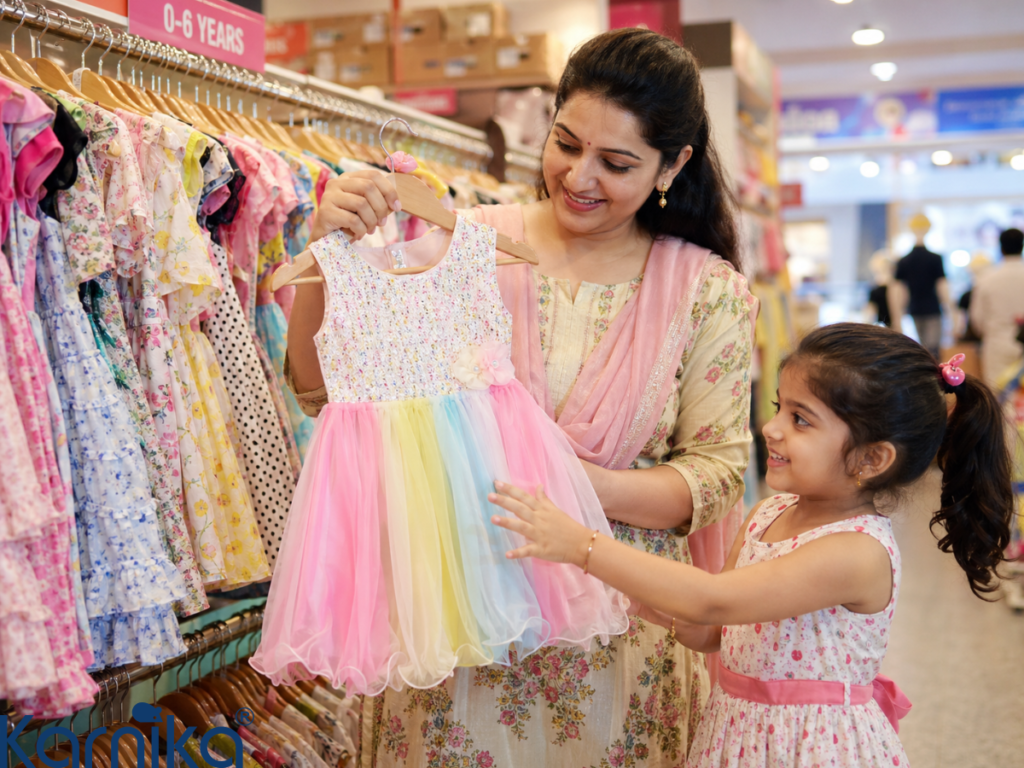
The best design brief means nothing if your supplier can’t execute it consistently across 500 pieces. Colour matching, stitch quality, and embellishment durability must be verified. This should not be assumed.
What to evaluate in a wholesale girls’ dress supplier
| Parameter | Why It Matters | How to Verify |
| Design fidelity | Prototype vs bulk production differences | Request pre-production sample |
| Colour consistency | Shade variation across dye lots | Check 3 random pieces from a bulk lot |
| Embellishment durability | Sequins, prints, beads falling off after 2 washes | Do a 5-wash test on samples |
| Sizing accuracy | Inconsistent measurements drive returns | Measure 5 random pieces per size |
| Lead time reliability | Festive season delays = zero sales window | Ask for references from 3 existing clients |
Karnika Industries runs a quality checkpoint at 3 stages: fabric inspection, stitching QC, and final embellishment review, before any bulk dispatch. This has helped our retail partners maintain a return rate below 1.2%.
Inventory Planning for Design Variety
More variety sounds better. In practice, too many designs spread demand too thin and create slow-moving tails that eat up capital.
Recommended assortment structure
| Assortment Tier | % of Inventory | Design Count (per 500 units) | Role |
| Core (bestsellers) | 50% | 4–5 designs | Consistent revenue |
| Seasonal | 30% | 3–4 designs | Occasion demand |
| Trend / New | 20% | 2–3 designs | Test & learn |
This 50-30-20 model protects your working capital while giving you room to experiment. Track sell-through at the 30-day mark: anything below 25% in 30 days is a warning sign.
Read Me: Baby T-Shirts Wholesale: The Ultimate Bulk Buying Checklist for Kidswear Retailers
Common Mistakes Retailers Should Avoid
| Mistake | What Goes Wrong | The Fix |
| Over-ordering on trend designs | Trend fades, inventory stuck for months | Cap trend buys at 20% of total order |
| Ignoring local preferences | Designs popular in Mumbai flop in Lucknow | Survey your own customer receipts first |
| Skipping age segmentation | Wrong design mix for your store’s customer base | Map your sales data to age groups quarterly |
| Ordering only one size ratio | Fast stockout in L/XL, surplus in small | Use the size distribution table (Section 8) |
| Choosing design over fabric | Complaints, returns, lost customers | Always check fabric-design compatibility |
| Late wholesale ordering | Miss the festive sales window entirely | Order 8–10 weeks ahead for festive season |
Quick Checklist for Wholesale Design Selection
- Have I identified my target buyer persona and her design preferences?
- Does my design mix cover the right age groups (0–12 yrs) proportionally?
- Are seasonal and occasion-based designs ordered 8–10 weeks in advance?
- Is fabric appropriate for the design style and the target age group?
- Have I checked color trends for my specific region and channel?
- Is my classic-to-trendy ratio at least 60:40?
- Does my size distribution follow the recommended ratio (L and XL heaviest)?
- Does design complexity match the price tier I’m targeting?
- Have I requested and tested pre-production samples from my supplier?
- Is my assortment following the 50-30-20 core/seasonal/trend split?
- Do I have a 30-day sell-through tracker in place for new designs?
- Have I avoided the 6 common mistakes listed in this guide?
Conclusion
Design selection in wholesale girls’ dresses is not guesswork. It is all about discipline. The retailers who consistently outperform in this category are the ones who marry local customer insight with structured buying frameworks: age-wise segmentation, seasonal timing, the right fabric-design pairing, and a disciplined classic-to-trend ratio.
At Karnika Industries, we work as partners with our retail clients, not just suppliers. Whether you’re ordering wholesale baby clothes, wholesale girls’ dresses, or a complete kids wholesale clothing assortment, our design team can help you build a collection that moves.
Ready to place your next wholesale order?
Contact Karnika Industries, India’s trusted children’s clothing wholesaler.
FAQ
1. What is the minimum order quantity for wholesale girls’ dresses from children’s clothing wholesalers?
MOQs vary by supplier. At Karnika Industries, our standard MOQ is 50 pieces per design for printed cotton dresses and 100 pieces for embroidered or festive styles. Many wholesalers allow mixed-size sets within the same design to help retailers meet MOQ without overstocking a single size.
2. How do I know which designs will sell in my local market?
Start with your own sales history. Look at what sold fastest in the last two seasons. Layer in regional data: tier-1 cities lean toward western silhouettes and prints, while tier-2/3 markets show stronger demand for ethnic and festive styles. If you’re new, order a small trial assortment of 3–4 designs before committing to bulk.
3. What fabric is best for wholesale baby clothes in the 0–2 year age group?
100% cotton is the safest and most commercially successful choice for infants. It is breathable, hypoallergenic, and washes well removing all key concerns for parents. Avoid synthetic blends for this age group entirely. For slightly older toddlers (2–4 yrs), a cotton blend is acceptable for school or casual wear.
4. How many designs should a retailer stock per season for girls’ dresses?
For a store carrying roughly 300–500 units of girls’ dresses per season, we recommend 8–12 distinct designs: 4–5 core bestsellers, 3–4 seasonal designs, and 2–3 trend SKUs. Going beyond 15 designs with limited units each creates fragmented inventory that’s hard to manage and slow to reorder.
5. When should I place my wholesale order for Diwali / festive season?
Order 8–10 weeks before the expected start of the festive season. For Diwali (typically October), this means placing your order by late July or early August. Suppliers need time for embroidery, embellishment finishing, and quality checks. Rush orders after September almost always compromise quality or miss delivery.