
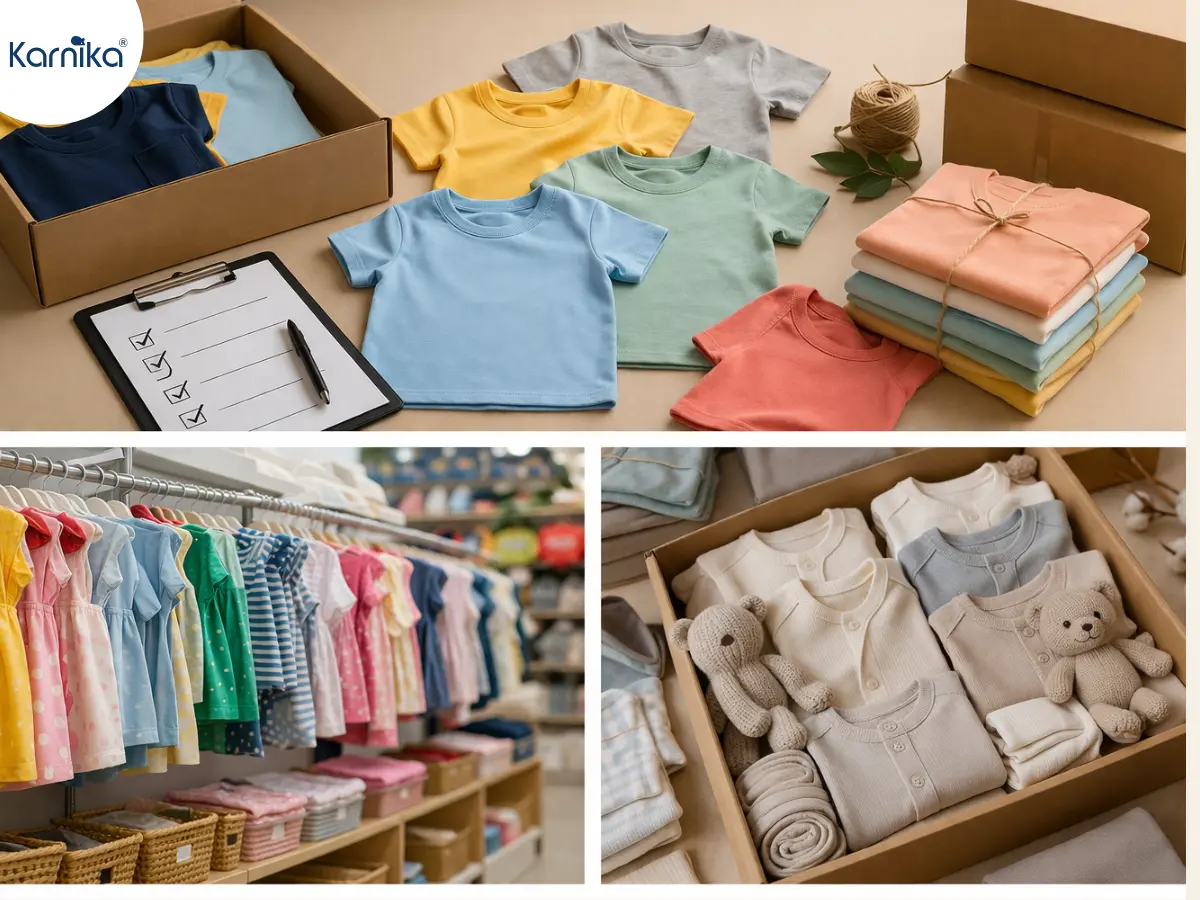
For people dealing with baby t-shirts wholesale, bulk buying is a huge task. However, smart buying can help in generating the difference between high margins and dead stocks. Retailers dealing in wholesale baby clothes must balance trend awareness, pricing, and inventory planning so that they can remain profitable. Karnika Industries has an experience of several years of manufacturing wholesale baby clothes and believes that if retailers and wholesalers make structured purchasing decisions, it can directly improve inventory turnover and customer satisfaction.
Why Bulk Buying Matters in Kidswear Retail
Kidswear is very different from the fashion that adults follow. Kids grow fast and the sizes keep on changing. Other than the size issue, the quality of the clothes become very crucial for the parents. Thus the trends of baby clothes keep on changing very frequently. For instance, a baby of three months will move to a completely new size range. As a result the old cloth will not be used by the baby. This problem makes bulk purchase problematic.
In kidswear, the window between ‘in trend’ and ‘clearance rack’ should be limited to one season so that it is easier to plan. Retailers should not bulk buy without a plan as it can destroy margins.
The Unique Challenges of Kidswear Bulk Buying
- Rapid size obsolescence:Kids outgrow sizes in 3–6 months, making stale size-heavy inventory a liability.
- Festival & seasonal spikes:Diwali, summer, school season, and winters create predictable demand surges that must be anticipated months in advance.
- Trend sensitivity:Cartoon character prints, colour palettes, and silhouettes change every 6–12 months.
- Safety & compliance pressure:Products for children are subject to stricter quality scrutiny by consumers and regulations.
- High return risk:Poor sizing or quality triggers returns that erode margins significantly.
Key Factors That Affect Kidswear Bulk Purchase Decision
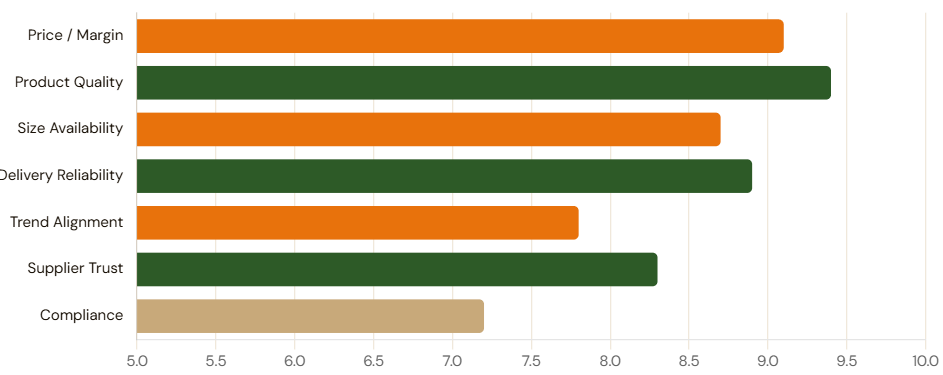
Understanding Your Customer Demand
Before investing in kids’wear wholesale, retailers must analyze their customers. It is very important to know what exactly the customers want?Buying decisions should be based on data and not by gut feeling. Retailers who understand their customers properly make 22–35% better inventory decisions.
Karnika Industries equips its retail partners with seasonal trend reports and category-wise demand forecasts. This is drawn from data across our 2,000+ retail network. Our team helps you map your customer profile to the right product mix. This helps to eliminate guesswork from your bulk buying process.
| Customer Segment | Price Sensitivity | Style Preference | Buying Frequency | Best SKU Focus |
| Tier 1 City Parents | Low–Medium | International cuts, premium prints | Monthly | Premium baby t-shirts, coordinated sets |
| Tier 2 / Tier 3 Parents | High | Ethnic styles, value-for-money basics | Seasonal | Economy kids dress wholesale |
| Gifting Buyers | Low | Packaged sets, bright colours | Festival-driven | Gift sets, matching sibling outfits |
| Institutional (Crèches/Schools) | Medium | Uniform styles, plain, durable | Annual / Bi-annual | Bulk plain t-shirts, bottoms |
| Online Resellers | Medium | Trendy, photo-ready, social media-friendly | Fortnightly | Trendy baby t-shirts wholesale |
Size Ratio Planning
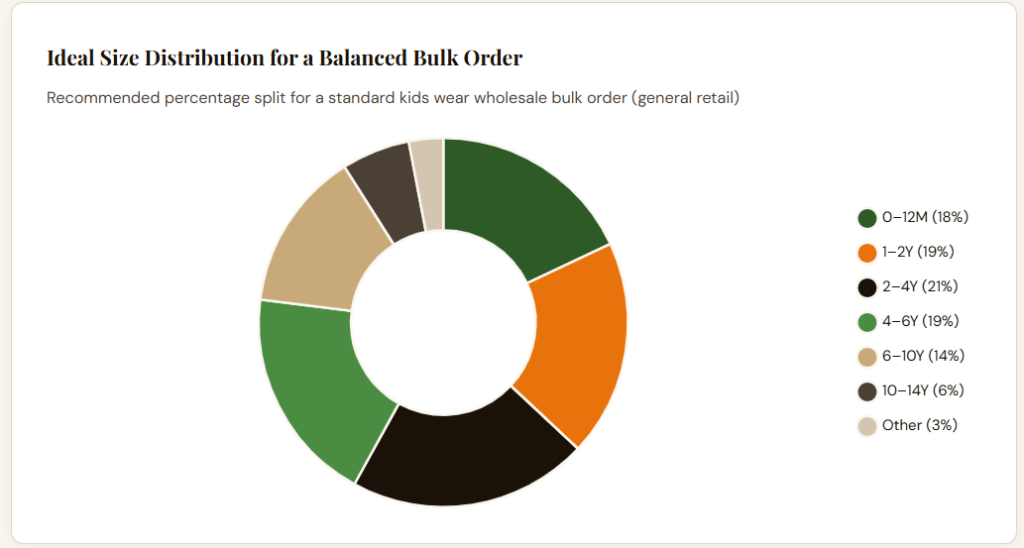
In kids wear wholesale one thing that cannot be overlooked is the size ratio. The retailers have to keep in mind each size in their bulk order. Kids of certain ages grow very fast so some sizes have a lot of demand but there are no repurchases. However, some sizes like 4-8 age children have a lot of demand and there are repurchases. These minute details have to be kept in mind. If size ratio planning is not done properly, either there will be dead stock or less stock.
Ideal Size Ratio Example (Baby T-Shirts)
| Age Group | Size Label | Recommended % of Order | Demand Velocity | Notes |
| 0–6 months | NB / 0–6M | 8–10% | Low–Medium | High gifting demand; outgrown quickly |
| 6–12 months | 6–12M | 12–15% | Medium | Strong baby shower gifting segment |
| 1–2 years | 12–24M | 18–20% | High | Peak demand for baby t-shirts wholesale |
| 2–4 years | 2Y–4Y | 20–22% | Very High | Best-performing category; stock in depth |
| 4–6 years | 4Y–6Y | 18–20% | High | School entry significantly boosts demand |
| 6–10 years | 6Y–10Y | 12–15% | Medium | Trend-sensitive; requires careful assortment planning |
| 10–14 years | 10Y–14Y | 5–8% | Low–Medium | Transitions toward tween/adult fashion preferences |
Read Me: How to Buy Children’s Clothing in Bulk: A Beginner’s Guide
Fabric Quality and Comfort Checks
The first thing that a parent sees while purchasing a kid’s dress is the quality of the product. There are few criterias that a retailer and a wholesaler should keep in mind before buying in bulk.
- The clothes , especially the basics or the ones most in demand should be either 100% cotton or cotton blends. This should be preferred while purchasing in bulk.
- Breathable and soft textures are a hit amongst parents.
- Durable stitching makes parents repurchase from the seller.
- Non-irritating dyes enhance the quality and bring the customers back.
If the quality of the products are poor, there would not be any repeat customers. Karnika industries make sure that their products are of top notch quality so that customers are satisfied and are bound to buy again.
| Fabric Type | Softness Rating | Durability | Breathability | Best For | Price Point |
| 100% Combed Cotton | ⭐⭐⭐⭐⭐ | High | Excellent | Baby t-shirts, innerwear | Medium–High |
| Cotton-Lycra Blend (95/5) | ⭐⭐⭐⭐⭐ | Very High | Very Good | Bodysuits, active wear | Medium–High |
| PC Fabric (Polyester-Cotton) | ⭐⭐⭐ | Very High | Moderate | Uniforms, economy range | Low–Medium |
| Hosiery (Interlock Knit) | ⭐⭐⭐⭐ | High | Good | Winter innerwear, basics | Low–Medium |
| Bamboo Cotton Blend | ⭐⭐⭐⭐⭐ | Medium | Excellent | Newborn, sensitive skin | High |
| Fleece / Terry | ⭐⭐⭐⭐ | High | Low | Winter kidswear, jackets | Medium |
Fabric Acceptance Checklist before Bulk buying of Kids dress wholesale
- GSM (grams per square metre) matches specification — 160–200 GSM for standard baby t-shirts wholesale
- Colour fastness test (no bleeding after 3 washes)
- Shrinkage within acceptable range (<3%)
- Seams are flat-locked or mock-overlock — no sharp edges touching baby skin
- Prints are non-toxic, AZO-free, and OEKO-TEX compliant
- Elastics (if any) are soft, non-restrictive, and durable
- Labels are soft-printed or heat-transferred — no scratchy woven tags
Seasonal and Trend-Based Selection
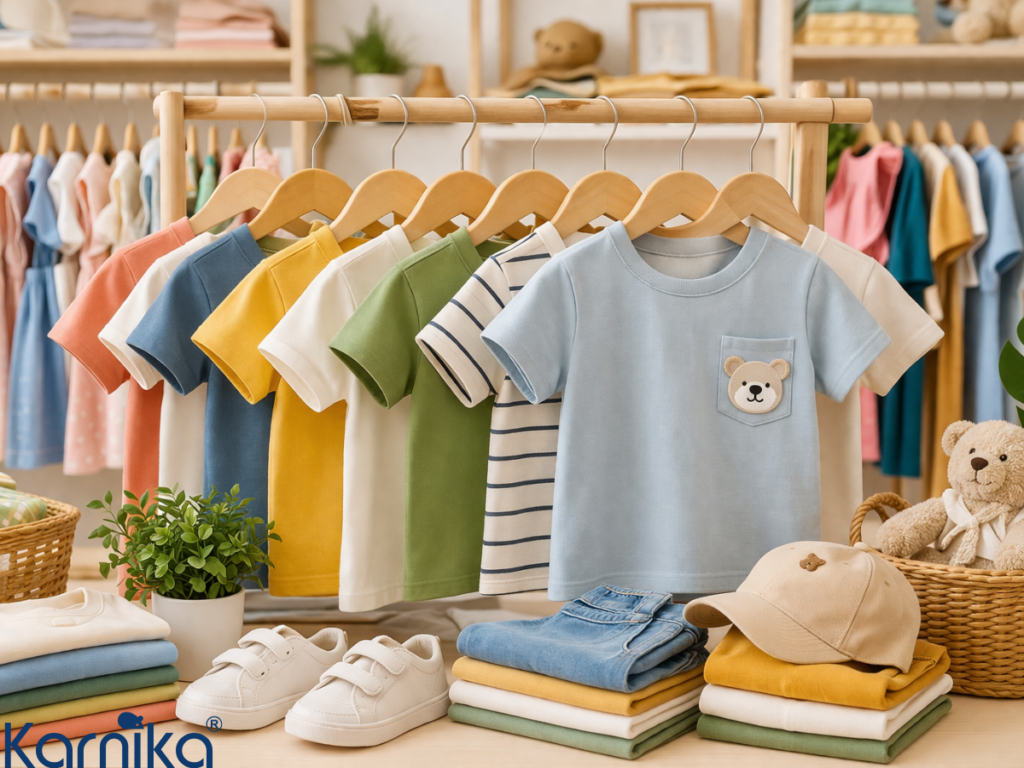
In kids dress wholesale, seasons matter and timings are crucial.One cannot order summer stock in May or winter stock in December. If they do so, they will miss the prime demand and the selling window. Smart retailers place orders 60–90 days ahead of peak season.
Retailers should align kids dress wholesale purchases with:
- Summer: Lightweight cotton, bright colors
- Winter: Layered options
- Festive seasons: Printed and themed designs
Annual Bulk Buying Calendar for Indian Retailers
Order WindowJanuary–February | Stock For SeasonSpring / Summer | Key OccasionsHoli, School Admissions | Priority CategoriesCotton tees, shorts, frocks |
| March–April | Summer peak | Summer holidays, birthdays | Baby t-shirts wholesale, sets, coordinates |
| June–July | Monsoon / Back to School | School reopening, Raksha Bandhan | Uniforms, casual tees, rainwear |
| August–September | Festive Season | Navratri, Dussehra, Diwali | Ethnic kids dress wholesale, festive sets |
| October–November | Winter | Diwali gifting, Christmas | Winter layering, gift packs, jackets |
| November–December | Year-end clearance + New Year | Christmas, New Year parties | Party wear, gender-neutral basics |
Trend Cycle Chart
Trend Popularity
│
│ ↑ Launch
│ / \
│ / \____ Decline
│
└────────────── Time →
Pricing and Margin Evaluation
In wholesale baby clothes , the profitability is set on the buying stage. While determining the sourcing itself it is determined whether there will be good return or will just survive. It is important to understand the numbers before placing bulk orders.
| Channel | Typical Wholesale Cost | Suggested MRP | Gross Margin % | Net(after ops) |
| Standalone Retail Store | ₹80–₹150 / piece | ₹199–₹399 | 45–55% | 20–30% |
| Online Marketplace (Meesho, Flipkart) | ₹60–₹120 / piece | ₹149–₹299 | 35–45% | 12–20% |
| WhatsApp / Social Reseller | ₹50–₹100 / piece | ₹120–₹249 | 40–55% | 22–32% |
| Regional Distributor | ₹55–₹110 / piece | ₹110–₹180 (to retailer) | 25–35% | 10–18% |
| Institutional / B2B Bulk | ₹45–₹90 / piece | ₹90–₹160 | 20–30% | 8–15% |
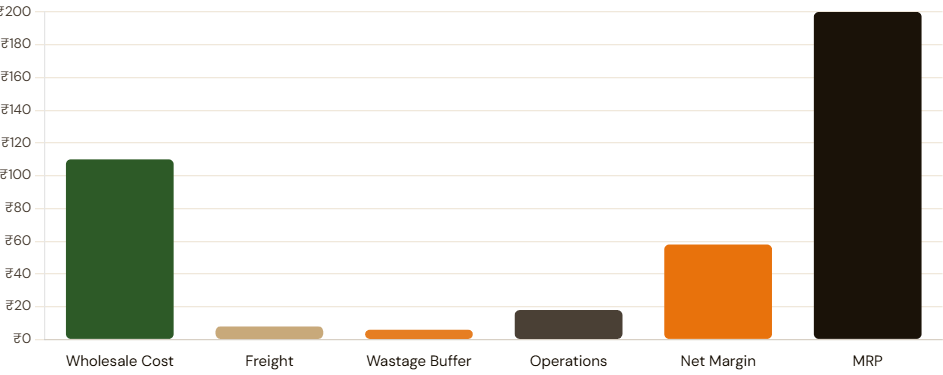
Margin Waterfall: Baby T-Shirt Retail (Standard Mid-Market SKU)
Illustrative breakdown from wholesale cost to net retailer margin (₹ per piece)
Margin Protection Rule
- The freight cost should not be more than 55% of MRP.
- Effective margin should include 5-8% wastage.
- Negotiate quantity-based pricing slabs — most manufacturers, including Karnika, offer tiered pricing above 500, 1000, and 5000 piece milestones.
- Use the MOQ (Minimum Order Quantity) wisely. Higher MOQ means lower per-unit cost but higher inventory risk.
Supplier Reliability and Consistency
When retailers source from the best kidswear brands in India, price is just one variable. Supplier reliability is a prime factor. If the supplier fails you, you cannot serve the customer that would ruin your image. So, retailers and wholesalers should keep in mind consistency of quality, adherence to delivery timelines, and communication which determines your operational stability.
| Evaluation Criterion | Weight | What to Look For | Red Flags |
| Product Quality Consistency | 25% | Consistent GSM, colour, stitching across batches | Variation between samples and bulk delivery |
| On-Time Delivery Rate | 20% | >95% on-time track record | Repeated delays, vague dispatch dates |
| MOQ Flexibility | 15% | Reasonable entry points for new SKUs | Inflexible MOQ with no negotiation |
| Defect Rate | 20% | <1.5% defect rate in bulk | >3% defects, no replacement policy |
| Communication & Responsiveness | 10% | Dedicated account manager, quick turnaround | Unresponsive, no escalation path |
| Compliance & Documentation | 10% | GST registration, OEKO-TEX, legal invoices | Missing documentation, no certifications |

Why Karnika Industries?
Karnika Industries is one of the best kidswear brands in India which has proven track record in baby t-shirts wholesale. We have consistent quality across batches. We have reliable dispatch schedules. Karnika Industries maintains a <1% defect rate across all production runs, a 97.3% on-time dispatch record, and assigns dedicated relationship managers to every retail account.Our partners have complete visibility from production to doorstep delivery.
Read Me: Common Retailer Mistake: What to Avoid When Buying Kidswear in Bulk
Inventory and Storage Planning
Dead inventory kills profits in kids dress wholesale retail. There should be a structured inventory model. This helps to keep cash flowing.
Inventory Strategy:
| Category | Healthy Stock Turn (Annual) | Warning Level | Action Trigger |
| Baby T-Shirts (0–2Y) | 6–8x | <4x | Discount at 90 days |
| Kids T-Shirts (2–6Y) | 5–7x | <3.5x | Discount at 75 days |
| Kids Dresses / Frocks | 4–6x | <3x | Seasonal clearance at 60 days |
| Winter Wear | 2–3x | <1.5x | Post-season deep discount |
| Ethnic / Festive Wear | 2–4x | <2x | Hold for next festival cycle |
Storage Tips:
- Products should be stored in clean, dry environment
- Polybag should be used in per piece with silica gel for longevity
- There should be size-wise segregation
- FIFO (First In, First Out) system should be used to prevent older stock from getting buried
- Colour-coded bin labelling by size and category helps in easy accessibility.
- Never stack heavy packets on soft fabric packages.
Logistics and Delivery Timelines
For bulk baby t-shirts wholesale orders, logistics is a strategic variable. If delivery is delayed, the selling window will be missed and the customers will also get a negative experience.
Timeline Planning:
| Stage | Ideal Timeline |
| Order Placement | Day 0 |
| Dispatch | 2–5 Days |
| Delivery | 5–10 Days |
Return, Exchange, and Defect Policies
One should always clarify:
- Defect replacement terms
- Return window
- Exchange conditions
This minimizes risk in wholesale baby clothes purchases.
| Policy Area | Industry Standard | What Karnika Offers | What to Avoid |
| Manufacturing Defect Return | Replacement within 30 days | Replacement or credit note, no questions | Suppliers who deny defects post-delivery |
| Size Discrepancy | Exchange within 15 days | Exchange if specs were mutually agreed | No exchange policy after dispatch |
| Colour Variation (shade) | Tolerable up to ±5% (industry norm) | Disclosed pre-dispatch; resolved case-by-case | Major colour deviations with no recourse |
| Short Shipment | Balance dispatched within 7 days | Immediate dispatch or credit adjustment | No acknowledgement of quantity shortfall |
| Order Cancellation | Varies by production stage | Partial refund if production not begun | Zero cancellation refund policy |
Packaging and Presentation
Packaging gives visual appeal. If wholesale baby clothes are well presented, perceived value is higher and this can result in premium pricing.
Good Packaging Includes:
- Individual polybag packaging per piece — clean, professional retail presentation
- Hanger-ready packaging where applicable — reduces display setup time in store
- Clear size sticker / hang tag on every piece for easy customer self-selection
- Carton quality: sturdy, labelled with SKU, size, colour, and quantity — no guesswork on the warehouse floor
- Gift box options available for sets — drives impulse purchase and AOV
- Brand-neutral or private label packaging: confirm option with your manufacturer
Compliance and Safety Standards
Children’s clothing must meet strict safety norms. There cannot be any experiments with children’s clothing. Following safety standards are a compulsion.
- Non-toxic dyes should not be used.
- Safe stitching should be ensured.
- It should be ensured that there are no choking hazards. Baby clothes should not have any such thing that the child can put into the mouth and get choked.
If these criteria are completed then it can result in long term trust.
Common Mistakes to Avoid in Bulk Buying
- Ignoring Size Ratios
Ordering equal quantities across sizes leads to fast sellouts in 2Y–4Y and excess stock in 10Y–12Y. Always base your size mix on actual sales data. - Trusting Samples Blindly
Sample pieces may not reflect bulk production quality. Always request a pre-production sample or start with a small trial order. - No Delivery Date in Writing
Verbal promises aren’t reliable. Always secure written confirmation of dispatch timelines—especially for seasonal or festival inventory. - Buying on Trend Without Sales Data
Following trends without validating them for your audience can lead to unsold stock. Test trends with only 10–15% of your order. - Skipping Defect Inspection at Receipt
Not checking goods on arrival can hurt margins. Even a 3% defect rate in 1,000 pieces means 30 unsellable items. - Over-Ordering on Single Designs
Stocking heavily on one design increases risk. Diversify across 5–8 styles per category to balance inventory. - Ignoring Freight in Cost Calculation
Shipping costs can add ₹3–₹12 per piece. Always calculate the landed cost, not just the base price. - No Supplier Backup
Relying on a single supplier is risky. Maintain relationships with 2–3 reliable vendors to avoid supply disruptions.
Read Me: Bulk Buying for Online vs Offline Stores: Key Differences Explained
Key Take Aways: Final Bulk Buying Checklist
- Analyze customer demand
- Plan correct size ratios
- Verify fabric quality
- Align with seasonal trends
- Calculate margins
- Check supplier reliability
- Confirm logistics timelines
- Understand return policies
- Inspect packaging quality
- Ensure safety compliance
Conclusion
The kidswear market rewards retailers who plan. In a category as dynamic as baby t-shirts wholesale and children’s apparel, every buying decision carries consequence — for your cash flow, your customer satisfaction, and your long-term business health.
The checklist in this guide is not theory — it’s the distilled experience of working with thousands of kids wear wholesale buyers across India. Retailers who apply even 70% of these principles consistently outperform those who rely on intuition and relationships alone.
At Karnika Industries, we do not just manufacture kidswear — we build partnerships. Our retail network benefits from product quality that drives repeat customers, pricing structures that protect margins, and service reliability that takes uncertainty out of your supply chain.
Ready to place a bulk order the right way?
Connect with the Karnika team and let’s build a sourcing plan that works for your business
Frequently Asked Questions (FAQs)
1. What is the ideal MOQ for baby t-shirts wholesale?
The ideal MOQ (Minimum Order Quantity) depends on your store size and demand. For small retailers, starting with 200–500 pieces is recommended, while larger retailers can go for 1,000+ pieces to unlock better pricing in baby t-shirts wholesale.
2. How do I choose the right size ratio in kids wear wholesale?
Size ratios should always be based on past sales data. Typically, sizes between 2Y–6Y have the highest demand, while newborn sizes move faster but have lower repeat purchases. A balanced mix prevents dead stock and stockouts.
3. What fabrics are best for wholesale baby clothes?
The best fabrics include:
- 100% combed cotton (most preferred)
- Cotton-Lycra blends (for stretch and durability)
- Bamboo cotton (for sensitive skin)
These fabrics ensure comfort, durability, and repeat purchases in wholesale baby clothes.
4. How far in advance should I plan bulk purchases for kids dress wholesale?
Retailers should ideally place orders 60–90 days before the season. This ensures timely stock availability and helps capture peak demand in kids dress wholesale.
5. What is a good profit margin in baby t-shirts wholesale?
A healthy margin typically ranges between 50–65% at MRP level, depending on your sales channel. After operational costs, net margins usually fall between 15–30%.