
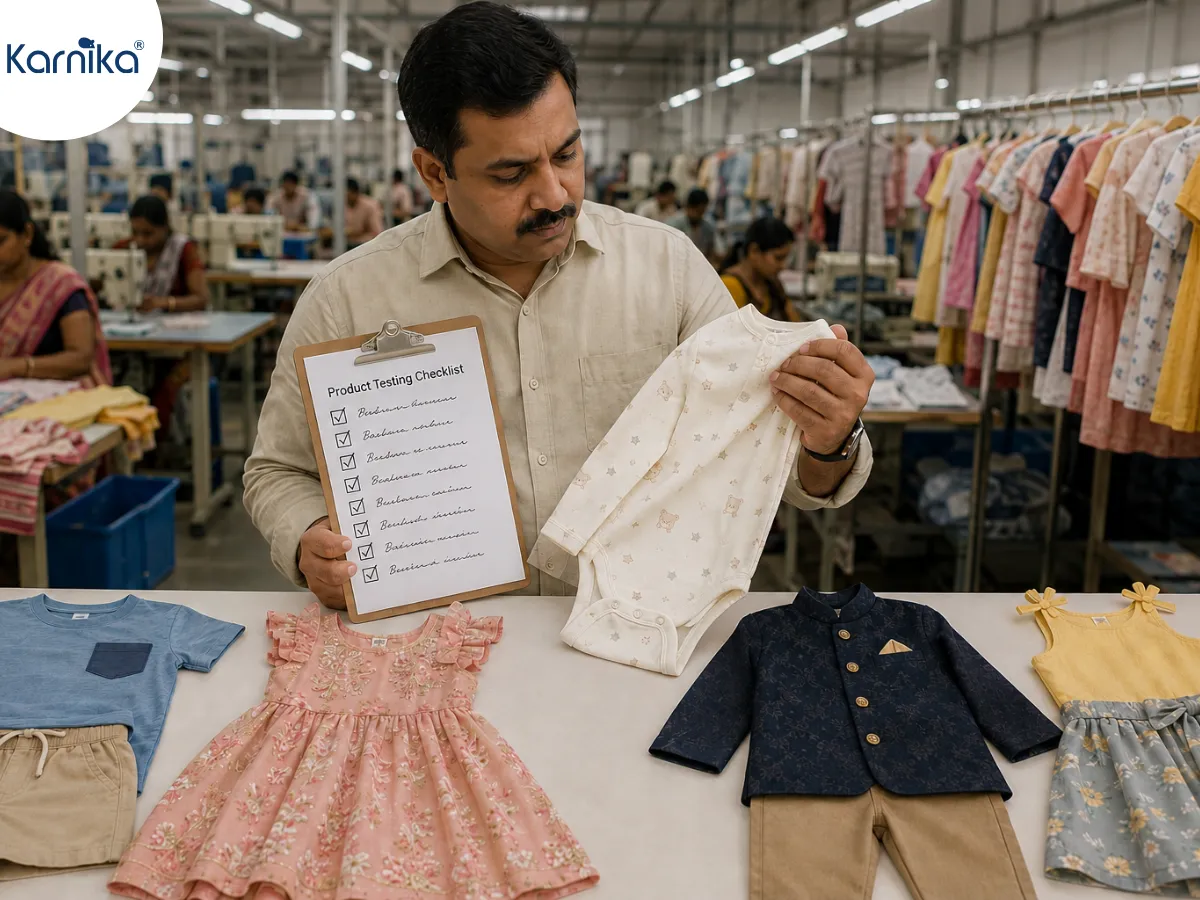
Checking the samples before placing a bulk order is crucial and so is a structured product testing checklist so that the retailers do not have to face inventory losses. If you are a retailer, you know what to check before buying products from the supplier.
At Karnika Industries, a Kolkata-based kidswear manufacturer with decades of experience supplying retailers across India and beyond, we have seen how a structured product testing checklist at the sample stage can save retailers from significant inventory losses, returns, and reputational damage.
This guide will help retailers to understand what to check before buying from suppliers, especially those dealing with kids wear brands.
Why Sample Evaluation Matters Before Bulk Production
Sample evaluation is one of the most important steps before purchasing order. If a sample is not checked then it can result in a heavy loss. Thus a product checklist evaluation is not just a formality, it acts as a risk management tool.
Think of a situation:
Suppose a fabric shrinks 5% after washing. Then in a 500- unit order, so many garments will shrink and might not fit the age group. Who will suffer? Initially the retailer as they will lose repeat customers and also new customers will never visit again.According to child safety regulations set by the Bureau of Indian Standards (BIS), which governs children’s garment safety under IS 16065, if any fastener or zip has sharp edge, it will fail the entire batch. Thus these are crucial points that retailers have to check and have to communicate them to the suppliers as well.
Thus a sample inspection checklist retail helps a retailer to keep a track of what to notice during sample checking. This process can help a retailer in several ways:
- Retailers are able to avoid making costly inventory mistakes as they find out the defects earlier.
- Retailers are able to communicate properly with the suppliers so that there is a consistency between the approved sample and bulk delivery.
- When retailers are careful, they can protect their brand reputation.
- With a good sample and proper negotiation, the trust on the manufacturer also increases.
The Complete Product Testing Checklist for Retailers
The following provides a detailed sample inspection checklist retail for retailer buyers.
Fabric Quality Inspection
When parents buy clothes for children, the first thing they do is touch the fabric and feel it. This shows that fabric is the foundation for all kids wear brands. A parent would never want their newborn to stay irritated , cry and have rashes. Thus they are very particular about the quality of fabric that they want. Thus while evaluating the fabric, the retailer should:
- Check the softness.First you should check the fabric with your inner wrist to see if it is skin-friendly and soft.
- GSM (grams per square metre) is also a crucial factor.Check if the weight of the fabric matches the specification sheet. For example a 180 GSM cotton jersey should neither be too thin or too thick.
- Breathability is another crucial point in clothing. Especially in hot and humid climates, which is very common in many places in India, breathable fabric is non-negotiable.
- Thickness consistency: Feel across different parts of the fabric to identify inconsistencies.
Stitching Quality
Poor stitching can ruin the entire shopping experience for parents. Check for:
- Consistent stitch density (typically 12 to 14 stitches per inch for woven fabrics).
- There should not be any loose or trailing threads at seams and hems.
- At points like armholes, crotch seams, and collar joins, seam strength should be firm.
- Overall finishing quality should be good. There should not be any puckering, uneven tension, or skipped stitches.
Size Accuracy
One of the biggest reasons why products get returned is the sizing issue. So you should check:
- Chest, waist, hip, and length measurements for each size.
- The sizes should match the sizing chart and cater to the mentioned age group.
- There has to be consistency in the left and right sides.
Check Fabric Performance Before Approving Samples
Only visual inspection is not enough. It is necessary to test fabric performance in real life situations.
Shrinkage Test
Wash the sample garment at the care label temperature (commonly 30°C or 40°C). Measure the garment before and after washing. Acceptable shrinkage in the industry is typically below 3% for most woven fabrics and below 5% for jersey knits. Any shrinkage beyond this range should be flagged with the manufacturer before production begins.
Also make sure that the limits for shrinkage are always assured in writing.
Colour Fastness Test
Colour fastness is particularly important for kidswear, as garments are washed frequently. Test for:
- Washing durability: Does the colour remain vibrant after repeated washes?
- Rubbing resistance: Does the dye transfer onto a white cloth when rubbed?
- Sweat resistance: Does the colour bleed when exposed to perspiration?
According to IS 3361 (the Indian Standard for colour fastness to washing), garments should achieve a minimum rating of Grade 4 on the grey scale.
Karnika Industries tests colour fastness as a standard part of its pre-production process.
Stretch Recovery and Shape Retention
For knit garments and activewear, stretch recovery is critical. Pull the fabric to its maximum stretch and release. It should return to its original dimensions without distortion. Similarly, assess whether the garment holds its shape after washing. It should stay in shape especially at ribbed cuffs, waistbands, and necklines.
Evaluate Product Comfort and Wearability
This section of the product evaluation checklist before bulk order is especially important for kidswear, where comfort directly affects parent purchasing decisions and repeat orders.
Comfort for Babies and Children
Internal seams should be flat or covered to prevent chafing. Labels must be soft and positioned away from the neck or lower back. Or they can be printed directly on the fabric. The garment should allow freedom of movement appropriate for the child’s age and activity level. Baby comfort is the prime factor for suppliers, retailers and customers.
Seasonal Suitability
Verify that the fabric weight and construction match the intended season. A 240 GSM fleece is appropriate for winter, whereas a 130 GSM poplin is better suited to summer. Mismatched seasonality leads to poor sell-through rates.
Design and Appearance Checks
The visual accuracy of your sample is part of the product testing checklist that retailers often focus on. However, appearance checks must go beyond aesthetics.
- Print quality: Is the print sharp and consistent across the garment? Are colours true to the approved artwork?
- Crack resistance: Press a printed area firmly with your thumb. Any immediate cracking suggests low-quality print binders.
- Embroidery quality: Check thread density, backing fabric, and whether embroidery stitching puckers the base fabric.
- Pattern alignment: Stripes, checks, and prints must align at seams.
- Design consistency: Compare the sample against your approved artwork file for any deviations in placement, size, or colour.
Safety Checks Retailers Should Never Ignore
For kidswear specifically, safety is non-negotiable. The BIS mandatory certification for children’s garments under IS 16065:2012 outlines requirements for mechanical and physical safety, chemical safety, and flammability. Your sample inspection checklist for retail must include:
| Safety Check | What to Test | Pass Criteria |
|---|---|---|
| Button Strength | Pull-test each button with 10N force for 10 seconds | Button must not detach |
| Zip Functionality | Open and close zip 50 times; check pull tab security | No snagging or failure |
| Snap Buttons | Test snap button strength and re-fastening reliability | No detachment under normal pull |
| Sharp Edges | Run fingertip along all seams, zips, and closures | No sharp points or edges |
| Small Parts (Choking) | Assess any component smaller than 3.17 cm diameter | Prohibited for under 3 years |
| Drawcord Lengths | Measure hood and waist drawcords per EN 14682 or IS 16065 | Must meet length/loop standards |
Packaging Evaluation During Sample Review
Packaging is frequently overlooked in a product evaluation checklist before bulk order, yet it directly affects how your product is received by the end customer and how smoothly your warehouse operations run.
- Product folding: Is the garment folded to display the key design element (front print, collar, etc.)?
- Label accuracy: Are all care labels, size labels, and country of origin labels present and accurate?
- Barcode placement: Is the barcode scannable and correctly positioned on the outer packaging?
- Packaging durability: Will the polybag or box withstand transit without tearing or crushing?
- Branding presentation: Does the packaging match your brand guidelines in terms of logo placement and design?
Questions to Ask Your Manufacturer at the Sample Stage
A structured what to check before buying from a supplier conversation should include the following questions:
- Will bulk production be carried out on the same machines and with the same fabric batch as the sample?
- What in-line and end-of-line quality control checks does your production team conduct?
- How are fabric batches managed to ensure colour consistency across the full order?
- What is your acceptable defect rate per hundred units (DHU)?
- Can we receive a pre-shipment production sample for approval before dispatch?
At Karnika Industries, these questions are answered transparently during the sample development stage. We provide full fabric test reports, GSM specifications, and size measurement sheets with every sample submission.
Common Sample Approval Mistakes Retailers Make
Understanding what to check before buying from a supplier also means knowing what not to do. These are the most common mistakes retailers make:
| Mistake | Why It Is Risky |
|---|---|
| Focusing only on design | Overlooks fabric performance, stitching quality, and safety. |
| Skipping wash tests | Leads to shrinkage and colour fastness issues in bulk. |
| Not measuring carefully | Results in sizing inconsistencies across the full order. |
| Ignoring packaging quality | Causes transit damage and poor unboxing experience. |
| Skipping wear testing | Comfort issues surface only after customer purchase. |
| Approving samples too quickly | Pressure to move fast leads to overlooking defects. |
How Reliable Manufacturers Support Retailers Through Sample Testing
A strong product testing checklist is most effective when your manufacturer actively supports the process. Here is what to expect from a quality-focused supplier like Karnika Industries:
| Support Area | How Karnika Industries Supports Retailers | Benefit to Retailers |
| Transparent Product Development | Karnika Industries provides complete fabric composition sheets, GSM reports, and construction specifications with every sample submission. | Retailers receive all necessary product information upfront, enabling informed purchasing decisions without delays. |
| Consistent Quality Standards | A three-stage quality control process is followed, including incoming fabric inspection, in-line production checks, and final pre-shipment inspection. | Ensures that bulk production matches the approved sample in fabric quality, construction, sizing, and finishing. |
| Pre-Production Testing Support | Shrinkage tests, colour fastness tests, and button pull-strength tests are conducted on all samples before submission. | Reduces revisions and helps retailers complete their sample inspection checklist more efficiently. |
| Faster Sample Revisions | Revised samples for changes in fit, fabric weight, print placement, or other specifications are typically completed within 7–10 working days. | Accelerates approval cycles and helps maintain production schedules and delivery timelines. |
Sample Approval Quick Reference Checklist
Use this summary as your product testing checklist when evaluating samples:
| Category | Key Checks |
|---|---|
| Fabric | Softness, GSM consistency, breathability, shrinkage, colour fastness |
| Construction | Stitch density, seam strength, loose threads, finished edges |
| Sizing | Measurement accuracy against size chart, fit across age groups |
| Safety | Button pull-test, zip durability, sharp edges, choking hazards, drawcords |
| Design | Print sharpness, colour accuracy, embroidery quality, pattern alignment |
| Packaging | Label accuracy, barcode placement, folding standard, packaging durability |
| Performance | Wash test, stretch recovery, shape retention, seasonal suitability |
Conclusion
A thorough product testing checklist at the sample stage helps the retailers to avoid losses after bulk order. By evaluating fabric quality, construction standards, sizing accuracy, safety compliance, and packaging before approving production, retailers can reduce returns, customer complaints, and inventory losses. This step is also crucial to rescue the supplier and retailer relationship. Not checking anything by yourself and later blaming the supplier is not professional. Retailers should complete a detailed investigation on their behalf to avoid problems later.
Karnika Industries has been partnering with kidswear retailers to deliver consistent quality, transparent communication, and production that matches approved samples because when your products perform well on the shop floor, it is good for both of us.
If you are preparing to place a bulk order contact us to discuss your sample requirements.
Frequently Asked Questions (FAQs)
1. What should retailers check before approving a garment sample?
Retailers should check fabric quality (softness, GSM, breathability), stitching consistency, size accuracy, safety features (buttons, zips, drawcords), print and embroidery quality, and packaging standards. A structured product testing checklist ensures nothing is missed.
2. Why is sample testing important before bulk production?
Sample testing allows retailers to identify defects, sizing inconsistencies, and performance issues before committing to a large order. A single problem uncovered at the sample stage is far less costly than the same problem discovered across thousands of units.
3. How can retailers evaluate fabric quality during sampling?
Retailers should assess fabric softness, GSM (weight), breathability, and suitability for the intended age group. Performance tests, including shrinkage after washing and colour fastness, should also be conducted before approving the sample.
4. What garment safety checks are important for kidswear?
For children’s garments, retailers must check button pull strength, zip durability, drawcord lengths, the absence of sharp edges, and the presence of any small parts that may pose a choking hazard. Compliance with BIS IS 16065:2012 is mandatory for the Indian market.
5. What are the most common sample approval mistakes?
The most common mistakes include focusing only on visual design, skipping wash and performance tests, not verifying measurements against the size chart, overlooking packaging quality, and approving samples too quickly under production timeline pressure.
6. What quality control questions should retailers ask manufacturers?
Retailers should ask about in-line quality checks during production, fabric batch management, acceptable defect rates (DHU), pre-shipment inspection processes, and whether test reports for fabric performance are available.
7. How does sample testing reduce product returns?
By identifying fabric, sizing, and construction defects before bulk production begins, sample testing ensures that the final stock meets quality standards. Fewer defects in the delivered batch translate directly into fewer customer returns and complaints.