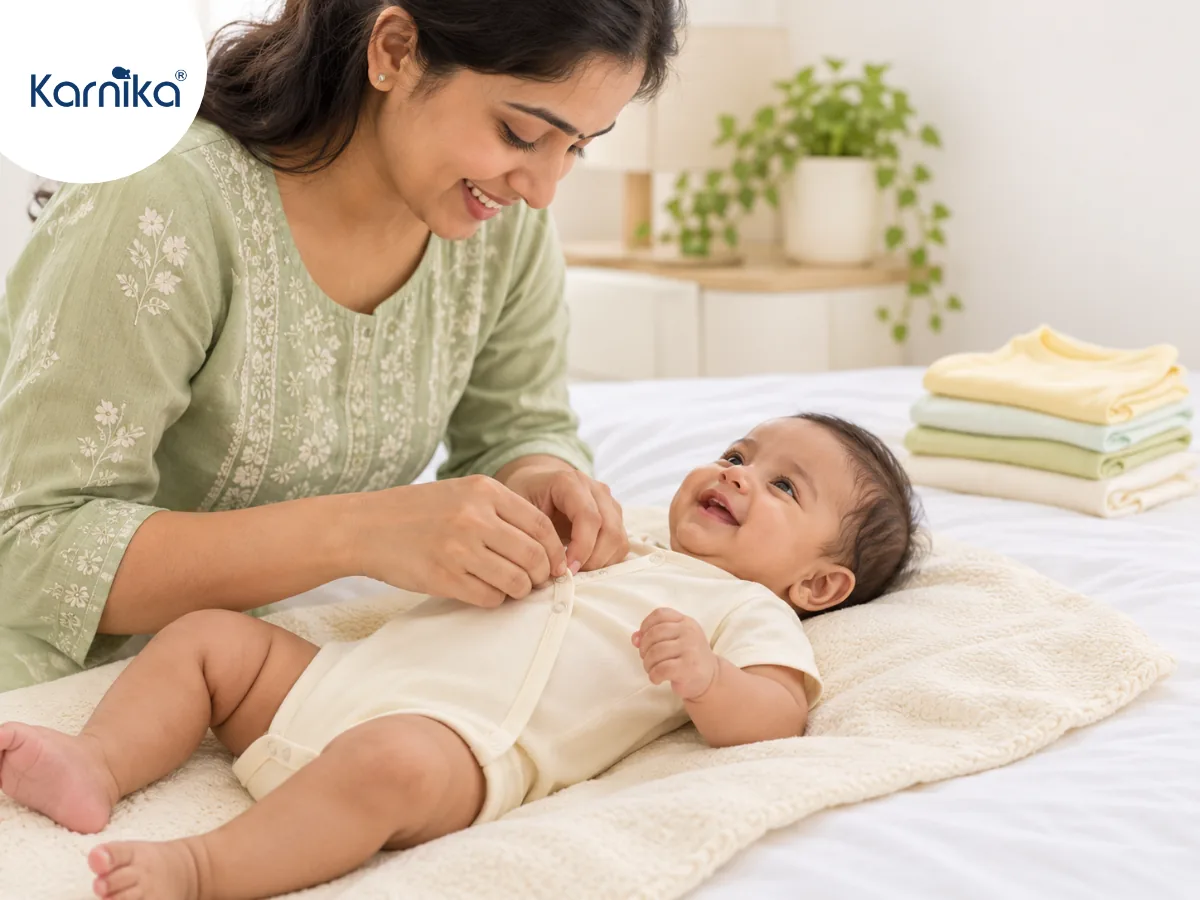
While choosing fabric for baby clothes in India, retailers have to be very careful. Parents, while shopping for their babies, first test the fabric. They feel the texture of the fabric, touch the fabric, and sometimes feel the fabric on their cheeks as well, only to make sure that the babies do not feel uncomfortable after wearing the clothes.
Infants cannot talk so their parents have to be very careful. When retailers choose fabric for baby clothes in India, they have to choose the best quality from the best manufacturers. Karnika Industries is a kidswear manufacturer based in Howrah that makes sure that the fabric for baby clothes is of premium quality and that babies do not feel uncomfortable.
Short answer: The best fabric for baby clothes in India is soft cotton in the right GSM (grams per square meter), which is the weight and density of the fabric. If the GSM is correct then the fabric will be suitable for all the different types of seasons available in India. However a baby’s cloth should never have synthetic fibers or a rough finish that can make the child uncomfortable.
Key takeaways
- The safest fabric for Indian babies would be soft cotton combed knit.
- Fabric: The fabric should be 120 to 150 GSM in hot weather and 180 to 200 GSM interlock in cooler months. Besides the thickness of the fabric, which is important for newborn babies.
- Higher GSM does not mean that the fabric is better. Higher GSM means warmer clothes that trap heat so higher or lower GSM depends on the weather where they are worn.
- The retailers should check shrinkage, colorfastness, and stitch strength on every style of every sample before ordering in bulk.
- Retailer: Every retailer should ask for certificates from the manufacturer. Do not believe in plain claims.
What Makes Newborn Cotton Clothes Safe and Comfortable for a Baby?
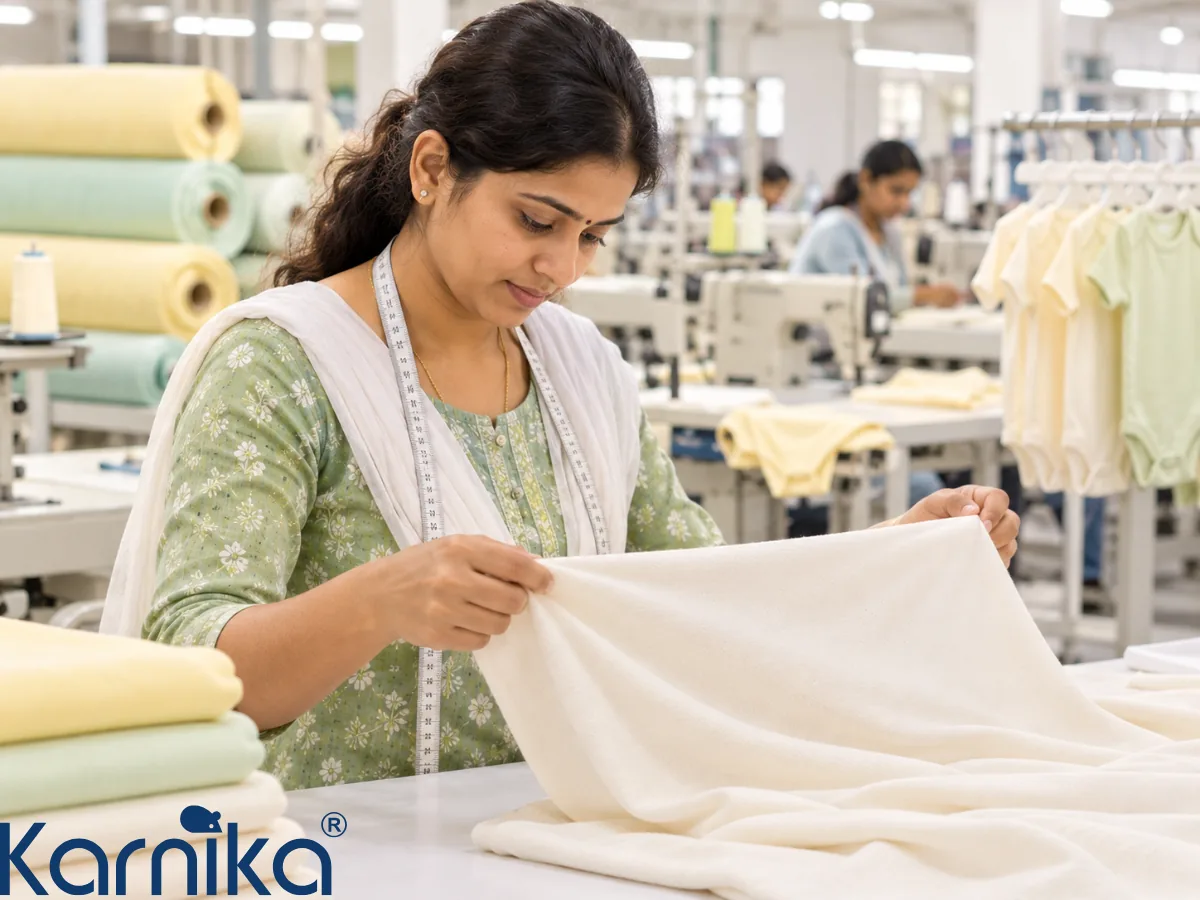
Cotton is a breathable fabric that absorbs very well and is soft and easy to wash too. Usually cotton is considered the safest fabric. Newborn cotton clothes are thus safe and comfortable for Indian temperatures, where the weather is mostly hot and even humid in places. Cotton clothes are the best wear for every age.
Skin sensitivity and heat rash
A newborn’s skin is very thin and very sensitive. Any fabric that traps heat and moisture can cause a rash on a newborn’s skin and make the child uncomfortable. Cotton is the best choice to avoid any kind of heat rash or skin problems.
Absorbency
Cotton fabric is best known for its absorbency. In many places in India the weather is hot and humid for most of the year. In such places cotton clothes are best because they can absorb sweat and dry very quickly, which makes the person feel comfortable.
Seams, labels and trims
Babies never feel comfortable if their clothes have rough prints, any scratchy substance, or any lace that is stiff or picky. Newborn garments should always be soft, have flat seams, and should not have any trims that can hurt the child. Any newborn garment should feel soft and should not have any uneven layer that can make the child uncomfortable. Thus while choosing the baby material, for baby clothes the manufacturers have to be very careful that the baby material is soft and not rough.
Baby Material Compared: Cotton, Interlock, Rib, Fleece and Muslin
There are many kinds of materials and many materials that are used in baby clothes as well. However which one fits the season and what to opt for depends on the retailer.
Single jerseys are usually best for summer. Interlock suits are best for cooler months and rib and fleece are best for the winter season. Muslin clothes are also best for hot weather or they are very good for swaddling newborn babies in any season. Organic cotton is a good option but there should be certification. Poly cotton might look good but they’re not really fit for newborn babies. It can be better for older kids.
GSM tells us what the weight of the fabric is and this decides which season the type of fabric should be used for. According to the general industry guides, the following table gives an idea of GSM figures.
| Fabric | Feel | Typical GSM | Best season | Best for | Watch out for |
|---|---|---|---|---|---|
| Single jersey cotton | Soft, light, stretchy | 120 to 160 | Summer, monsoon | Tees, bodysuits, rompers | Edges can curl; pale shades may show through |
| Interlock | Smooth, dense, stable | 180 to 220 | Spring, autumn, mild winter | Sets, nightwear, frocks | Warm for peak summer |
| Rib | Stretchy, close fitting | 180 to 240 | Cooler months | Cuffs, necks, fitted rompers | Tight rib can mark skin |
| Fleece | Plush, very warm | 240 to 320 | Winter only | Winter sets, jackets | Overheating and pilling |
| Muslin or malmal | Airy, woven, light | 50 to 120 | Hot summer | Swaddles, summer frocks | Creases easily; little stretch |
| Organic cotton | Soft, similar to standard cotton | 130 to 180 | Depends on the knit | Parents who ask for organic | Ask for a certificate, not just a claim |
| Poly-cotton blend | Smooth, crease resistant | 140 to 200 | Cooler months | Durable everyday wear | Less breathable; avoid for newborns in summer |
What to stock and at what time of the season completely depends on the retailers. However the retailer should know what type of fabric suits which weather so that they can stock the right fabric at the right time.
What Is GSM in Clothing, and What GSM Is Best for Baby Clothes in India?
GSM stands for grams per square metre. For fabric for baby clothes in India, best suited for hot summers is 120 to 150 GSM, and for cooler months is 180 to 220 GSM. A thick fabric has a higher GSM and a thin fabric has a lower GSM. GSM does not explain the quality of the fabric but it explains the thickness of the fabric.
GSM by season
These ranges reflect general industry practice:
- Hot and humid weather: 120 to 150 GSM single jersey
- Monsoon and spring: 140 to 180 GSM
- Mild winter: 180 to 220 GSM interlock
- Cold north: 220 GSM and above, layered over a lighter inner layer
Why higher GSM is not always better
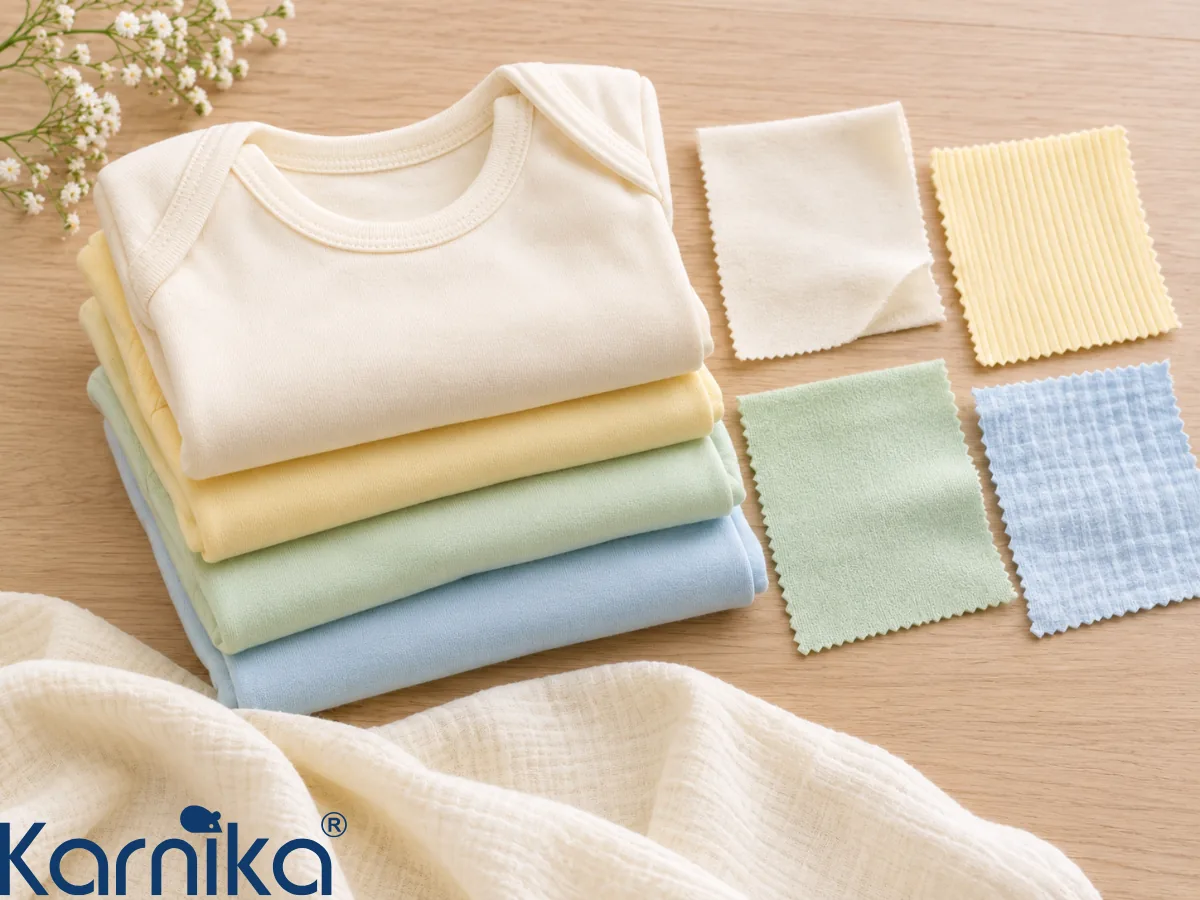
GSM does not define the quality of the product. GSM defines the thickness of the product.
Now if someone wears a fabric with a higher GSM in Kolkata weather in March, that person will either boil or sweat furiously and ultimately fall sick. So the GSM of the fabric should suit the weather. If it is a winter season or if it is a place where the weather is always cool, then the GSM should be higher. However if it is a summer season or if it’s a place where the weather is usually hot or humid, the GSM should be lower.
Knit or Woven for Babies? Stretch, Dressing Ease and Seam Comfort
A knit stretches and the seams are away from the skin so it is, preferably, a better choice for babies instead of a woven fabric. But the seams can make the baby uncomfortable.
Choosing Fabric for Baby Clothes in India by Season and Region
India is a vast country with different weather throughout the country. There are places where it is hot almost all year round. There are places where there are different seasons and the weather changes according to the season. There are places where it is cool or very cold all year round.
The fabric varies from place to place in India. A light single jersey is the best for the humid season whereas light cotton knit or muslin is good for dry seasons. Layered interlock and rib are best for the cold season in the north. A medium-weight cotton layer is good for any air-conditioned room.
- Humid east and coast (Kolkata, Chennai, Mumbai): light single jersey that absorbs sweat and dries quickly.
- Dry heat (Jaipur and the wider Rajasthan market): light cotton knit or muslin. The coverage should be more due to intense sun.
- Cold north (Delhi NCR, Punjab, hill states): an interlock base layer under rib knit or fleece.
- Air-conditioned rooms: a medium weight cotton layer. The clothes should be fully covered.
How We Test Fabric Shrinkage, Colour Fastness and Stitch Strength
A quality of a fabric is not only known by its feel but also by whether it shrinks, whether color bleeds, and whether the stitch comes out. At Karnika Industries these factors are checked before they are sold to the retailers.
If a fabric shrinks after washing, then the parents will never be able to judge the size of the clothes before buying them. If a fabric color bleeds, that shows that the quality of the dye is not good. If the stitch comes out, that shows that enough care has not been given while manufacturing the fabric.
All these three points are crucial during a quality check of a fabric. A retailer should ask the manufacturer for the actual test results and if they are not able to show those results, then the retailer should reconsider believing that manufacturer.
Certifications to Ask for on Pure Cotton Baby Clothes
Pure cotton baby clothes should be rid of any dye or chemicals. However many times even pure cotton baby clothes are not free from chemicals. There are certificates that prove the purity of the fabric and before purchasing from manufacturers every retailer should ask for Oeko-Tex Standard 100. Class 1 covers baby material clothes. A retailer should always ask for certificates to ensure that the quality of the product is guaranteed.
Retailer Checklist
The Five-Point Fabric Check
There are few things that a retailer should check before placing an order:
- What is the exact GSM and what is the knit type?
- What the fiber is made of and whether the cotton is combed or carded.
- How much the fabric shrinks after washing and how it is tested.
- What the color bleeding result is after washing or perspiration.
- What certificates the fabric has and whether the manufacturer would share those with the retailers.
Three quick checks before purchase
A retailer should check a few things before buying from the manufacturer:
- A retailer should pull the fabric and release it to see whether the knit comes to its original shape. Usually a good knit always comes back to its original shape.
- When the fabric is held towards the light, if there are uneven loops or a see-through look, then that shows the fabric is very thin. If it’s opaque then it shows the fabric is thick.
- If a retailer places a drop of water on the fabric, cotton will absorb it immediately. If it’s some other fabric it will not absorb. This will prove whether the fabric is pure cotton or not.
FAQs
Which fabric is best for baby clothes in India?
India has different types of weather so usually a soft combed cotton knit is best for all weather when it comes to fabric for baby clothes in India. However it is important to see the GSM. A low GSM suits hot weather and a higher GSM suits cold weather. Usually cotton is best for most places in India because cotton is breathable, it absorbs sweat, and it is easy to maintain as well.
How many GSM should newborn clothes be?
For newborn clothes 120 to 150 GSM should be for hot weather. 140 to 180 GSM should be for monsoon weather and usually 180 to 220 GSM suits cold weather.
Is organic cotton worth the extra price?
Organic cloth is worth the extra price but it should have a GOTS certificate. This certificate proves that the cloth is actually organic and it is made of good conventional cotton. If the manufacturer has the certificate only then the organic cotton should be purchased.
Can babies wear polyester?
It is preferable not to give polyester to babies, at least newborns. Children above 6 months can wear polyester but on very rare occasions, maybe just 1 or 2 days at a festival. Newborn skin is very sensitive so cotton is best for them.
Why do baby clothes shrink?
If the cotton fiber is not well knit, then while washing the loosely knitted fabric can relax. Thus the finish of the fabric is very important.
You can request samples from Karnika Industries and check the quality, compare GSM, and check the wash performance before you order in bulk.