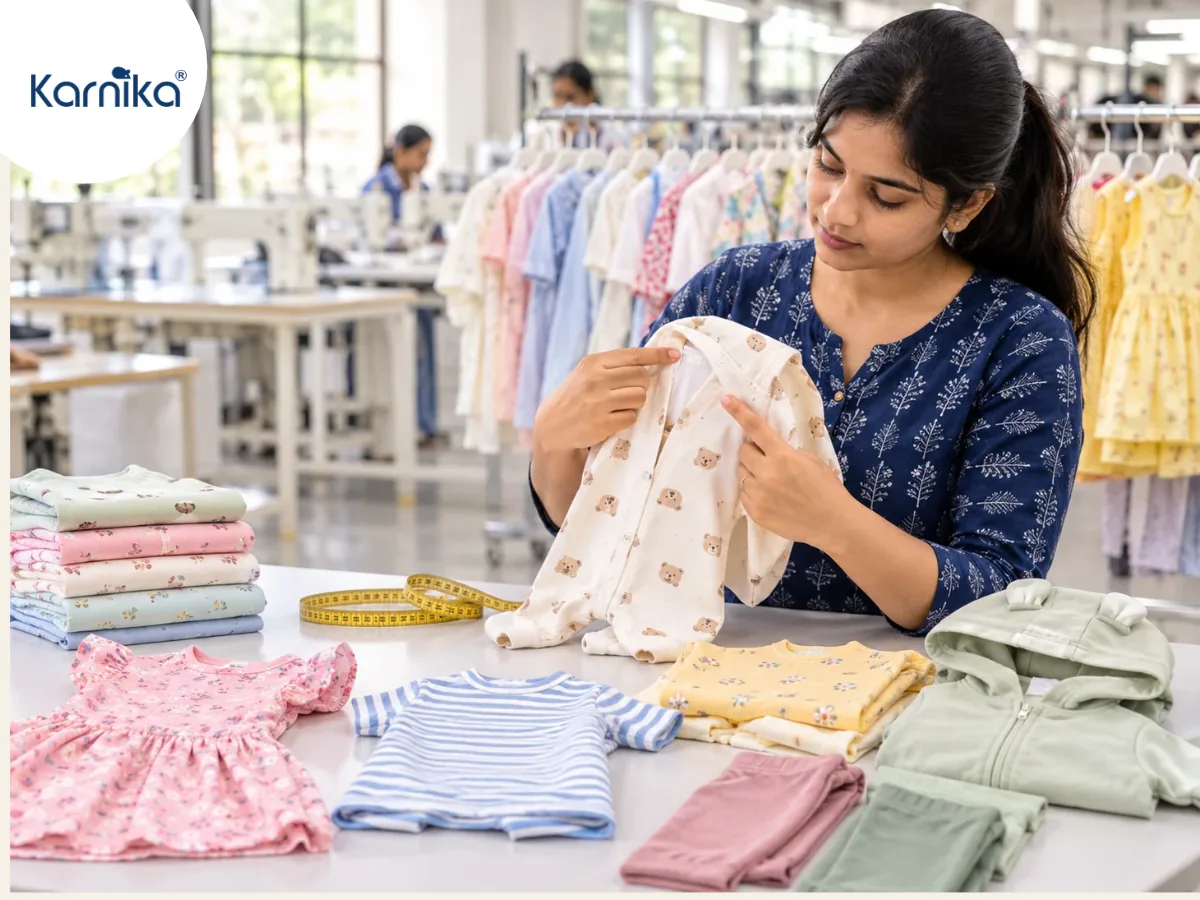
Quality control in garment manufacturing is crucial for a retailer. This decides if the retailer will have all the stock sold or if the retailer will get complaints from customers. When it comes to kidswear the parents are very particular about the quality of the product. If there is a lack of quality control in garment manufacturing, then the customers will return the products and will never return to the retailer to purchase a new product ever again.
Karnika Industries has manufactured kidswear since 2008 in Howrah, Kolkata. This guide by Karnika Industries helps to understand how quality control works in the kidswear business and how retailers should decide which manufacturer they should choose.
Key takeaways
- The garment quality control checklist contains five stages.
- AQL shows how many possible defects there can be in a unit and how many are still eligible to pass.
- It is very important that there is an extra check on seams, fasteners, dyes, and small things.
- Especially in kidswear one should ask the supplier to give a written AQL level and the sample inspection report.
- Karnika Industries has a record of 90% on-time delivery and it has produced more than 10,000 units a month.
Short answer
Quality control in garment manufacturing includes several continuous checks on the fabric to see the quality of the fabric, the sewing, the finish, the seams, and the color bleeding. This quality check confirms that each piece is approved and fit to be sold to the retailers. For kidswear there are five stages, which end with AQL sampling inspection and extra tests for seams and dyes.
What Are the 5 Stages of Garment Quality Control?
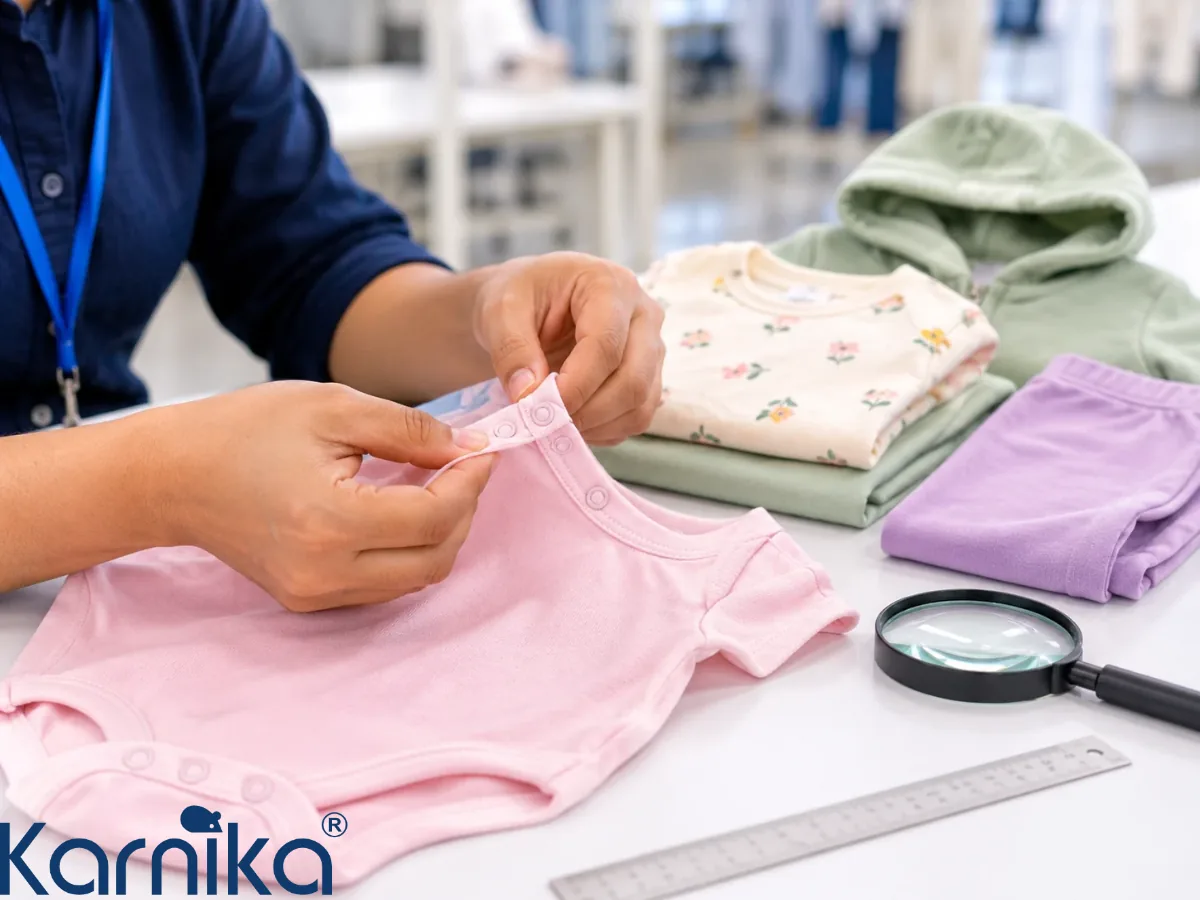
The garment quality control checklist includes 5 stages:
- Incoming fabric inspection: In this stage fabric needs to be checked before cutting. For kids’ wear fabric has to be soft and comfortable so that the kids do not have any rash or uneasiness. Many factories select the 4-point system check. In this system they get to know flaws in every roll. Points are given for this check and if there are more than 40 points per 100 sq yd, then the entire roll will be rejected. This stage also checks shrinkage, shade matching, and fabric weight.
- Pre-production approval: The buyer first asks for a golden sample. They approve the golden sample after checking the fit, the stitching, and the trims. Later the factory has to make a size set so that they have proper measurements across every size. If this step is skipped then there’s a high chance that in bulk production the sizes can differ and the entire production can differ from the golden sample so these checks are important.
- Cutting and inline inspection: In order to check size and shade consistency, cut panels are checked. When the cutting is done inspectors check the garments so that if there is any uneven stitching it can be corrected then and there. If this process is continuously done then it is easy to find a fault at 100 pieces and stop that fault at that time.
- Final inspection using AQL. After the garment is finished an inspector can take any sample from the entire lot and check it. He will check the sample as per the agreed limits.
- The pre-shipment audit is the last check. Make sure that the packing, the labels, the size ratios, the carton making, and shipping are properly done. If there is a flawless garment but it is in the wrong carton, then that means it is a failed delivery. Everything has to be done properly and perfectly. Ask for certifications that prove the quality of the products.
| Inspection type | When it happens | What it catches | Cost of fixing |
| In-line | During sewing | Stitching and measurement errors | Low, fixed on the line |
| Final (AQL) | After finishing | Defects across the whole lot | Medium, rework or sorting |
| Pre-shipment | Before dispatch | Packing, label and carton errors | Medium, repacking |
When there is a check at every stage, it is easy to catch the faults early and correct them at the earliest possible time.
How Does AQL in Garment Inspection Work?
AQL stands for Acceptable Quality Limit. It is a sampling plan, based on the ISO 2859-1 standard, that sets how many defective pieces a lot may contain and still be accepted. Inspectors check a random sample instead of every piece, and the lot size decides how many garments they pick.
Three defect classes carry separate limits. Critical defects, such as a needle fragment in a seam, have an AQL of 0, so none is acceptable. Major defects, which make a garment unsaleable, are commonly set at AQL 2.5. Minor defects, which are cosmetic, are commonly set at AQL 4.0. Buyers can agree on different levels in writing.
The sample sizes below follow general inspection level II in ISO 2859-1 (International Organization for Standardization).
| Lot size (pieces) | Sample size (garments) |
| 151 to 280 | 32 |
| 281 to 500 | 50 |
| 501 to 1,200 | 80 |
| 1,201 to 3,200 | 125 |
Worked example
Take a lot of 1,000 pieces. The inspector checks 80 garments. At AQL 2.5 for major defects, the lot passes if no more than 5 of those 80 garments have a major defect, and a sixth major defect fails the lot. At AQL 4.0 for minor defects, up to 7 are allowed. Any critical defect fails the lot immediately.
Garment defects types and how they are classified
Classification can vary by buyer, so agree to it in writing before production starts.
| Defect | Example | Class |
| Needle fragment | Broken needle tip inside a seam | Critical |
| Detachable small part | Loose button or snap | Critical (kidswear) |
| Open seam | Side seam split | Major |
| Wrong size label | Size 4 label on a size 6 garment | Major |
| Shade difference | Sleeve and body visibly different | Major |
| Skipped stitch | Single missed stitch in a hem | Minor |
| Loose thread | Untrimmed thread end | Minor |
Which Extra Checks Do Kids Clothing Quality Standards Require?
Kids clothing quality standards have some criteria which are applicable mostly to kidswear. There are times when people neglect this part during adult garment inspection. However, because children can chew the cloth, pull the cloth, put their garment in their mouth, and also have skin irritability, these checks are very important.
- Seam strength, as children often pull their seams harder than an adult does.
- The fasteners, snaps, and buttons should have a pull test. It is best to avoid anything that can choke a baby or a toddler in a garment for ages 0 to 5 years.
- For younger children buttons and snaps should be tight so that the kids do not break them while playing and there is no choking accident.
- Drawstrings and small parts should not be in dresses for babies and toddlers. For older children whatever is used should be firm and steady.
- A wash test should confirm that the color does not bleed and the size does not shrink.
- For newborn babies and even toddlers the fabric and the neckline should be good. The fabric should be soft and the neckline should be stretchable because many toddlers, even though the size of the dress fits, struggle while putting the dress through their head.
Garment Quality Control Checklist: What to Ask Before You Order
A good garment quality control checklist has five questions. So a retailer should always ask:
- What is the AQL level that we use for critical defects, for major defects, and for minor defects?
- Who completes inspection during different stages of production and what are the stages when the inspection is done?
- Can you share a recent test report, an inspection report, with me?
- What is your policy on rework, replacement, and refund for defective goods?
- Do you have samples and photos of the actual bulk production before dispatch?
If a manufacturer answers all these points without any hesitation, then it will be easier for the retailers to go ahead with the manufacturing. However the retailers should look for certain red flags, for example:
- if the inspection takes place only at the end of production
- if there is no written AQL level that the manufacturer can provide
- if there is no test report that the manufacturer shares
- if the manufacturer answers vaguely about the defects
- if the approved sample looks better than the picture of the bulk sample
While bulk buying baby clothes retailers have to check many points and ask some questions of the manufacturers before they lock their order.
Karnika Industries focuses on quality and gives prior importance to seams, fasteners, labels, sizes, and all those small details that are crucial in baby wear. Karnika Industries gives prior importance to its retailers, due to which Karnika has been trusted by over 2,500 retailers across the country. Our motto is “Made for kids, loved by parents, and chosen by retailers” and we stand by it.
FAQs on Garment Quality Control
What is quality control in garment manufacturing?
Quality control in garment manufacturing focuses on inspection of fabric and checks at every stage, including an inspection of the finished garment before it is dispatched for delivery. Good quality control in garment manufacturing usually takes place at every stage so that if there is a slight mistake in any stage, it can be corrected then and there.
What is AQL 2.5 in garment inspection?
An AQL of 2.5 means there are major defects in the garments. This means that if 80 garments are inspected, 5 of them have major defects and cannot be passed.
What is the difference between in-line inspection and final inspection in garments?
Inspection means the inspection of the garments that keeps on taking place during production. However the final inspection happens only after the entire production is completed. In the case of inline inspection it is easier to catch minor defects earlier so that the entire batch does not get wasted. However after everything is over, a final inspection is very important again so that the final product gives the best quality.
What are the most common garment defect types?
The most common garment defects are seams that are open, stitches that are not properly done, threads that become loose, shades that differ even in the same fabric, labels that do not match the garment, sizes that do not match the size guides.
In kidswear having a loose button or a needle fragment is considered a critical defect that can fail the entire bulk production.
What should a garment quality control checklist include for kids clothing quality standards?
A garment quality control checklist should include the AQL level, the inspection stages, the seams, the fasteners tests, the needle detection, the color fastness result, the shrinkage result.
It also should consist of the rework and refund terms and conditions. All these should be in writing so that they are on consistent proof.