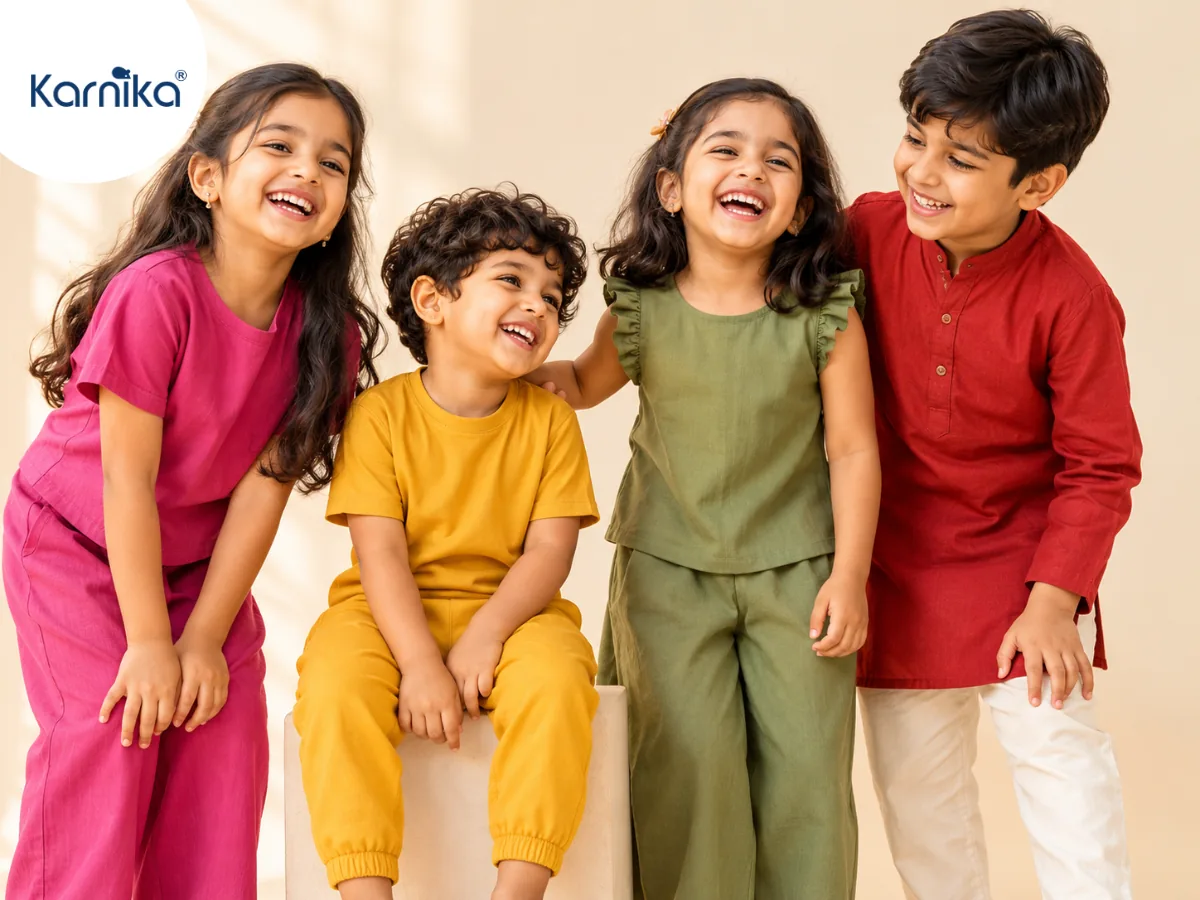
Just like any other fashion trends, kidswear trends also keep on changing. However with the continuous change in trends, what matters to Indian retailers, especially in 2026-27, is a practical approach while buying any kidswear.
Even though current parents are quite aware of fashion trends and new trends, one thing which they never compromise with is the comfort, the fabric quality, the feel of the fabric, and the unisex ease, dresses wearable on a daily basis and some dresses specially made for special occasions.
Thus retailers need to keep these demands of customers in their mind while contacting the manufacturers and stocking kidswear. Karnika Industries, a kidswear manufacturer based in Howrah, can turn each trend into a buying decision that depends on the season, the fabric, and order size as well.
Short answer: The current kidswear trends in India in 2026-27 mostly focus on comfort, gender neutral kids clothing styles, festive and ethnic wear, seasonal wear, and layering for winters. Retailers should make their list before ordering in bulk, as trends keep on changing. However in kidswear trends, quality and comfort never change.
How big is the Indian kidswear market?
According to IMARC Group’s 2026 report, the Indian kidswear market in 2025 was at USD 11.1 billion and it is expected to grow to 17.4 billion by 2034. It is expected that there would be a 4.9% increase per year.
The IMARC children’s wear report takes into account the broader market and mentions that the broader market of children’s wear is at USD 28.18 billion. The Technopark projection, which was published by India Retailing, pointed out that there should be a 22% market of Indian apparel in kidswear in 2026, according to the Business Standard report of June 2026. That India kidswear is one of the fastest-growing apparel segments in the clothing business.
The six kidswear trends for 2026–27
The six kidswear trends for 2026 would be:
Comfort first: Parents choose comfort over anything when it comes to kids’ wear. Matching tops and bottoms in soft knits, comfortable co-ords, T-shirts, shorts, joggers, and pajama sets are the best choices to stock up on anytime in the year. A retailer should choose a soft cotton jersey at the mid-price point so that there can be repeated purchases. Comfortable basic clothing is always in demand so they should be priced reasonably.
Gender-neutral kids clothing: Nowadays many people are moving away from pink for girls and blue for boys. In fact parents are opting for gender neutral clothes and colors, which anybody can wear. The times when siblings are of similar age and parents prefer to get such clothing, which can be shared by both the siblings, girl and boy: retailers should stock rompers, sleepsuits, plain tees, and joggers, especially for toddlers and infants. The fabric should be very soft cotton fabric, which is at the entry price point.
Organic baby clothes trends: In 2026 organic clothing will become in demand. According to the IMARC Kidswear report, organic and sustainable clothing are among the most demanded kidswear clothes, especially for newborns and infants. Parents prefer organic clothing because they can be trusted easily. There should be a third-party certificate to prove that the clothing is actually organic. However the prices can be slightly high which parents usually pay for newborns and infants.
Festive wear: The festive kidswear trends India 2026 include ethnic and party wear. As in India, there are many festivals and many weddings. The demand for festive kidswear is a lot especially during the festive and wedding season.
Retailers should stock boys’ fancy suits and girls’ heavy embroidered or colorful dresses. If the finish is rich the price can be slightly high, which people do pay during the festive season.
Bold prints and colors: In 2026 and 2027 bold prints and color have also come into high demand. Ideally they should stock one or two print stories per season. The fabric should be good, the color should not bleach, and the print quality should also not fade.
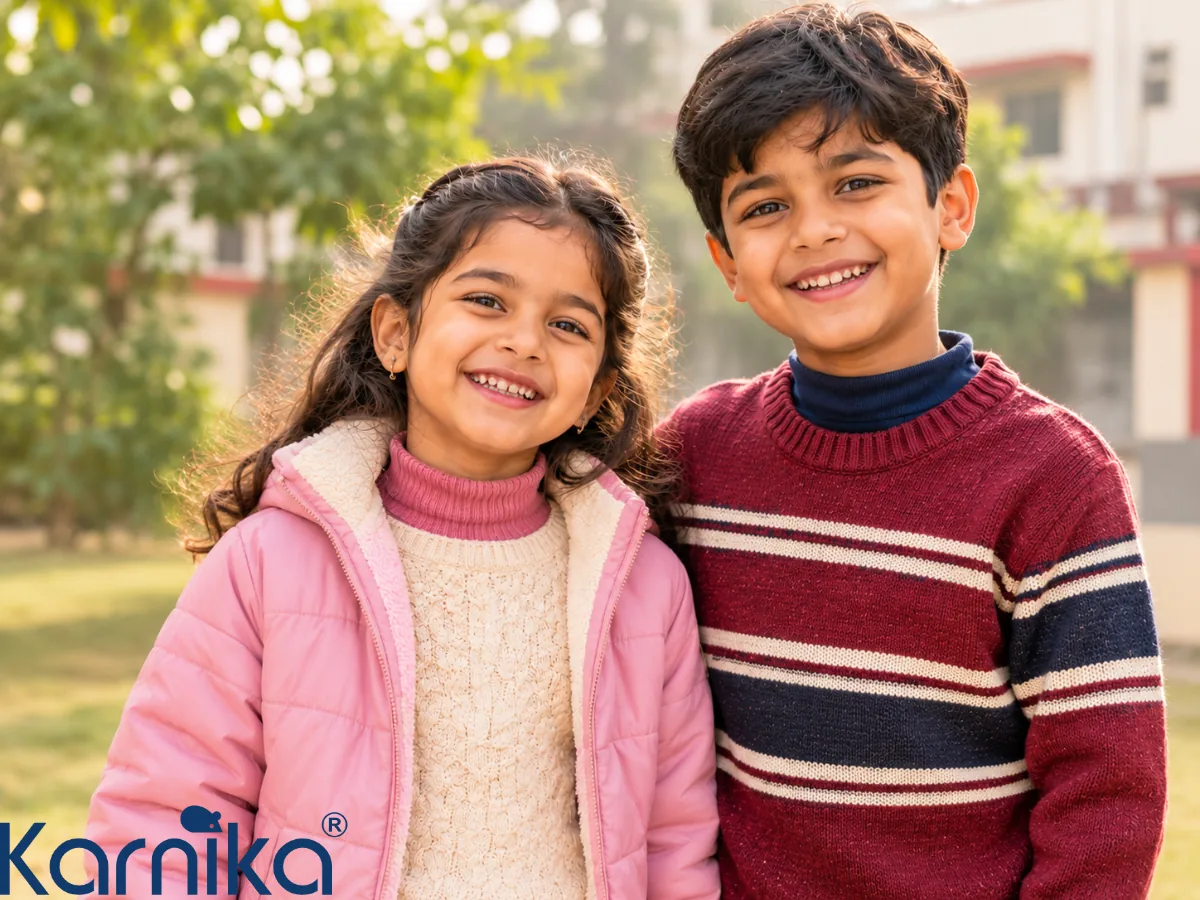
Winter layering clothes: In India many places have winter and it is quite cold. Parents often prefer layers because the weather is quite unpredictable most of the time. The retailer should stock thermals, knitted sets, jackets, and sweaters so that they can be worn in layers by the children according to the weather. The price should not be too high but in the medium range as children grow very fast. Parents have to keep on stocking winter clothes almost every season.
Kidswear trends by season: what to order and by when
Kids’ wear trends keep on changing based on seasons. During the festive month, especially in September, October, and November, when there are Navratri, Durga Puja, Diwali, and many such festivals around India (or even during wedding seasons, or winter, summer, and school opening times), they have different demands for different types of clothes. The table below gives a guide of when the demand arises and when to order them.
| Season | What to order | Order by (planning guide) |
| Puja and Diwali | Festive sets, fancy suits, frocks | June to July |
| Wedding season | Occasion wear, ethnic sets | July to August |
| Winter | Thermals, knitted sets, layers | June to July |
| Summer | Cotton tees, shorts, co-ords | December to January |
| School reopening | Everyday sets, basics, pyjamas | January to February |
Kidswear trends India 2026: what is selling in tier-2 and tier-3 markets?
In Tier 2, Tier 3 towns there is more demand for comfortable basics and festive wear during the festive and wedding seasons. Karnika’s May 2026 investor presentation has details about these towns where there are growth opportunities. However these points should be taken as a general trade practice because this demand varies from place to place.
For instance in East India, during Durga Puja, or rather from 2 months before Durga Puja, orders of ethnic or any new clothes start increasing as people start shopping for Durga Puja 2 months prior and shop till the day before the puja. Similarly in the North, the demand for woolen clothes is high especially as Navratri enters because before that the temperature starts falling.
In tier 3 towns the first trial order of a retailer should always be everyday basic clothes and a few festive pieces. It is also advisable to have one print story. Usually basics sell through fast so after that retailers can reorder but it is not advisable to stock a lot of clothes at one time especially in towns.
Buying plan for retailers: a kidswear checklist
The best kidswear buying plan would be:
1. Basics: A retailer should start by stocking up 70% of basics and 30% of fashion clothes. After that if the basics get sold, then they can reorder them or change according to the demand of the season.
2. Size curve: All the sizes should be purchased depending on the age. The retailer can restock later. For instance there’s always a huge demand for newborn clothes and for clothes from 0 to 2 years as children grow very fast. However there are always repurchase orders of the same size during ages 8 to 12 because at this age kids wear trendy clothes and they repurchase from the same retailer.
3. Season fit: Retailers should purchase according to the season as per the months.
4. Reorder timing: The reorder timing should be after the first 2 weeks of selling. If something sells then it should be reordered.
5. Low MOQ trial: A retailer should ask the supplier for a low minimum order quantity on every new fashion.
6. Proof: A retailer should always ask for proof, fabric swatches, wash tests, and fabric quality proof.
Which kidswear trends are fading or overhyped?
The kidswear trends that seem to fade or are overhyped are infant clothes that are heavily embellished, novelty prints that have become out of season, and organic claims without any proof. These things usually do not work.
Karnika Industries makes sure that infant clothes are comfortable and cute but not heavily embellished. We provide proofs for all the claims we have so retailers do not have to trust us blindly. They can check the certificates before building a relationship.
A retailer should ask a few questions for any trend:
1. Will the fabric survive repeated washing?
2. Is the print available in full-size curve?
3. Will it sell after the first month?
Karnika Industries Limited is a kidswear manufacturer. It was founded in 2008 in Howrah, West Bengal. It is listed on the NSE Emerge SME platform. It supplies more than 2,500 retail clients.
Request a new season catalogue at email sales@karnikaindustries.com or call 033-2655-8101.
Frequently asked Questions
What are the key kids fashion trends 2026-27 in India?
The kids fashion trends 2026-27 are clothes that are comfortable, gender-neutral styles, organic fabrics, festive wear, and winter layering.
Which winter kidswear 2026 styles sell best in India?
Winter kidswear 2026 styles include thermals, knitted sets, and layers sell very well in India. In India mostly, the seasons are not steady so parents prefer to stock up different items for different layers so that they can dress the child according to the weather.
Is the organic baby clothes trend worth stocking?
Yes, organic baby clothes. The trend is worth stocking because currently parents, especially of newborns and infants, do pay for organic clothes because for them the kids comfort is the prime factor. However a retailer should make sure that the organic fabric has a certificate because parents are very careful nowadays.
Which festive kidswear trends sell best?
Fancy boys’ suits, ethnic sets, girls’ frocks, ethnic and occasion sets sell well during festive and wedding seasons. However highly embellished clothes are not preferable. In 2026-27 parents also prefer soft lining under the clothes so that the kids do not get irritated.
Is gender neutral kids clothing worth stocking?
Yes, gender neutral kids clothing is worth stocking, especially for infants and even toddlers, because nowadays often parents prefer neutral colors and options. For newborns many purchases even before the child is born so neutral colors are always preferable because in India people do not know whether a girl is going to be born or a boy. So neutral kids’ clothing is preferable.
How much kidswear is bought online?
It is difficult to say how much kidswear is bought online because there is no reliable figure on this. However according to Care Ratings’ January 2026 report, about 22% of apparel are bought online.