
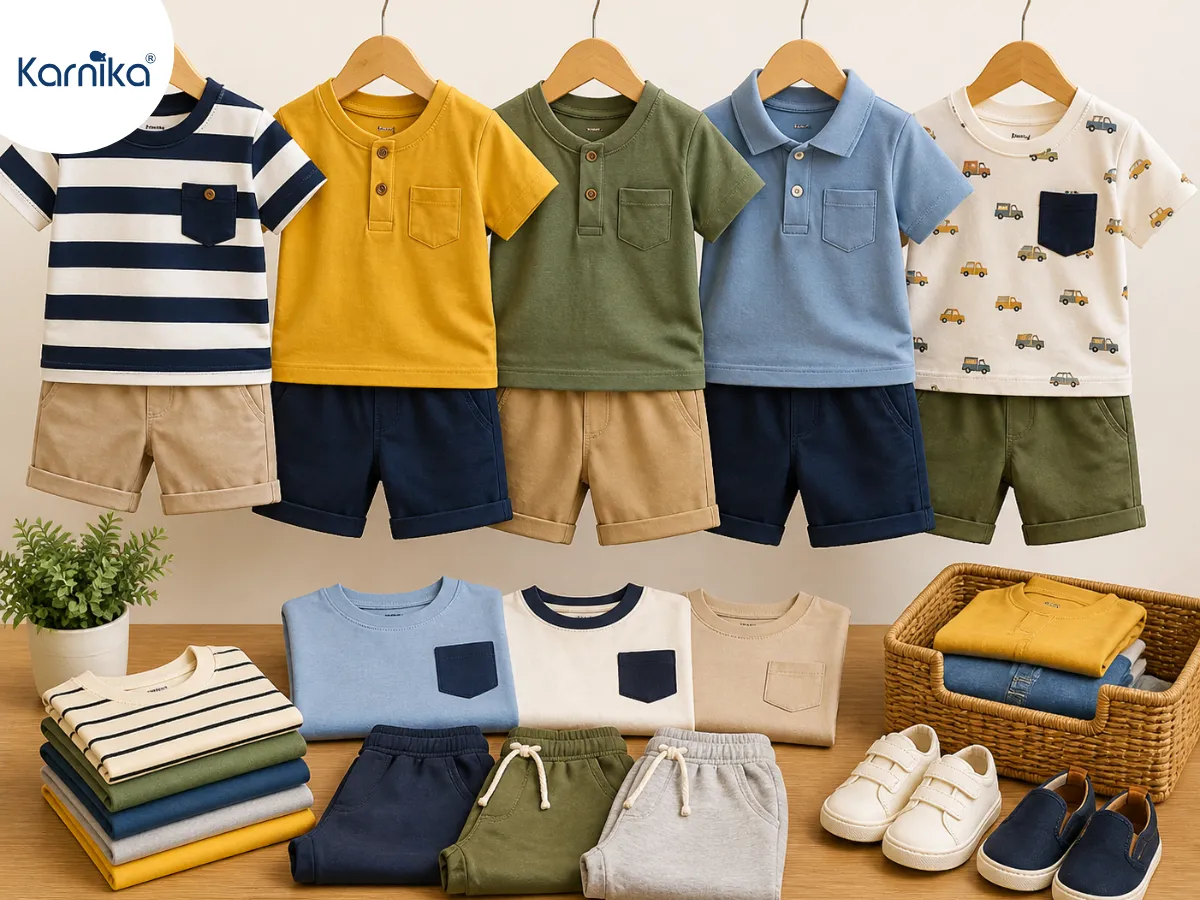
Whether it is wholesale boys clothing or girls’ clothing, the biggest mistake bulk buyers make is chasing trends. They usually follow the trend of a viral cartoon character or a viral trend and stock up many trendy products. However, when the trend goes, all those products stay on the shelf. The buyers who consistently profit in wholesale boys clothing do not do this. They stock what always moves. Safe is not boring, it is smart investment.
For example, a retailer ordered 500 pieces of Labubu printed T-shirts and 500 pieces of solid-color basics with simple prints in the same season. By the 90-day mark, the basics were 80% sold through but the character t-shirts could barely reach 60 % as the craze ended, and so did the purchase.
Understanding Bulk Buyer Psychology
To sell wholesale boys clothing profitably, one must know the buyer mentality.
| Buyer Type | Primary Need | Order Size | Price Sensitivity |
| Retail Shop Owners | Fast turnover, display variety | 100–500 pcs | Medium |
| E-commerce Resellers | Low returns, photography-ready styles | 50–300 pcs | Medium-High |
| School/Uniform Suppliers | Fabric consistency, standard cuts | 500–5000 pcs | Low (quality-focused) |
| Baby Clothing Stores | Baby rompers wholesale, tiny size range | 100–500 pcs | Medium |
| Export Buyers | International sizing, quality certs | 1000+ pcs | Low |
The Bulk Buyer Mindset Checklist
- Fast turnover: The first question before bulk buying should be that will the stock clear in 60–90 days?
- Low return rates: Wholesalers should target low return rates. This is only possible if they choose comfortable fabric, and standard sizing
- Size flexibility: Size flexibility keeping the data in mind helps in purchasing bulk orders. Few sizes that sell fast should be stocked up more than those that are less in demand.
- Repeat demand: Parents buy again when kids grow. Thus, wholesalers should reorder certain stocks that get repeated orders.
- Margin headroom: There should be a margin headroom. There should be a minimum 35–45% gross margin after landed cost.
- Supplier reliability: The lead time consistency matters more than lowest price. Thus, the wholesalers should focus on the supplier reliability and the quality they provide. If the suppliers are not reliable, a lot of money can be at stake.
Karnika Industries is a reliable supplier who keeps the demand in mind, maintains a balance in the designs and understands the trend in boys clothing.
Read Me: How to Buy Children’s Clothing in Bulk: A Beginner’s Guide
What Makes a Style “Safe” in Boys’ Wear?
In wholesale boys clothing, there are a few criteria that create a safe style for boys.
The Four Safety Pillars
| Pillar | What It Means | Example |
| Timeless Appeal | No heavy trend dependency; works year-round | Plain crew-neck tees, polo shirts |
| Neutral Colors | Blue, black, grey, white, navy, earthy tones | Navy shorts, grey track pants |
| Comfort-Driven Design | Parents choose comfort; stretchy, breathable fabrics | 100% cotton, jersey knit |
| Easy Sizing | Standard cuts; avoid tapered or complex fits | Regular fit, elastic waistbands |
The Red Flags: What to Avoid in Bulk Buying
- Character or IP prints: Licensed characters often sell only while a movie, show, or franchise is actively popular. Once that media cycle fades, demand usually drops fast.
- Highly seasonal graphics: Holiday-specific or trend-driven prints have a very narrow selling window. Unsold inventory often ends up needing deep discounts.
- Slim-fit or fashion-forward cuts for toddlers: Parents usually prioritize comfort, easy movement, and room to grow.
- Synthetic-heavy fabrics: Fabric labels matter. Many parents actively check for softness and breathability, so polyester-heavy pieces can lead to hesitation or higher return rates.
- Neon or ultra-bright color palettes: Bold colors can be harder to coordinate with basics already in a child’s wardrobe, which often slows sell-through.
- Complicated closures: Too many buttons, decorative fasteners, or awkward back closures can frustrate parents who want quick and easy dressing. Simpler usually sells better.
Top Profitable Boys’ Wear Categories for Bulk Orders
Based on Karnika Industries‘ sourcing experience across retail, e-commerce, and uniform segments, these categories consistently deliver the strongest sell-through rates.
Basic T-Shirts – Evergreen Bestseller
- Basics: Solid colours and minimal prints remain the backbone of every profitable wholesale boys clothing catalogue. These are in demand all year round. Thus this category gets 85% sold within 90 days for established retailers.
- Best colors: Navy, white, grey, black, royal blue, olive are some common colours that adults prefer for boys. Stocking up these colours are usually safe as they get stock out quickly.
- Fabric: 100% cotton or 95/5 cotton-spandex for stretch are the fabrics that are mostly in demand in baby clothing stores.
- MOQ: The minimum order quantity should be 100 pieces per colour per size run. However, the local data should be consulted before deciding the MOQ.
Read Me: Low MOQ Clothing Manufacturer: Hidden Risks & Insights
Demand of Shirts
Usually, parents try to be creative while choosing boys’ clothes as according to the general belief, boys’ fashion have very less choice in comparison to girl’s fashion. Usually there is a huge demand for checked or printed shirts that are trendy yet a basic must-have in a child’s wardrobe.
Cotton Shorts & Track Pants
This is the highest repeat-purchase category in boys’ wear. Kids outgrow bottoms faster than tops, and parents reorder the same comfortable styles even though the sizes change. Parents always prefer the comfortable bottom wear that can be used on a regular basis.
Co-ord Sets – Growing But Still Safe
Co-ord sets are a new trend. Parents are preferring tops and bottoms in the same styles so that they do not have to mix and match while buying.
School-Friendly Wear
White shirts, navy bottoms, and school uniform sets represent the most recession-proof demand in kids’ wear. Institutional buyers place large, predictable orders with low return rates and strong repeat business.
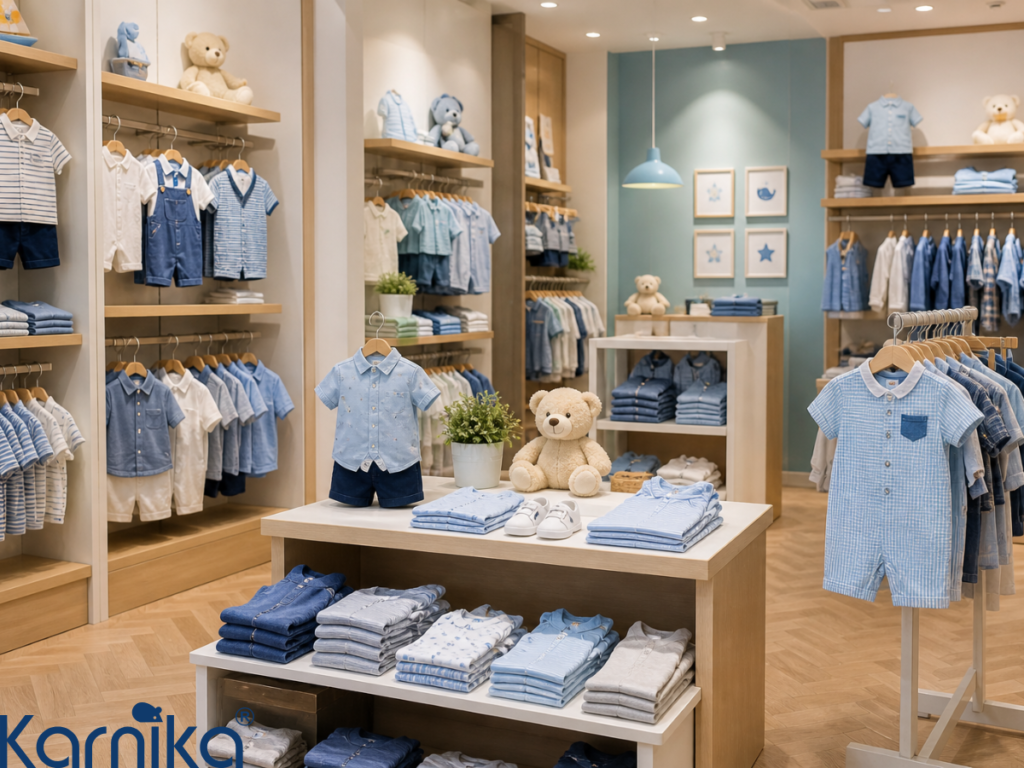
Baby Rompers Wholesale
Baby rompers have emerged as a breakout sub-category for baby clothing store buyers and e-commerce sellers. Baby dress wholesale complements this range well for operators serving multiple age groups. Demand from baby clothing stores has grown 28% year-over-year (2022–2024). Stick to solid colours and simple snap closures for the safest inventory profile.
Category Margin & MOQ Reference Table
| Category | Min. MOQ | Wholesale Cost | MRP Range | Gross Margin | Risk Level |
| Basic T-Shirts | 100 pcs | ₹80–₹150 | ₹180–₹350 | 45–55% | Low |
| Casual/Check Shirts | 50 pcs | ₹150–₹280 | ₹350–₹650 | 42–50% | Low |
| Cotton Shorts | 100 pcs | ₹90–₹160 | ₹200–₹380 | 45–58% | Low |
| Track Pants | 100 pcs | ₹130–₹220 | ₹300–₹500 | 40–50% | Low |
| Co-ord Sets | 50 pcs | ₹220–₹420 | ₹550–₹950 | 45–60% | Medium |
| School Uniform Sets | 200 pcs | ₹180–₹320 | ₹400–₹700 | 38–48% | Very Low |
| Baby Rompers Wholesale | 100 pcs | ₹110–₹200 | ₹250–₹480 | 42–55% | Low |
| Graphic Tees (Trending) | 100 pcs | ₹100–₹180 | ₹220–₹400 | 40–48% | HIGH |
Data-Backed Trends That Are Still Safe to Buy
These are not flash-in-the-pan trends. They represent structural market shifts that informed wholesale boys clothing buyers can build long-term strategy around.
| Trend | Evidence | Safe Style Implication |
| Comfort Wear Growth | Post-2020 casual/athleisure kidswear segment grew 31% (GlobalMarketStatistics 2023). | Stock more track pants, joggers, soft-waist shorts |
| Mid-Range Pricing Surge | ₹300–₹700 MRP segment grew fastest; premium segment contracted | Avoid ultra-cheap (quality risk) and ultra-premium (slow turnover) |
| Online Channel Demand | E-commerce kids’ wear up 44% (Market Reports 2025); basics photograph best | Solid colors outsell complex prints on marketplace listings |
| Urban vs. Semi-Urban Split | Semi-urban prefers value basics; metros lean co-ord sets and mild prints | Tailor your stock mix to your buyer’s geography |
| Sustainability Awareness | 38% of consumers now consider fabric sourcing (Ross 2024) | Cotton certification (BCI, GOTS) is becoming a sales advantage |
How to Maximize Profit in Bulk Orders
1.Choose the Right Price Segment
- The ₹300–₹700 MRP range (mid-range) consistently delivers the best inventory velocity and acceptable margins.
- Going too cheap increases returns and damages your reputation.
- Going too premium slows cash flow and narrows your buyer base.
2. Smart MOQ Strategies
- For new styles, negotiate half-MOQ trial runs before committing to full lots
- Use full-MOQ leverage for proven fast-movers to negotiate 8–12% price breaks
- Combine multiple styles in one shipment to hit supplier MOQ without over-ordering any single SKU
3. The 70-20-10 Mix Rule
- Industry veterans use this simple framework for every bulk order:
- 70% proven evergreen styles — your core revenue base
- 20% slightly trendy but safe — keeps your catalog fresh
- 10% experimental — test new styles without betting the business on them
Mini Profit Calculation — Basic T-Shirt Bulk Order
| Item | Amount (INR) |
| Order Quantity | 300 pcs |
| Wholesale Cost per Piece | ₹120 |
| Total COGS | ₹36,000 |
| Freight + Packing | ₹2,400 |
| Total Landed Cost | ₹38,400 |
| Selling Price (MRP) | ₹280 per pc |
| Total Revenue (100% sell-through) | ₹84,000 |
| Gross Profit | ₹45,600 (54.3% margin) |
| At 85% sell-through (realistic) | ₹33,000 net (~46% effective margin) |
Vendor Negotiation Tips
- Negotiate payment terms (45-day credit) before negotiating price — cash flow protection matters more
- Ask for fabric test reports upfront; prevents disputes and costly return processing later
- Build relationships with 2–3 reliable suppliers rather than always hunting for the cheapest source
- Request a sample lot (20–30 pcs) before confirming any new style order above 200 pieces
Common Mistakes That Kill Profit
| Mistake | Why It Hurts | How to Avoid It |
| Over-ordering trendy items | Trend fades; stuck with dead stock at 20–30% markdown | Cap trendy SKUs at 10% of total order volume |
| Ignoring fabric quality | Returns increase 3–5x; B2B reputation damaged permanently | Check GSM weight and fabric composition before every order |
| Poor size distribution | Large sizes sell out; small sizes pile up (or vice versa) | Use ratio: 5–6yr (25%), 7–8yr (30%), 9–10yr (25%), 11–12yr (20%) |
| Unreliable suppliers | Delayed delivery kills seasonal sell-through window | Verify at least 3 previous client references before first order |
| Skipping sample approval | Bulk production differs from sample; mass cancellations follow | Never skip pre-production sample sign-off on new styles |
Those who master in the industry, never order a new style in full quantity on the first run. They test 50–100 pieces, track sell-through in 3 weeks, and then reorder 3–4 times if it performs. This eliminates dead stocks and keeps cash flowing.
Bundle Selling Strategy
- If a basic T-shirt is paired with shorts as a set, it increases average order value by 30–40%.
- If wholesalers offer ‘school starter packs’ (3 white shirts + 2 navy bottoms) to institutional buyers, such strategies often give a permanent customer.
- It is best to bundle slow-moving prints with bestseller basics. One should never bundle two slow SKUs together.
Seasonal Stocking Hacks
- Stock up on cotton basics in February for the April–June summer peak. The demand usually spikes 40–60% if the strategy is followed.
- Place school uniform orders in March/April to capture June–July school re-opening demand.
- Baby rompers wholesale orders peak October–January. Wholesalers should order 6–8 weeks early from manufacturers.
- Testing new styles with a baby clothing store audience is easier than with older kids. Parents of younger kids are less brand-conscious and more quality-focused. New fabrics and cuts get validated faster there.
Pre-Order Checklist: Before You Place a Bulk Boys’ Wear Order
Use this checklist before confirming any wholesale boys clothing order. If even two items are incomplete, the problem should be resolved before buying.
- Demand verified: Sales data or market research confirms this style sells in your target geography
- Size ratio optimized: Size mix reflects actual customer demand, not equal quantities across sizes
- Fabric quality checked: Sample tested; GSM, composition, shrinkage, and colorfastness verified
- Margin calculated: Landed cost computed including freight, taxes, packaging; minimum 35% confirmed
- Supplier reliability confirmed: References checked; delivery window locked in writing
- MOQ matches your sell-through horizon: You can realistically sell 80%+ within 90 days
- Sample approved: Pre-production sample reviewed and signed off before production begins
- Payment terms agreed: Credit terms or escrow arrangement in place to protect cash position
Read Me: Children’s Clothing Wholesalers: Girls’ Dress Design Guide
Conclusion
Every experienced wholesale buyer would conclude the same thing; profitable buying is usually boring. It is the inventory that moves reliably, in every season, across every buyer type. When the retailers and wholesalers buy wisely, there is a lot of profit in wholesale boys clothing.
Basics, school wear, and baby rompers wholesale are not fallback categories. They are the foundation of a sustainable wholesale business.
Contact Karnika Industries to know more.
FAQ’s
Q1. What is the minimum order quantity for wholesale boys clothing from Karnika Industries?
MOQ varies by category. Basic T-shirts and cotton shorts typically start at 100 pieces per style per colour. Co-Ord sets and school wear often start at 50–200 pieces. Baby rompers wholesale accepts 100-piece minimums. Established buyers can negotiate 50-piece trial runs for new styles. Contact Karnika Industries directly for current MOQ schedules.
Q2. Which colours sell best in kids wear and wholesale boys clothing?
Navy blue, white, grey, and black consistently top sell-through charts across retail and e-commerce channels. For younger boys (2–6 years), bright primaries (red, royal blue, yellow) also perform well. Earthy tones (olive, rust, beige) are growing in the urban mid-range segment. Avoid neon colours in core bulk quantities — reserve those for test lots only.
Q3. How do I start a baby clothing store with a smart wholesale strategy?
Start with a focused assortment: baby rompers wholesale (0–24 months), basic onesies, and soft cotton sets. Keep your initial SKU count low (8–12 styles) to manage inventory risk. Source from 2 reliable suppliers and build reorder relationships before expanding. Baby dress wholesale is a strong add-on once you have validated your core romper and bodysuit range.
Q4. What is the recommended size ratio for a boys’ clothing bulk order?
For a 300-piece bulk order covering ages 4–12, a proven distribution is: Size 4–5 yr: 15%, Size 6–7 yr: 25%, Size 8–9 yr: 30%, Size 10–11 yr: 20%, Size 12–13 yr: 10%. For baby rompers, weight toward the 6–12M and 12–18M bands. Always adjust based on your specific customer base data.
Q5. Are co-ord sets safe to buy in bulk for boys’ wear?
Yes — co-ord sets have moved from trend to mainstream in the 4–12 year segment. They simplify buying decisions for parents, photograph well for e-commerce, and command a higher per-piece price. Stick to neutral or earth-tone combinations and standard cotton fabric. Simple matching sets consistently outperform over-styled versions in bulk sell-through.
Q6. How can I verify a wholesale boys clothing supplier’s reliability?
Request at least three verified buyer references and contact them directly. Ask specifically about delivery adherence, quality consistency across orders, and how disputes were handled. For orders exceeding ₹5 lakh, a factory visit is advisable. For first transactions, use escrow payment options rather than full advance payment. Karnika Industries provides references and facility visits on request.
Q7. What is the difference between kids wear dresses and school-specific uniforms in bulk buying?
Kids wear dresses boys cover the full casual and semi-formal clothing spectrum for ages 2–14, including T-shirts, shirts, shorts, track pants, and co-Ord sets. School-specific uniforms are a sub-segment with defined colours (typically white and navy) and standardized cuts. School wear buyers are institutional (schools, uniform suppliers) with large, predictable orders. Both categories are safe for bulk buying; the key difference is your buyer type and order cycle.