
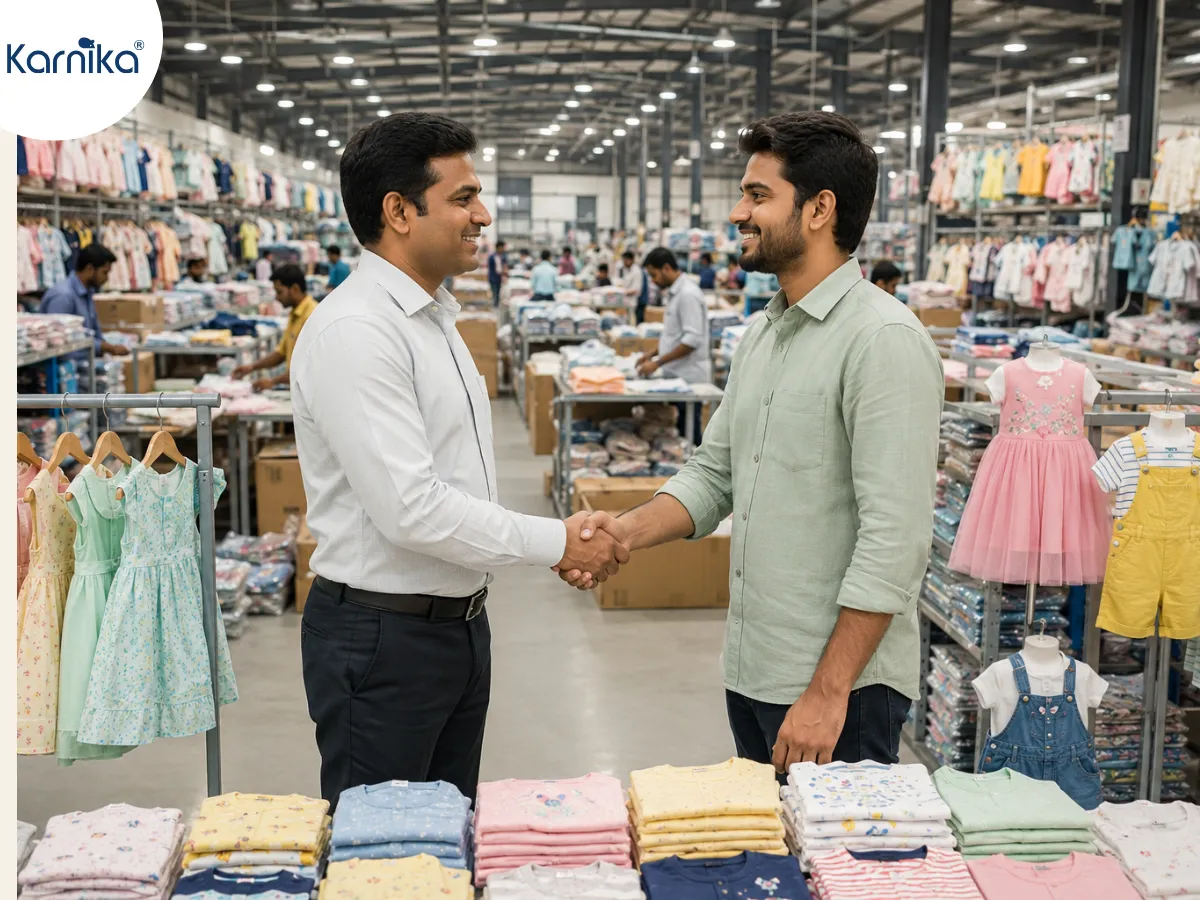
Wholesale clothing suppliers for retailers shapes the image of the retailers. The suppliers are the ones who send the products to the retailers. So, the quality of the products, the delivery time, the quantity, and the size, are all dependent on the suppliers. However, retailers often face the question: Should they stay with the old suppliers or should they go for a new one?This question might sound simple but before taking the decision, the retailers have to keep a lot of factors in mind.
At Karnika Industries, a Kolkata-based kidswear manufacturer with over two decades of production and export experience, we have worked with retailers across India and internationally. As we understand what makes and breaks supplier-retailer relationships, this guide will help you to get answers to your questions.
Why Supplier Relationships Matter in Retail
The supplier- retailer relationship is most crucial as the suppliers are those who have to deliver you on time. If wholesale clothing suppliers for retailers fail to deliver, then your shelves will not get stocked, your customers might return, your reputation can be at stake. Not only this, even the quality of products depend on the supplier. After approving the golden sample, if all the batches are not the same, there is a possibility of many stocks remaining unsold. Thus , the supplier is very crucial for the retailer and retailers have to choose their suppliers after proper research.
For kidswear retailers in particular, wholesale kids clothing suppliers have to be reliable as children’s clothing has to be perfect. Parents usually buy kids products based on trust. If a parent starts trusting a retailer, they will keep buying from the same shop. But once the trust is broken, the retailer can lose the customer forever.
What Is a Long-Term Supplier Relationship?
A long-term supplier relationship develops over repeated orders, consistent communication, and mutual understanding of business expectations.With time the suppliers understand your and your customers needs as well. They understand how much quantity might be required during which season, what type of packaging you prefer, and what is your quality threshold. This knowledge makes the communication easy and the end-product perfect.
Read Me: The Real Impact of Kids’ Clothing Packaging on Retail Sales
Advantages of Working With a Long-Term Wholesale Clothing Supplier
Retailers who maintain strong long-term supplier relationships benefit from a range of operational and commercial advantages.
| Advantage | Description | Benefit for Retailers |
| Consistent Product Quality | Long-term suppliers understand your quality standards, materials, and production requirements through repeated collaborations. | Reduces quality issues, minimizes returns, and maintains customer satisfaction. |
| Faster Order Processing | Suppliers retain design specifications, size charts, fabric preferences, and packaging details for repeat orders. | Shortens lead times and enables quicker replenishment of inventory. |
| Reliable Delivery Performance | Familiarity with ordering patterns and production schedules improves delivery accuracy. | Supports better inventory planning and reduces stock shortages. |
| Priority Support During Peak Seasons | Established retail partners often receive production priority during busy periods such as holidays or back-to-school seasons. | Ensures product availability and prevents lost sales opportunities. |
| Better Problem Resolution | Existing communication channels and mutual trust help resolve issues efficiently. | Minimizes disruptions, reduces delays, and strengthens business continuity. |
Challenges of Relying Solely on a Long-Term Supplier
Even though long-term supplier relationships have a lot of advantages, retailers who solely trust in the long-term relationship can face certain problems.
- There is a high chance of failing miserably if by any chance the long-term supplier ever fails in quality or faces operational issues.
- Often old suppliers do not explore new designs and new markets. As a result the retailer also stays behind and is unable to explore new options.
- When the supplier-retailer relationship extends for years, the supplier may increase the price as there is no price competition with the other.
Why Retailers Explore New Wholesale Clothing Suppliers for Retailers
If retailers will not explore new suppliers, they will not be able to expand the product categories. Often retailers want a change to bring down the price as many new suppliers give discounted prices. New suppliers also help to enter new market segments.
Advantages of Working With a New Supplier
A new supplier can introduce genuine value to your supply chain when evaluated and onboarded correctly.
| Advantage | Description | Benefit for Retailers |
| Access to Fresh Product Innovations | New suppliers often introduce updated designs, emerging fashion trends, and innovative fabrics that existing suppliers may not prioritize. | Helps retailers stay competitive, attract customers, and respond quickly to market trends. |
| Potential Cost Advantages | New suppliers may offer competitive pricing, introductory discounts, or flexible terms to establish a business relationship. | Reduces sourcing costs and can improve profit margins. |
| Supply Chain Diversification | Partnering with additional suppliers decreases dependence on a single source and spreads supply risk. | Improves business continuity and reduces the impact of supply chain disruptions. |
Risks Associated With New Suppliers
Introducing a new wholesale clothing supplier carries risks that retailers must manage carefully.
- Unproven product quality until initial orders are assessed
- Delivery timelines are uncertain until production history is established
- Communication processes take time to develop and streamline
- Sample-to-bulk consistency is not guaranteed until the supplier demonstrates reliable production control
- Inventory planning is more difficult without historical order data
- Quality standards may vary between sample batches and full production runs

Long-Term Supplier vs New Supplier: Side-by-Side Comparison
The table below summarises the key differences retailers should consider when evaluating their supplier strategy.
| Factor | Long-Term Supplier | New Supplier |
| Quality Consistency | High — track record established | Unknown initially; requires validation |
| Delivery Reliability | Proven and predictable | Needs careful assessment |
| Pricing | Stable; occasional loyalty benefits | Potentially competitive |
| Product Innovation | Moderate; familiar range | Often higher; fresh designs |
| Communication | Established and efficient | Still developing |
| Risk Level | Lower overall | Higher until relationship matures |
| Flexibility | Moderate | Can be high |
| Inventory Support | Strong; aligned to your cycles | Limited initially |
When Retailers Should Stay With an Existing Supplier
Wholesale clothing suppliers for retailers relationships depend on trust. Maintaining a long-term relationship makes clear commercial sense when:
- The same supplier has always maintained the quality in multiple order cycles.
- When there are old suppliers, the delivery reliability is high,
- Customer feedback is always positive on the product
- The supplier resolves issues quickly and easily.
When Retailers Should Consider a New Wholesale Clothing Supplier
The retailers should change the sourcing options when:
- The old supplier is unable to supply proper quality.
- There are frequent delivery delays that affect stock availability and customer satisfaction
- There is no product innovation or want to create a new design.
- There is poor communication or slow response.
How Retailers Can Evaluate a New Wholesale Clothing Supplier Safely
Evaluating a new supplier does not have to be high risk if retailers follow a structured onboarding process.
| Evaluation Step | Description | Benefit for Retailers |
| Start With Sample Orders | Request pre-production samples to assess fabric quality, stitching, sizing accuracy, print quality, and packaging standards before placing bulk orders. | Reduces the risk of quality issues and ensures products meet brand expectations. |
| Conduct Product Testing | Verify compliance with relevant quality and safety standards, particularly for kidswear and other regulated products. | Protects customers, maintains compliance, and reduces liability risks. |
| Verify Manufacturing Capabilities | Evaluate the supplier’s production capacity, machinery, quality control procedures, and workforce capabilities. | Ensures the supplier can meet order volumes and delivery requirements during peak periods. |
| Place Small Trial Orders Before Scaling | Begin with limited orders to assess delivery performance, packaging consistency, and overall service quality. | Minimizes financial risk and allows retailers to evaluate reliability before larger commitments. |
| Assess Communication Responsiveness | Monitor how quickly and effectively the supplier responds during the enquiry and sampling stages. | Helps predict future communication quality and supports smoother order management. |
Why Many Successful Retailers Work With Multiple Wholesale Clothing Suppliers
Many of the most commercially successful retailers do not rely on a single wholesale clothing supplier. Instead, they maintain a core long-term partner for their primary range while periodically testing new suppliers for specific categories. These can be seasonal collections, or product innovations.
This approach offers retailers:
- Reduced vulnerability to single-source supply disruptions
- Access to a broader product range and wider design options
- Greater flexibility to respond to seasonal demand fluctuations
- A competitive dynamic that encourages suppliers to maintain performance standards
- Improved business continuity planning across the supply chain
What Retailers Should Look for in a Kidswear Manufacturing Partner
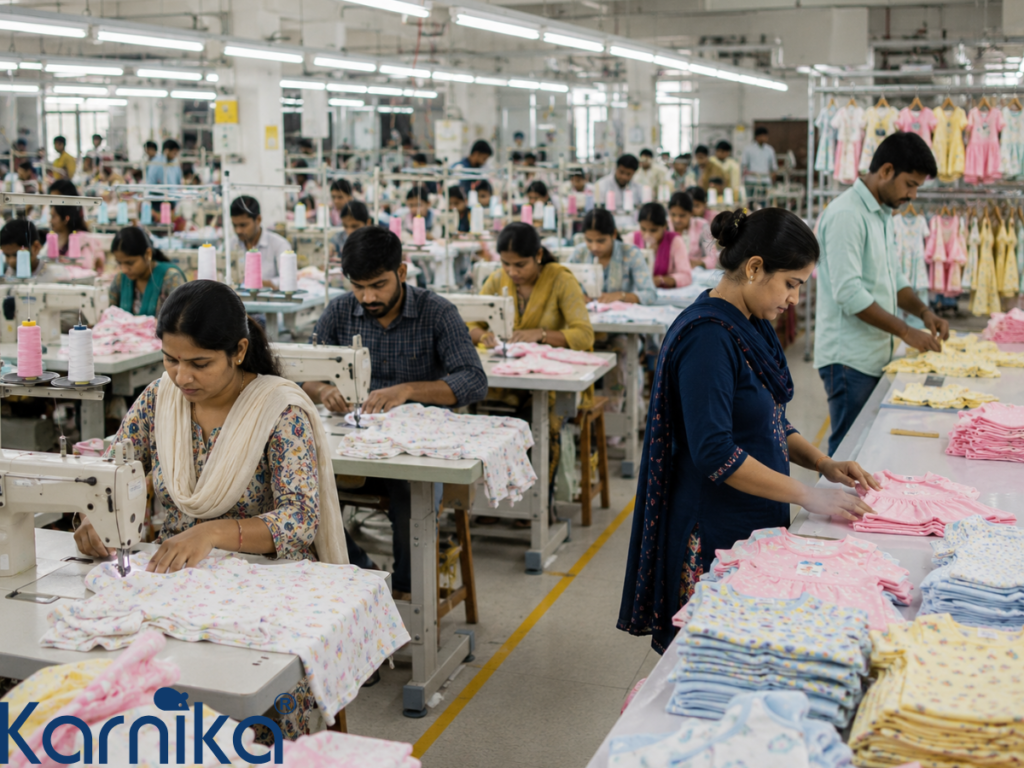
For retailers sourcing children’s clothing, the right manufacturing partner combines the reliability of an established relationship with the responsiveness and innovation expected from a modern kidswear supplier. At Karnika Industries, we supply retailers with a broad portfolio spanning infant wear, toddler clothing, ethnic wear, nightwear, and seasonal collections. All are produced under consistent quality control standards at our Kolkata manufacturing facility.
When evaluating a kidswear wholesale clothing supplier, retailers should look for:
- Consistent product quality across fabric, stitching, sizing, and finishing
- A broad product portfolio that can serve multiple age groups and clothing categories
- Reliable delivery performance with clear production and dispatch timelines
- Scalable production capacity to support order growth
- Strong quality control systems, including pre-dispatch inspection processes
- Long-term business support and willingness to develop products in line with your retail requirements
Karnika Industries has supplied kidswear to retailers across domestic and international markets, building long-term partnerships grounded in product quality, transparent communication, and reliable fulfilment. Our production facility in Kolkata enables us to offer flexible MOQs, seasonal collection development, and consistent turnaround times suited to retail planning cycles.
How Retailers Can Build a Balanced Supplier Strategy
Rather than choosing exclusively between a long-term supplier and a new one, the most effective retail sourcing strategies combine both approaches thoughtfully.
- Maintain a core long-term supplier for your primary product range and high-volume SKUs
- Periodically evaluate new suppliers for specific categories, seasonal products, or niche requirements
- Compare supplier performance using consistent metrics: quality pass rates, on-time delivery, communication responsiveness, and pricing
- Diversify your supplier base without creating unnecessary operational complexity
- Focus on total supplier value , quality, reliability, communication, and long-term support, rather than making decisions based solely on price
Conclusion
Choosing between a long-term wholesale clothing supplier and a new supplier is not a binary decision. Both have a role to play in a well-structured retail sourcing strategy. Long-term supplier relationship management is successful when there is consistency, operational efficiency, and trust built over time. New suppliers can introduce innovation, competitive dynamics, and supply chain resilience.
So, a successful retailer always maintains a balance. They stay on good terms with a long-term supplier, but also experience new suppliers for a limited range.
Karnika industry can guarantee you a long-term strong relationship with its quality products and on-time delivery. To know more, contact us.
Frequently Asked Questions (FAQs)
1. Is it better to work with a long-term supplier or a new supplier?
The most effective approach for most retailers is to maintain a reliable long-term supplier for your core range whilst periodically evaluating new suppliers for specific product categories or innovation. Both serve different strategic purposes.Chosing wholesale clothing suppliers for retailers is a crucial task. Thus, there should be a balance.
2. What are the main advantages of a long-term supplier relationship?
Long-term suppliers offer consistent product quality, faster order processing, reliable delivery timelines, priority support during peak seasons, and established communication processes. These advantages compound over time as the relationship matures.
3. What risks come with using a new wholesale clothing supplier?
Key risks include unproven product quality, uncertain delivery timelines, undeveloped communication processes, and potential inconsistencies between sample and bulk production. Mitigating these risks requires a structured onboarding process, beginning with sample orders and small trial batches.
4. How can retailers evaluate a new garment supplier safely?
Request pre-production samples, conduct product testing against your quality standards, verify manufacturing capacity, assess communication responsiveness, and place a small trial order before scaling volume commitments.
5. Should retailers work with multiple suppliers?
Yes, for most retailers, working with more than one supplier reduces supply chain risk, improves product variety, and creates healthy competition that encourages all suppliers to maintain strong performance standards.
6. What makes a reliable kidswear wholesale clothing supplier?
A reliable kidswear supplier offers consistent product quality across fabric and stitching, a broad product range, predictable delivery timelines, scalable capacity, strong quality control processes, and long-term commercial support tailored to retail requirements.