
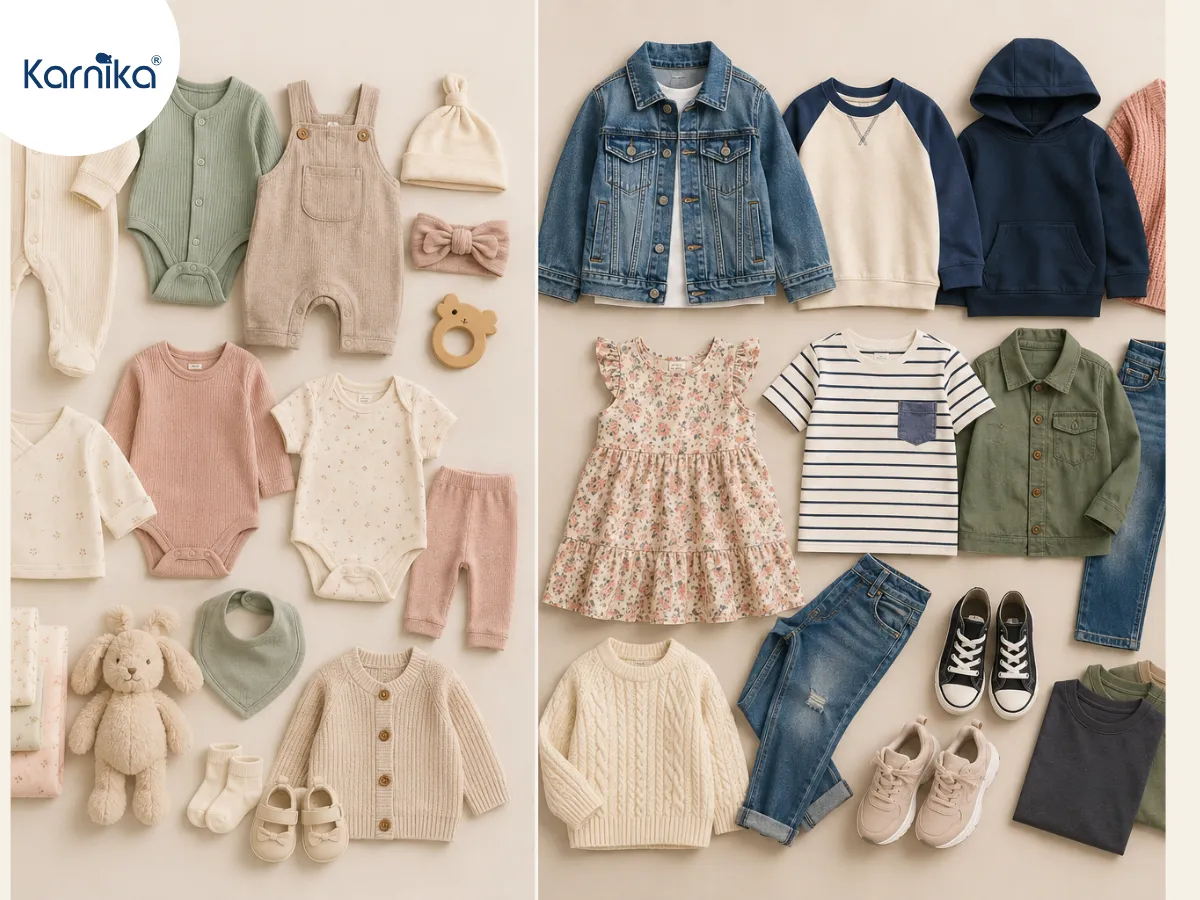
Baby apparel is in demand all the time. It does not matter if it is winter or summer, hilly region or tropical region, babies are born all the time . The baby birth does not see any economic condition and this is why baby apparels are essential items that retailers and wholesalers must stock. However, does this make it a better business choice than kidswear? That is the question every smart retailer, wholesale buyer, and e-commerce seller must ask before investing their capital. Karnika Industries provides a guide breaking down the real numbers, risks, and opportunities in both categories.
What Does Business Stability Actually Mean in Garment Retail?
Demand and stability are not the same. Smart sellers do not chase demand, they chase stability. A product can have high demand one season and crash the next. This can make your inventory a liability overnight. There are so many instances where one product is in demand in one season and has no demand in the other. So this can result in huge losses.
Stability can be measured across five parameters:
| Stability Parameter | Babywear Score | Kidswear Score |
| Consistent Year-Round Demand | 9/10 | 7/10 |
| Low Return Rate | 6/10 | 7/10 |
| Low Trend Dependency | 9/10 | 5/10 |
| Predictable Inventory Turnover | 8/10 | 6/10 |
| Reliable Margins | 7/10 | 6/10 |
| OVERALL STABILITY SCORE | 39/50 | 31/50 |
Baby Apparel: The High-Trust, Essentials-Driven Category
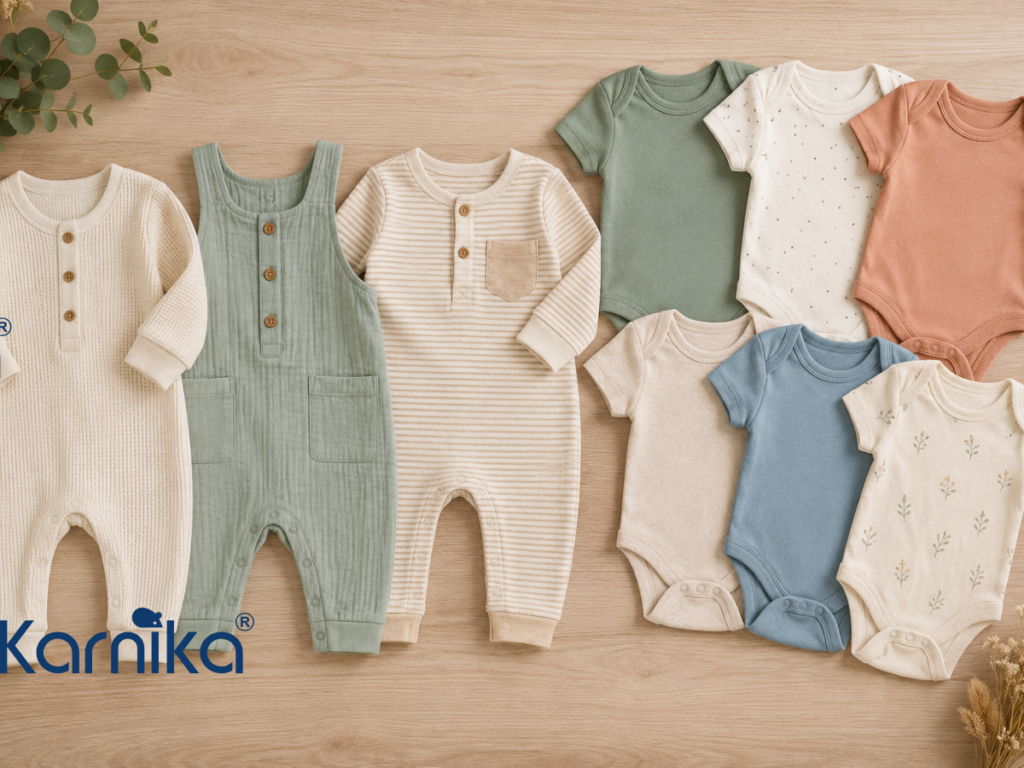
Baby apparel has a constant demand. As babies are born any time, it falls under the essential category.
Strengths of the Baby Apparel Category
- Baby kidswear is in demand all the time. Rompers, onesies, sleep suits, new born clothes and any dress for the age range 0-12 months should be in stock.
- When the due date is near, parents will buy the clothes. For a ten year old, parents can wait for a Diwali or Durga Puja to shop, but for baby apparel, one must shop as the baby arrives. Thus, people dealing with baby dress wholesale should remember that the demand is constant.
- Babies outgrow clothes rapidly .So between 0–12 months window the parents will have to buy multiple times. This creates natural repeat purchase loops for loyal customers. That means if a baby dress wholesaler sells a good quality brand, the customers will return to buy clothes again.
- Baby apparel need not be fashionable, it has to be soft and cute. Thus soft colours and cute prints often get good demand.
- Parents purchasing for newborns are willing to pay a premium price for quality, safety, and softness. In kidswear parents often check the budget before shopping.
Challenges of the Baby Apparel Category
- Parents want the fabric to be the best. It cannot develop allergy or rashes, it should be comfortable and should not irritate the baby. A single quality failure can permanently damage brand trust.No parent compromises when it comes to baby products.
- The 0–12 month range is a limited SKU spread. It is a very small selling window. So, newborn baby clothes wholesalers and baby dress sellers must move stock quickly. Otherwise they can go wrong in stocking up.
- Parents return items decisively when comfort or safety is in question. So, if the quality is bad, there will be returns. Parents of this group do not compromise with quality.
- Safety labels, fabric certifications, and age-appropriate labelling can create difficulties in operations. These are minute factors that have to be maintained. If there is any failure, the wholesalers will not be able to release stocks.
Read Me: Why newborn baby rompers are an evergreen bulk order product
Kidswear: The Volume-Driven, Style-Sensitive Category
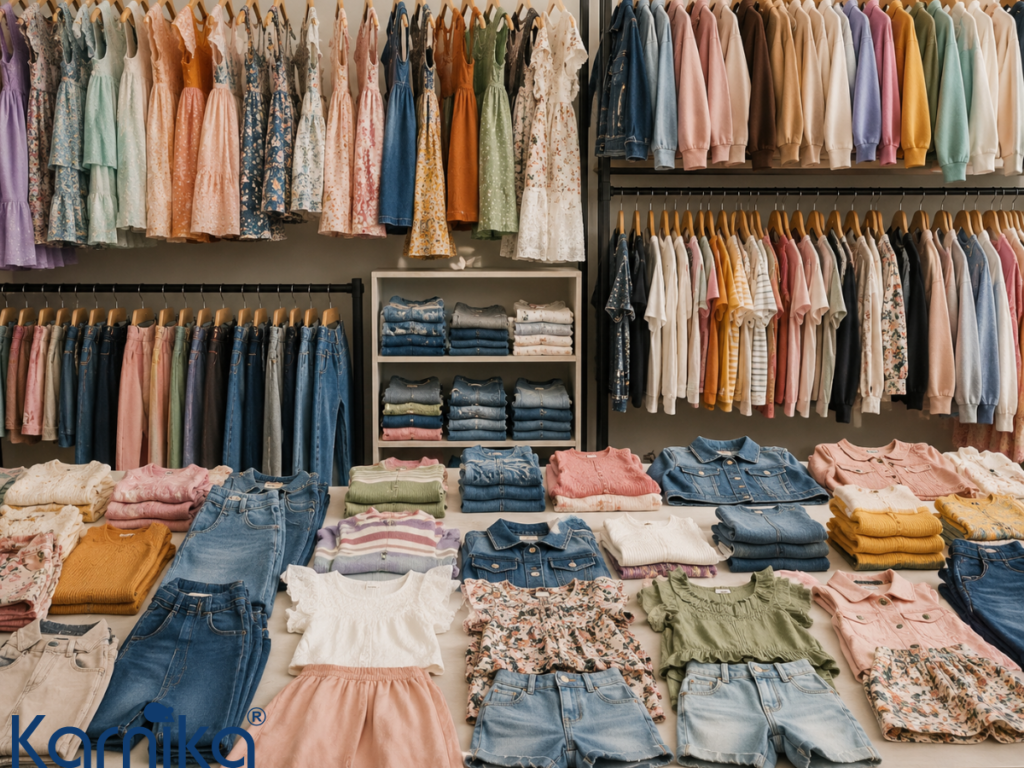
Kidswear is a huge range from 1 to 12 years old. So in this range the demand is different and varied.
Strengths of the Kidswear Category
- The range is wide that extends from toddlers dungarees to teen co-ords. So in kidswear the SKU is broad, giving sellers more upsell and cross-sell opportunities.
- There are more sizes, more styles and more selling opportunities per customer visit
- There are seasonal spikes. So the sellers can stock up as per the demand.
- The more the products get listed, there is more organic visibility on platforms like Amazon, Meesho, and Flipkart.
Challenges of the Kidswear Category
- Kids follow trends and the trends can change rapidly. So if a seller stocks up too much, there can be losses.
- Because of seasonal fluctuations revenue can spike and drop dramatically across quarters. This makes cash flow planning difficult.
- There is a huge competition in the kidswear market. This results in saturation.
Head-to-Head Comparison: Baby Apparel vs Kidswear
The table below provides a direct, factor-by-factor comparison — with a clear winner for each parameter.
| Stability Factor | Babywear | Kidswear | Winner |
| Demand Stability | Very High | Medium-High | Babywear |
| Trend Dependency | Low | High | Babywear |
| Return Risk | Medium-High | Medium | Kidswear |
| Profit Margins | Moderate & Steady | Variable (Higher Ceiling) | Tie |
| Inventory Risk | Low (Essentials) | Higher (Trend-driven) | Babywear |
| Customer Loyalty | Strong | Moderate | Babywear |
| Catalog Width | Narrow (0–24 mo.) | Wide (1–12 yrs) | Kidswear |
| Scaling Potential | Moderate | High | Kidswear |
Which Category Performs Better in Real Market Conditions?
For small retail shop owners and independent local boutiques, starting with baby apparel would be the best option because of guaranteed demand. A wholesale provider like Karnika Industries will be able to provide consistent quality baby clothing for baby dress wholesalers to help create and grow positive word-of-mouth throughout their business locality.
When selling kidswear on e-commerce sites, kidswear is much more popular, resulting in having more SEOs (stock keeping units) and therefore increasing the potential for having your product found via algorithms on marketplace websites.
If you are a wholesale trader or B2B distributor, it would be advisable to stock both categories of product in order to address a larger variety of demand. To assist their wholesale clients with meeting demand across both categories, Karnika Industries regularly supports wholesale clients with mixed MOQs (minimum order quantities) by providing their customers with a variety of kidswear and baby wear merchandise.
Read Me: Low MOQ Clothing Manufacturer: Hidden Risks & Insights
Profit vs. Stability: The Real Trade-Off Every Seller Faces
Risk-reward equation can be broken down
- Baby apparel has a stable income. It gives moderate margins. It has lower growth ceiling. It is ideal for building a long-term, sustainable business and the cash flow is also predictable.
- Kidswear can give higher income. It has variable margins and higher risk exposure. It is ideal for sellers who can take inventory risk and respond quickly to market trends.
Hidden Risks Most Sellers Ignore
There are some problems that sellers often tend to ignore.
Hidden Risks in Baby Apparel
- If baby apparels do not have a certification, there can be legal problems.
- If there is a single defective piece in the batch and it is sold to the customers, then the brand reputation can take a toll.
- Baby apparel sellers become dependent on one bestselling product . Now single SKU usually gives pressure on price.
Hidden Risks in Kidswear
- Kids have varied trends which keep on changing. Thus, if kids dress wholesalers buy stocks without proper trend calculation, the whole stock can stay unmoved.
- Without confirmed demand overstocking season items can result in heavy losses.
- If kids dress wholesale use animal prints without permission, there can be legal action against them.
Karnika Industries lowers these risks through certified fabric sourcing, pre-season design consultations, and flexible MOQ structures for both baby apparel and kidswear buyers.
The Expert Strategy: The Hybrid Portfolio Model
Based on 20+ years of manufacturing experience and market observation across domestic and export markets, Karnika
Industries recommends the following portfolio model for maximum stability with growth potential:
| Category | Portfolio Mix | Business Benefit |
| Baby apparel (essentials) | 60–70% | Stable, year-round cash flow |
| Kids dress wholesale (trends) | 20–30% | Higher margins during seasons |
| Newborn baby clothes wholesale | 10–20% | Premium pricing, loyal customers |
Why this model works:
- Baby apparel essentials give a balanced cash flow.
- Limiting trend-driven kidswear to 20–30% of inventory results in low risk.
- Mixing fast-moving essentials with higher-margin seasonal pieces optimises warehouse turnover.
- Ordering both categories from a single, reliable manufacturer like Karnika Industries gives you better pricing, priority production slots, and streamlined logistics.
How to Choose the Right Category for Your Business
Use this decision framework based on your current situation:
- Start with baby apparel. Lower MOQs, faster inventory turnover, and predictable demand make it the safest entry point.
- Start with or add kidswear to your stock later. Invest in trend research and keep stock lean.
- Adopt the hybrid model from the first day. Secure a reliable baby apparel supplier and gradually add a kidswear catalogue.
- Baby apparel is your best investment. Safety-certified, premium baby garments have strong demand in UAE, the UK, and Southeast Asia. These are the categories where Karnika Industries has established export credentials.
Quick Decision Checklist Before Placing Your First Wholesale Order
- Budget level : How much can you invest without giving pressure to your working capital?
- Risk tolerance : Can you hold inventory for 60–90 days if demand slows?
- Target customers : New mothers? Gift buyers? School-age children’s parents? Which is your target customer?
- Storage capacity : Do you have space for seasonal overstock?
- Supplier reliability : Is your manufacturer consistent on quality, delivery timelines, and fabric standards?
- Sales channel : Offline retail, e-commerce marketplace, wholesale distribution, or export?
Conclusion
Comparing baby apparel to kidswear comes down to each retailer’s goals, level of risk, and where you want to fit within your local community.
- From an overall volume of sales, the baby retailer has the strongest base. Their sales are mostly driven by the same customers and grow as part of the soft trend.
- On the other hand, the largest volume sales potential in kidswear comes from a larger selection of items than would be available in baby apparel, hence there is higher upside potential in the future.
At Karnika Industries, we have spent over two decades helping retailers, wholesalers, and exporters build sustainable garment businesses across both categories. Contact us now for the best experience.
(FAQs)
1. Is baby apparel more profitable than kidswear?
Although kid’s wear can generate a higher profit at peak times of the year, there is an increased risk of liquidation and other factors affecting total margin. By offering both categories in the appropriate volume and product mix, you can leverage their positives while utilising each other’s weaknesses.
2. What is the best starting point for a new garment business , baby apparel or kidswear?
Newbie vendors are encouraged to begin with baby apparel since its lower starting minimum orders (i.e., a small amount of clothes) creates year-round industry demand and removes the complexities of emerging fashion trends. Karnika Industries has baby dress wholesale and newborn baby clothing wholesale options that match these criteria specifically for beginners.
3. How do I find a reliable baby apparel manufacturer in India?
Look for manufacturers that (a) have transparent fabric certification; (b) offer consistent quality in multiple production runs; (c) maintain a level of flexibility with respect to minimum quantity requirements for baby and children’s clothing (dress) and wholesale distributors; and (d) have a proven history within the exporting community. Karnika Industries meets all four of these qualifications; they have manufacturing facilities specifically designed for baby and children clothing.
4. What is the minimum order quantity for baby dress wholesale from Karnika Industries?
Karnika Industries offers competitive total activity minimum quantities (AQM) by segmenting them into different regions or categories for both large wholesale distributors and retailing vendors. If you would like additional information regarding AQM by region or category for each of the above categories including baby apparel, baby children’s clothing and wholesale children’s clothing (as well as newborn baby clothing) please contact us directly.
5. Which category, baby apparel or kidswear is better for e-commerce?
Selling children’s clothing via an electronic commerce platform offers many advantages. Typically, online shoppers are able to find more options for kidswear on e-commerce sites, particularly when utilizing current technology trends. In addition, e-commerce platforms succeed well in the area of gift/ subscription/ premium retail outlets. The hybrid catalogue has also been shown to perform much better than selling in one category, i.e. baby clothing on Amazon and Flipkart.