
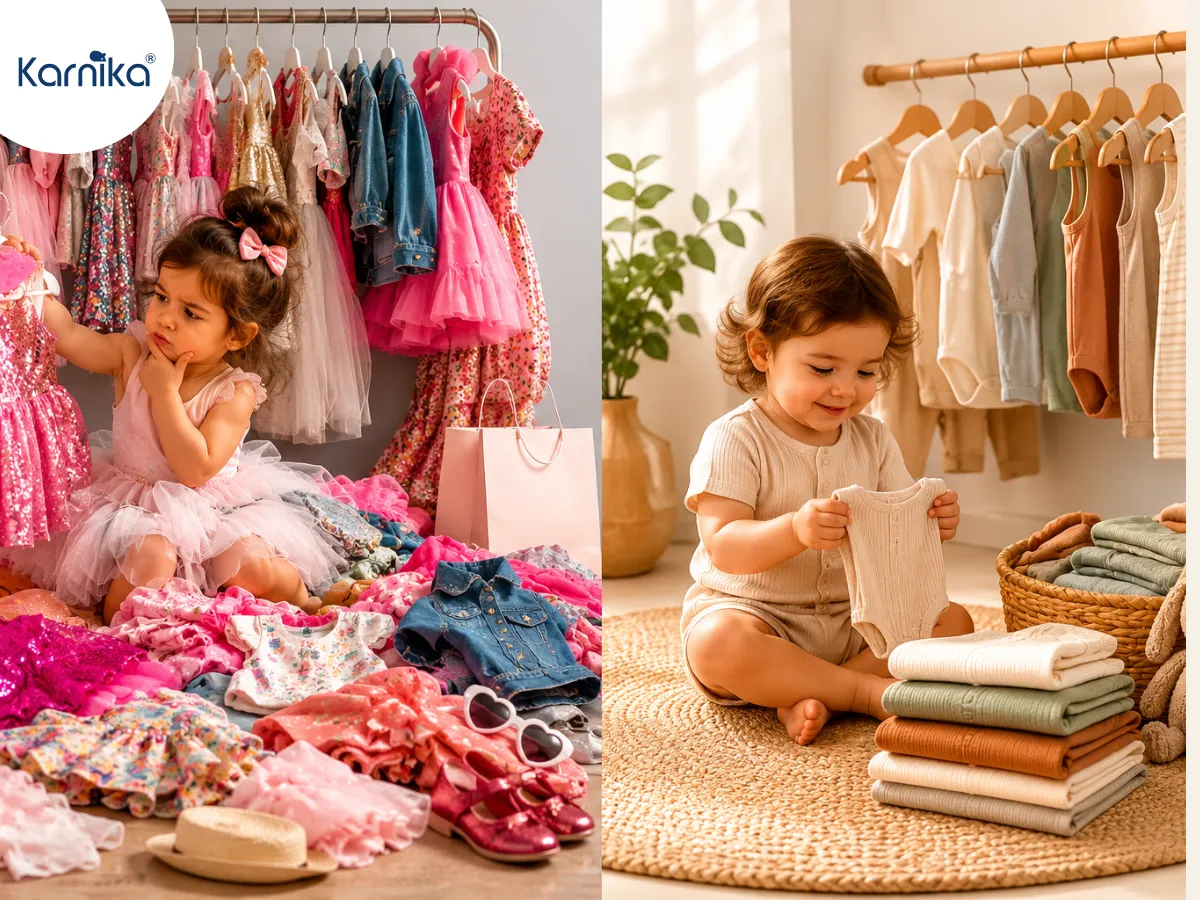
Fast fashion vs sustainable fashion is an important debatable topic that every kids wear retailer questions. Retailers and wholesalers dealing with kids clothing deals with kids ranging from 0 to 12 years. Thus at some age sustainable fashion becomes a necessity and for some children, fast fashion becomes a must-have. Thus it becomes important to get the balance just right.
Karnika Industries gives you the full picture of the risks, the rewards, and the winning hybrid strategy that India’s most profitable kidswear retailers are using right now.
The Illusion of Fast Fashion Profits
It is 2026 and it is the world of social media and kids too have access to it. So nowadays children are very conscious of the trendy clothes that trend on social media. As the appeal of fast fashion is undeniable, there is rapid turnover, high markup potential, trend-driven excitement. This is a sure shot formula to get high profits. However, fast fashion can only give high returns if the entire stock is out. For small retailers, if the stock is not out, there can be huge losses.
Disadvantages of fast fashion:
- Dead stock stays if the trends go quickly.
- Marginal gain before trends get viral.
- Usually procurement costs increase as there are frequent sourcing cycles.
- Viral trends usually do not stay for long. So the trend windows are sometimes very short.
Fast fashion vs slow fashion shows that fast fashion can give sudden profit but if not calculated properly, it can give losses as well.
Understanding the Two Models
It is important to understand both the models before making any decision.
Fast Fashion is Trend-Driven
- The trend of fast fashion keeps on changing based on social media trends.
- The lifecycle of these products are short (4–12 weeks).
- There is a high markup potential when trends hit.
- There can be high dead stocks.
- Requires constant supplier communication and sourcing agility
Sustainable or Repeat Fashion means Evergreen Selling
What is sustainable fashion? Sustainable fashion is those basic kids’ wear that are in demand throughout the year. In kidswear, this includes school uniforms, basic bodysuits, leggings, solid-colour tees, and everyday essentials. For new borns rompers and onesies are evergreen fashion that parents must buy.
Sustainable fashion has:
- Long product lifecycle (6–24 months)
- Predictable demand and steady cash flow
- Easier inventory planning and supplier relationships
- Aligns with growing consumer demand for ethical, quality apparel
- Supports what is sustainable fashion’s core promise: buy less, buy better
Read Me: Baby Apparel vs Kidswear: Which Has More Business Stability
What Retailers Actually Care About
Before comparing models, let us define what success actually looks like for a children’s apparel retailer:
| Success Metric | Why It Matters | Which Model Favours It |
| Inventory Turnover | How quickly stock converts to revenue | Fast Fashion (if trends hit) |
| Profit Margin | Net profit per unit sold | Both (context-dependent) |
| Dead Stock Risk | Unsold inventory destroying cash flow | Sustainable Fashion |
| Customer Retention | Repeat buyers = lower acquisition cost | Sustainable Fashion |
| Operational Complexity | Staff time, sourcing effort, logistics | Sustainable Fashion |
| Brand Excitement | Attracting new customers & social buzz | Fast Fashion |
| Cash Flow Stability | Predictable monthly revenue | Sustainable Fashion |
Fast Fashion vs Sustainable Fashion: Head-to-Head
| Factor | Fast Fashion | Sustainable Fashion | Winner |
| Demand Pattern | Unpredictable spikes | Consistent & steady | Sustainable |
| Inventory Risk | High dead-stock risk | Low replenishable | Sustainable |
| Profit Margins | High if sold at peak | Moderate but reliable | Tie |
| Trend Dependency | Very high | Low | Sustainable |
| Customer Loyalty | Low impulse buyers | High repeat buyers | Sustainable |
| Brand Excitement | High during trend cycles | Moderate | Fast Fashion |
| Operational Effort | High (constant refresh) | Moderate | Sustainable |
| Cash Flow Stability | Unpredictable | Highly predictable | Sustainable |
| Environmental Impact | High waste, poor ethics | Low waste, ethical | Sustainable |
| New Customer Appeal | Strong for trend-seekers | Steady, trust-driven | Fast Fashion |
Table: Fast fashion vs sustainable fashion comparison across key retail metrics.
Fast Fashion: High Risk, High Reward
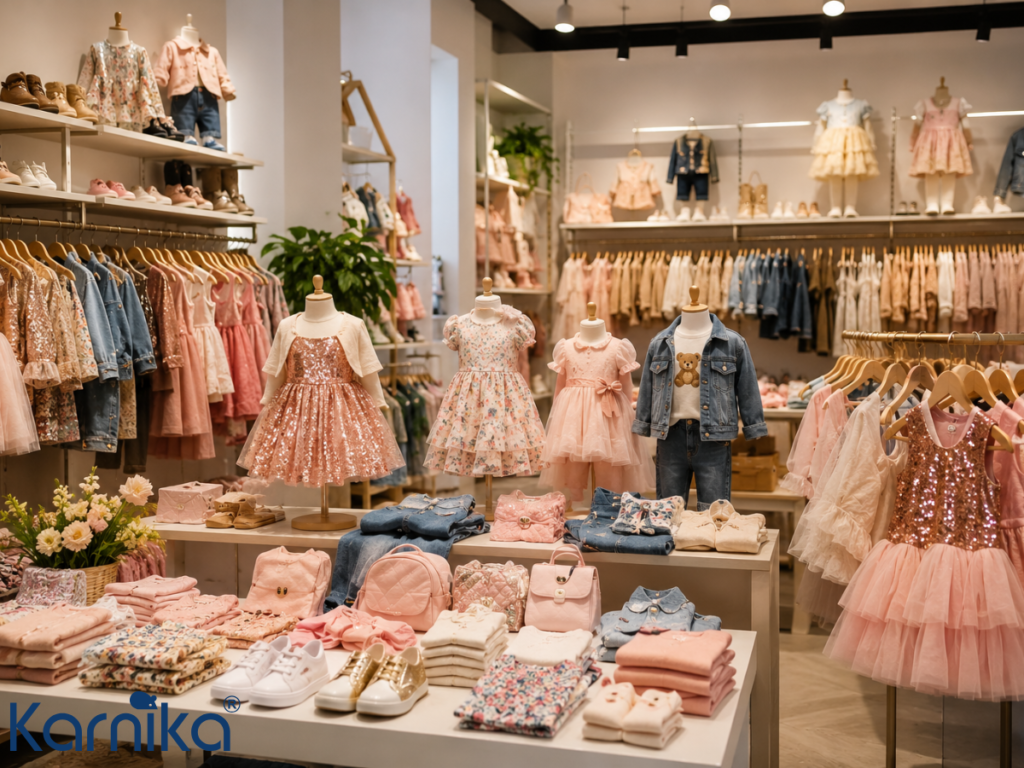
Everything has both positive and negative sides.
Advantages of Fast Fashion
- Quick sales velocity during trend peaks
- Higher markup potential (30–60% above cost)
- Attracts trend-conscious, social-media-influenced shoppers
- Creates buzz and word-of-mouth during peak cycles
Challenges of Fast Fashion
- Unsold inventory can erode 3–6 months of profit
- Requires constant design refresh. This becomes expensive and time-consuming
- Demand forecasting is notoriously inaccurate
- In kidswear especially, trends move faster than sourcing cycles
Karnika Industries Insight: As a kids wear manufacturer, we see fast-fashion trend items work best in limited-quantity drops, not deep inventory buys. Order small, sell fast, move on.
Sustainable or Repeat Fashion: The Stability Engine
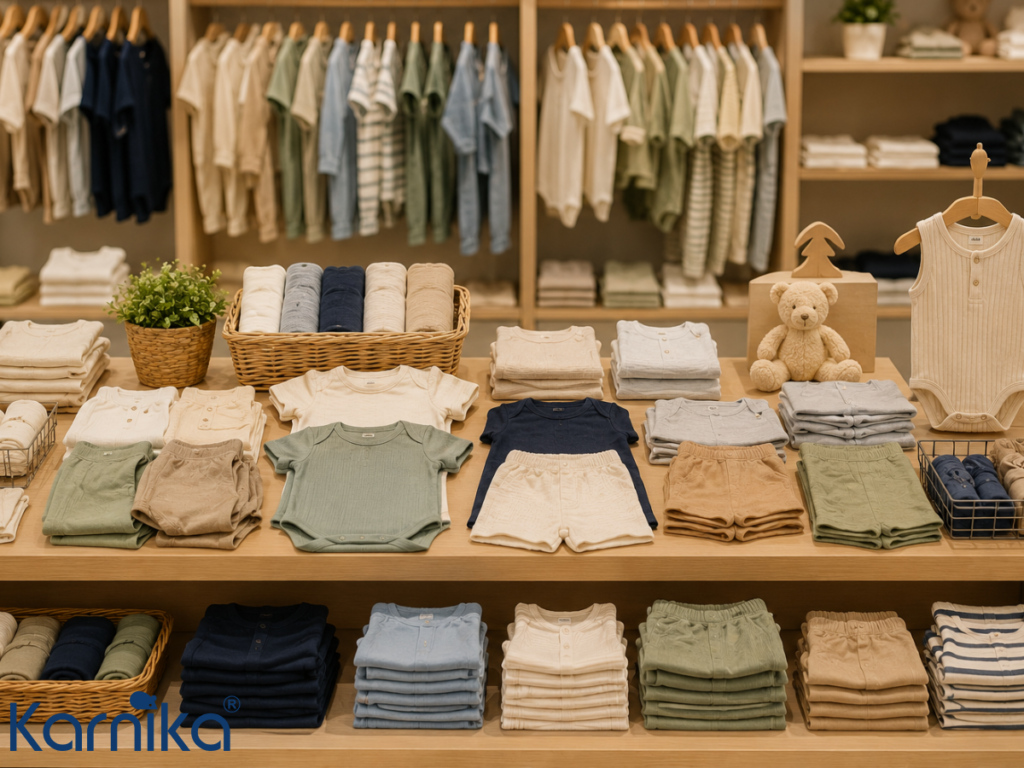
Sustainable fashion is in demand all year round. But they have their disadvantages as well.
Advantages
- Predictable weekly and monthly sales
- Easier inventory management and reorder planning
- Builds genuine customer loyalty. The parents return for quality basics
- Aligns with the global shift in what is sustainable fashion . It means ethics, quality and durability.
- This type of fashion usually gains popularity from word of mouth.
Challenges
- Lower excitement factor as it is harder to create viral moments
- Slower brand growth if used as your only strategy
- May feel less differentiated in a crowded market
Profit Reality: Which One Actually Makes More Money?
Let us look at a realistic example from the kidswear wholesale clothing market:
| Item Type | Buy Price (per unit) | Sell Price | Margin % | Units Sold (of 100) | Revenue | Dead Stock Loss | Net Profit |
| Trend Kidswear Set | Rs. 280 | Rs. 650 | 57% | 65 units | Rs. 42,250 | Rs. 9,800 (35 units) | Rs. 32,450 |
| Basic Kids T-Shirt (Replenishable) | Rs. 120 | Rs. 250 | 52% | 96 units | Rs. 24,000 | Rs. 480 (4 units) | Rs. 23,520 |
| Sustainable Organic Tee | Rs. 180 | Rs. 380 | 53% | 92 units | Rs. 34,960 | Rs. 1,440 (8 units) | Rs. 33,520 |
The table is based on Karnika Industries supplier data across 200+ retail accounts, FY 2024–25.
Key takeaway: The trend item generated slightly less net profit than the sustainable organic tee. This resulted in more risk. When dead stock losses are factored in, sustainable fashion’s lower gross margin is largely offset by dramatically better sell-through rates.
Hidden Costs Retailers Often Ignore
Hidden costs are where fast fashion vs sustainable fashion decisions go wrong for most retailers. Retailers should always calculate the hidden costs before making any purchase.
In Fast Fashion:
- Dead stock disposal costs (discounting, bundling, donation write-offs)
- Frequent sourcing trips and sampling costs
- Marketing spend to build urgency around trend windows
- Staff training time for new collections every 4–8 weeks
- Storage costs for slow-moving inventory
In Repeat / Sustainable Fashion:
- Missed trend opportunities (manageable with a hybrid approach)
- Slower initial brand excitement and customer acquisition
- Higher per-unit sourcing cost for quality/organic materials
The hidden costs of fast fashion are rarely visible until Q4 stocktakes. Build a simple dead-stock tracking system from Day 1. It will change how you buy.
The Smart Hybrid Model (Best Approach for Most Retailers)
The answer to fast fashion vs sustainable fashion is not a binary choice. It is a strategic blend. Based on our experience supplying kidswear wholesale clothing to retailers across markets, the optimal mix is:
| Stock Category | % of Total Inventory | Examples | Reorder Frequency |
| Sustainable / Repeat Basics | 60–70% | School uniforms, tees, leggings, bodysuits | Monthly / Bi-monthly |
| Seasonal Trend Pieces | 20–30% | Festive wear, character prints, seasonal colours | Per season (4x/year) |
| Viral / Fast Fashion Drops | 10–15% | Social-media-inspired limited sets | On-demand, small lots |
Why This Hybrid Works:
- Basics ensure consistent cash flow and cover operational costs
- Seasonal pieces create sales peaks without overexposure
- Limited fast-fashion drops generate excitement with controlled risk
- Mirrors the fast fashion vs slow fashion balance that global retail leaders use
Karnika Industries suggests to start with 70% repeat/sustainable and 30% trend. Adjust ratio quarterly based on your sell-through data. Never let trend inventory exceed 40% of total stock.
Which Model Works for Which Retailer?
| Retailer Type | Recommended Mix | Why | Ideal Supplier Type |
| Small Independent Shops | 70% Sustainable / 30% Fast | Low risk tolerance, limited storage | Flexible MOQ kids wear manufacturer |
| Boutique Kids Stores | 50% Sustainable / 50% Fast | Unique styles are your USP | Design-forward kidswear wholesale clothing supplier |
| Online Sellers | 60% Sustainable / 40% Fast | Wider reach, trend-sensitive audience | Hybrid catalogue supplier like Karnika Industries |
| Multi-Category Retailers | 75% Sustainable / 25% Fast | Operational efficiency is critical | Consolidated kids wear manufacturer |
| Export/Wholesale Buyers | 65% Sustainable / 35% Fast | Consistent demand from downstream retailers | Volume-capable kidswear wholesale clothing partner |
Inventory Planning Tips for Both Models
The following inventory planning tips can be helpful.
For Fast Fashion Inventory:
- Buy in smaller quantities. One should never exceed 60% confidence of full sell-through.
- Set a hard ‘exit date’ . If 80% is not sold by Week 6, discount immediately
- Track social media trends 6–8 weeks ahead of buying cycles
- Maintain a reserve budget (15–20% of fast fashion spend) for emergency reorders
For Sustainable / Repeat Fashion Inventory:
- Stock deeper in proven SKUs. There is no need to dominate aross many styles
- Set automated reorder triggers at 30% stock level
- Negotiate replenishment-friendly MOQs with your kids wear manufacturer
- Review weekly sell-through data. Even ‘basics’ can slow during season shifts
For Both Models:
- Review your inventory composition monthly. Ratios drift without tracking
- Use what is sustainable fashion as a buyer’s filter. Will this item hold value for more than six months?
- Build supplier relationships that allow mixed-order flexibility
Future Retail Trends Shaping the Decision
| Trend | Impact on Fast Fashion | Impact on Sustainable Fashion | Timeline |
| Gen Z & Millennial Parent Spending | Demand for ethical sourcing growing | Strong tailwind, parents buy ‘better’ | Now – 2027 |
| Social Commerce Growth | Accelerates trend cycles | Basics go viral too (TikTok made simple) | Ongoing |
| AI-Powered Demand Forecasting | Makes fast fashion safer | Improves reorder precision | 2025–2028 |
| Sustainability Regulations (India/EU) | Increasing compliance costs | Competitive advantage | 2025–2030 |
| Rising Raw Material Costs | Margin pressure on low-quality fast items | Quality basics retain margin better | Ongoing |
| Kids Wear Market Growth (India) | Strong overall tailwind | Basics segment fastest-growing | 2024–2029 |
Your Quick Decision Checklist
Before deciding your fast fashion vs sustainable fashion inventory ratio, answer these:
| Question | If Answer is YES → Lean Toward | If Answer is NO → Lean Toward |
| Is your risk tolerance high? | Fast Fashion (30–40% of stock) | Sustainable Fashion (70%+ of stock) |
| Do you have deep storage capacity? | Fast Fashion (bulk seasonal buys) | Sustainable Fashion (tight, curated SKUs) |
| Is your customer base trend-conscious? | Fast Fashion allocation increase | Sustainable/Repeat Fashion focus |
| Do you track sell-through weekly? | Fast Fashion (data = safety net) | Sustainable Fashion until systems improve |
| Does your supplier offer flexible MOQs? | Fast Fashion experimentation viable | Stick to replenishable basics |
| Is cash flow currently stable? | Increase Fast Fashion allocation | Build stable base with Sustainable first |
Conclusion: It is Not Fast vs Repeat. It is How You Balance Them
Fast Fashion vs sustainable fashion is actually a topic where choosing any one is not a good option. It is best to choose both and maintain the balance. The most profitable children’s apparel retailers do not choose one. They orchestrate both with precision.
Fast fashion brings excitement, drives new customer acquisition, and creates brand energy
Sustainable or repeat fashion brings stability, protects cash flow, and builds the loyal customer base every business depends on. The hybrid model is 60–70% sustainable, 30–40% trend. It delivers the best of both, with the risk of neither at its extreme
Whether you are a boutique owner, an online seller, or a growing wholesale buyer, the question is not which model is better? It is which mix is right for your business right now?
Ready to Build Your Hybrid Strategy? Karnika Industries offers flexible kidswear wholesale clothing programmes designed for retailers of all sizes. From replenishable basics to seasonal trend collections, we are India’s kids wear manufacturer built for the modern retail balance. Contact us today to explore our catalogue.
Frequently Asked Questions (FAQs)
1. What is the main difference between fast fashion vs sustainable fashion?
Fast fashion focuses on rapid, low-cost trend cycles with high environmental impact. Sustainable fashion (also called slow fashion) prioritises quality, ethical production, and long product lifecycles, reducing waste and increasing per-item value for retailers.
2. What is sustainable fashion in simple terms?
Sustainable fashion means designing, producing, and selling clothes in ways that respect the environment and workers. For retailers, it means stocking durable, replenishable basics that sell consistently like the kidswear wholesale clothing lines Karnika Industries offers
3. Is fast fashion vs slow fashion really a profit question?
Yes. Fast fashion can deliver spikes in revenue but carries high dead-stock risk. Slow/sustainable fashion offers stable margins, repeat customers, and lower operational stress, especially valuable for small retailers and kids wear manufacturers.
4. Which model works better for kidswear wholesale clothing?
A hybrid model works best. Kids’ basics (bodysuits, school uniforms, leggings) should form 60–70% of your stock as repeat/sustainable items. Trend-led seasonal pieces can make up the remaining 30–40% for excitement and new customer acquisition.
5. How does Karnika Industries support both fast and sustainable fashion retail?
Karnika Industries, as a leading kids wear manufacturer, offers both trend-driven seasonal collections and a strong catalogue of evergreen basics. Their kidswear wholesale clothing programme allows retailers to order replenishable staples on flexible MOQs while also accessing fresh seasonal designs.